Workplace & Career
How to Promote Your Business Locally (10 Strategies)
Learn the best strategies to promote your business locally: Google listings, reviews, local ads, and partnerships that small business owners use to grow.

If you want to learn how to promote your business locally, the honest answer is that no single channel does the job alone. Small business owners who win their neighborhood stack a few cheap, repeatable tactics and run them every week. This guide lays out a playbook for operators who want phones ringing, not vanity metrics.
Quick answer
To promote your business locally, claim your Google Business Profile, list your business on Nextdoor and Yelp, earn reviews from real customers, run geo-targeted ads, and use email marketing to bring people back. Pick three tactics, run them for 90 days, then measure what drove calls and visits.
Key takeaways
- A complete Google Business Profile listing is the highest-leverage free tool for local visibility.
- Reviews are local currency: ask every happy customer, every time.
- Local SEO and a clear online presence help nearby buyers find your business website first.
- Geo-targeted ads on social media platforms beat broad campaigns when customers live within a few miles.
- Local partnerships, chamber of commerce events, and word of mouth build trust an algorithm cannot fake.
Why Local Promotion Matters for Small Business Owners
Small business owners compete for a small, specific local market: the people who live or work within a few miles of the door. Ignoring that local market and marketing like a national brand wastes budget on people who will never walk in.
A strong local promotion plan matters because it is often the cheapest path to a new customer. It builds brand awareness among neighbors, strengthens your local online presence, and turns foot traffic into repeat local customers.
Local visibility is especially important for small, service-based businesses without a national ad budget. Getting the basics right online and offline compounds faster than any single paid campaign, and it pairs well with the broader habits covered in our workplace management guides.
Start With Your Google Business Profile Listing
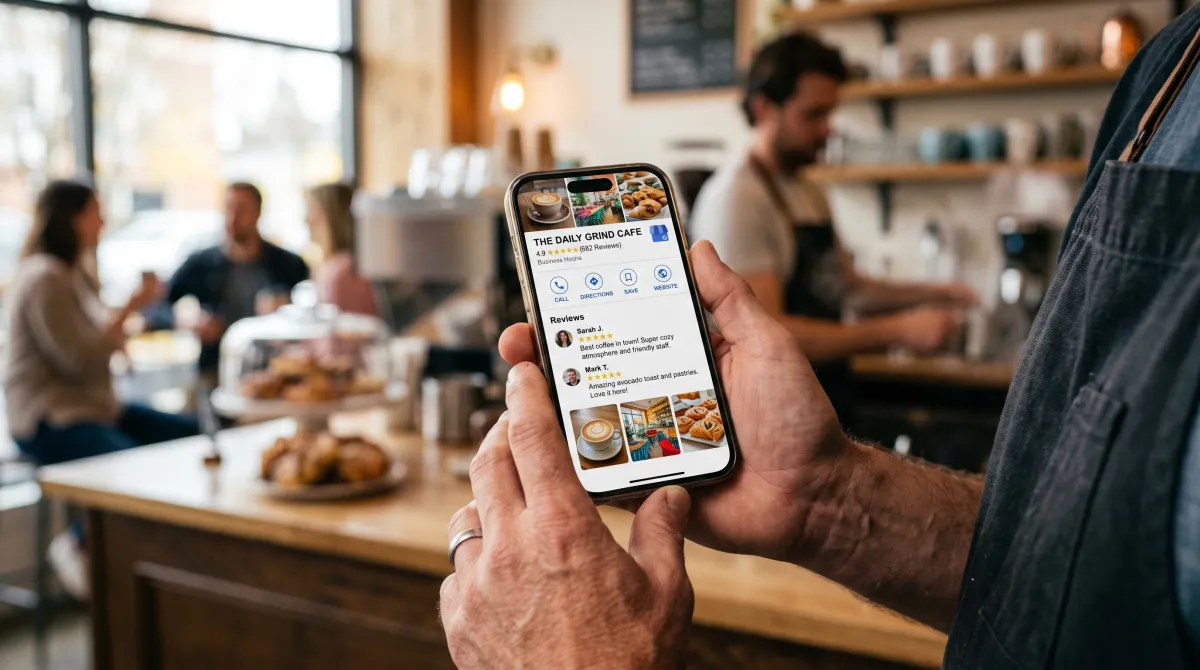
Before spending a dollar, claim your Google Business Profile. This free google tool controls the listing that shows your hours, photos, and reviews whenever someone nearby searches for what you sell.
A complete profile often outranks a fancy business website in the local pack, the map results Google shows above ordinary local search results.
Fill in every field: accurate business hours, your service area, and specific business information about what makes your shop different. Google My Business, now folded into your Google Business Profile, still rewards owners who keep listings current.
Optimize each field with the exact words nearby customers actually type, not generic buzzwords. Post updates weekly using google's free tools, and treat your Google Business page like a live storefront, not a one-time listing, which boosts local relevance and local presence in search.
Strengthen Local SEO on Your Business Website
SEO is not only for national brands. Local SEO means optimizing your business website so it ranks for the exact keyword phrases nearby buyers type into their phones.
Create a page for each town or neighborhood you serve. Mention local landmarks, keep your name, address, and phone number identical everywhere, and work in the keyword phrases people actually search.
You do not need a full digital marketing agency to do this well. A single afternoon spent on local seo basics is often more effective local marketing than a month of scattered social posts.
Pick one local strategy and execute it consistently, rather than chasing every generic list of marketing tips for small businesses you find online.
List Your Business on Google, Yelp, and Nextdoor
Get listed in the online directories that matter in your area: Yelp, Apple Maps, Nextdoor, and your local chamber of commerce.
Each accurate directory listing is another path a potential customer can take to your door, and each one should point to the same business website.
Use your official business name and address, written exactly the same way, on every listing. Directories flag mismatched details as duplicates, and a potential customer who sees two different addresses for one shop will simply choose another business instead.
Look for niche directories related to your business too, such as trade associations or industry-specific listing sites, not just the big general ones.
The Better Business Bureau listing also matters for trust, especially when your product or service carries a higher price tag, and it helps local brands stand out from national chains.
Turn Reviews Into Proof for Local Customers
Google reviews are the most persuasive local advertising you never pay for. A steady stream of recent, specific reviews tells local consumers you are the safe choice.
Build a simple ask into your routine. After a good interaction, send a one-tap link by text or email so nearby customers can leave feedback in under a minute.
Reply to all of them, including the critical ones. Reading a harsh review calmly takes the same even keel you would use to handle a difficult coworker's comments without escalating, and it often convinces the next new customer more than the five-star praise does.

Advertise Your Business With Local Digital Marketing
Paid social and search ads work locally because you can draw a tight radius around your business and stop paying to reach people who will never visit.
Set up a business account on Meta and Google, then run facebook ads and google ads aimed only at your zip codes. Add a landing page that matches the offer in the ad, not just your homepage.
Start small, ten to twenty dollars a day, and track cost per call or visit rather than impressions. Small, well-targeted local ads almost always beat one big regional campaign.
Local print ads in a neighborhood paper can still work for older audiences that internet-first strategies tend to miss, especially when paired with a clear call to action, which still counts as local advertising.
Use Social Media Platforms to Reach Nearby Buyers
Local social media is less about follower count and more about being visible the moment a neighbor asks for a recommendation.
Keep your business on Facebook active, respond fast in local Facebook groups, and share offers on WhatsApp for regulars who prefer messaging over email.
Different social media platforms and social platform algorithms favor different content, but a genuine local photo usually beats a stock graphic on all of them.
Build Local Business Partnerships
Some of the fastest local business growth comes from a business that shares your customer but not your service: a coffee shop and a bookstore, a gym and a physiotherapist.
Propose a simple cross-promotion. Display each other's cards, bundle a small joint offer, or co-host a class, and choose the best partner based on shared values, not just shared foot traffic.
When you formalize a cross-promotion, spell out in what capacity you know each partner, the same clarity you would want on a reference check.
Word of mouth from a partner who is not one of your direct local competitors spreads faster than any ad you could run.
Your neighborhood does not need to know your brand story. It needs to trust that you will do the job right, on time, today.
Show Up in the Local Community
Foot traffic loves a reason to gather. Set up a booth at the farmers market, sponsor a youth team, or host a small workshop in your space. Showing up in the local community builds trust an ad cannot buy.
Pick events your real customers attend, not the biggest crowd you can find. Local news outlets often cover small sponsorships for free, which puts your business using nothing more than a phone call to the editor.
Not every hire will run your local plan well. If someone on your team gets a formal warning, this guide on whether a write-up means you should quit can help you handle the conversation fairly.

Grow Your Business With Email Marketing
Promotion is not only about new faces. Your cheapest revenue is the customer who already likes you, so collect emails and phone numbers at the point of sale, with permission.
Email marketing done well keeps you top of mind without becoming spam: one useful monthly note beats five sales-y blasts. That combination is local business marketing at its simplest, and small business marketing at its cheapest.
Combine it with a short text before a slow weekend. If you are grooming an employee to run these campaigns, watch for the same initiative that signals a boss is about to promote a team member, since that person often becomes the one who helps you grow your small business.
10 Local Marketing Strategies to Promote Your Business Locally
If you are short on time, here are the best ways to promote a small business locally, ranked by how fast they typically produce a phone call or a visit. Match the list to your actual business needs instead of copying every tactic at once.
- Claim and complete your Google Business Profile listing.
- Ask every happy customer for a Google review.
- List your business on Yelp, Nextdoor, and your local chamber of commerce.
- Run small, geo-targeted Facebook ads and Google ads.
- Publish one local SEO page per neighborhood you serve.
- Partner with another business that shares your customer.
- Sponsor a local event or youth team.
- Start a monthly email marketing note for repeat customers.
- Register with the Better Business Bureau and other online directories.
- Track results monthly and cut whatever is not working.
None of these ideas for small businesses require a big budget. The Small Business Administration and most local Better Business Bureau chapters also offer free counseling if you want a second opinion on your plan.
There is no single best way to promote your business locally forever; the best marketing strategies change as your local market shifts. What works to promote a small business downtown will not always translate to a strip mall, so revisit this local small business checklist every quarter.
Small business owners who treat this as an ongoing set of strategies to promote your business locally consistently outperform those who run one campaign and stop. When customers can reach your business directly through call buttons on platforms like Google, you cut out the extra step that loses impatient shoppers.
Comparing Local Promotion Channels
| Channel | Cost | Best for | Speed of results |
|---|---|---|---|
| Google Business Profile | Free | Search visibility and trust | 2-6 weeks |
| Customer reviews | Free | Conversion and credibility | Ongoing |
| Geo-targeted ads | Low to medium | Fast reach to nearby buyers | Days |
| Local partnerships | Free to low | Word of mouth referrals | Weeks |
| Events and sponsorships | Low to medium | Community presence | Event day onward |
| Email and SMS | Low | Repeat business | Immediate |
A 90-Day Plan to Promote Your Business Locally
Do not try all of this at once. In month one, perfect your Google Business Profile and build the review-asking habit. These two cost nothing and lift everything else.
In month two, add one paid channel and one partnership. Test, measure cost per call, and double down on the winner. In month three, layer in an event or sponsorship and start your email list so you can bring customers back without paying again.
Stay focused on signal, not noise, and cut the dead weight early so your local strategy keeps improving instead of just growing longer.
Frequently Asked Questions
What is the 3-3-3 rule in marketing?
The 3-3-3 rule suggests sharing content across three types of posts, on three platforms, for three months before judging results. Applied locally, give a new local SEO page, a review campaign, and one paid channel a real three-month test before switching tactics.
What are the 7 methods of promotion?
The seven classic methods of promotion are advertising, public relations, personal selling, sales promotion, direct marketing, sponsorship, and digital or social media marketing. A small business rarely needs all seven at once; two or three run consistently beat all seven run poorly.
What is the fastest way to promote your business?
Geo-targeted ads on Google or Facebook usually produce calls within days, making them the fastest way to promote your business when you need results now. Free tactics like your Google Business Profile take longer but cost nothing.
What are some clever ways to promote my business?
Cross-promotions with a nearby, non-competing business, a QR code that links straight to your review page, and a small sponsorship at a local event all count as clever ways to promote a business without a big ad budget.