Marketing
What Is Marketing? Definition, 4 Ps & Best Tools (2026)
What is marketing? The operator's definition: creating, communicating, and delivering value. See the 4 Ps, the main types, and the best tools to run in 2026.

If you ask ten people what is marketing, you get ten answers: ads, social media, a logo, a sale. None of them are wrong, but none are complete. Here is the operator's version, the definition that actually holds up when you run a business, plus the tools worth paying for in 2026.
Quick answer
Marketing is the process of creating, communicating, and delivering something of value, then exchanging it with the right people for money or attention. It covers everything from product and pricing to the channels and messages that connect a product or service with a target audience.
Key takeaways
- The official marketing definition from the American Marketing Association frames it as creating, communicating, delivering, and exchanging value.
- The 4 Ps of marketing (Product, Price, Place, Promotion) are still the core framework after 60 years.
- The main types of marketing split into traditional and digital, then into inbound and outbound.
- Good marketing is not noise; it is matching customer needs to a product through the right marketing channels.
- In 2026, AI and search are reshaping how every marketer works, but the fundamentals have not moved.
Definition of Marketing: Understanding Marketing in Plain English
The cleanest definition of marketing comes from the American Marketing Association. In its definition, marketing is the activity, set of institutions, and processes for creating, communicating, delivering, and exchanging offerings that have value for customers, clients, partners, and society at large.
Read that twice. It is not about shouting. The marketing meaning here is value first, exchange second. You build something people want, you tell the right people clearly, you deliver it, and the exchange follows.
Understanding marketing this way kills a common myth. Marketing is not just advertising or a clever campaign. When someone says marketing refers only to ads, they are describing one tool inside a much wider business function, which is why our complete marketing hub treats it as a system, not a single tactic.
Defining marketing in one line: it is how a business turns a real customer need into a product people choose to pay for. Everything else is detail.
Marketing is not the art of selling what you make. It is the art of knowing what to make, and who it is for.

The 4 Ps of Marketing: Marketing Strategies That Still Work
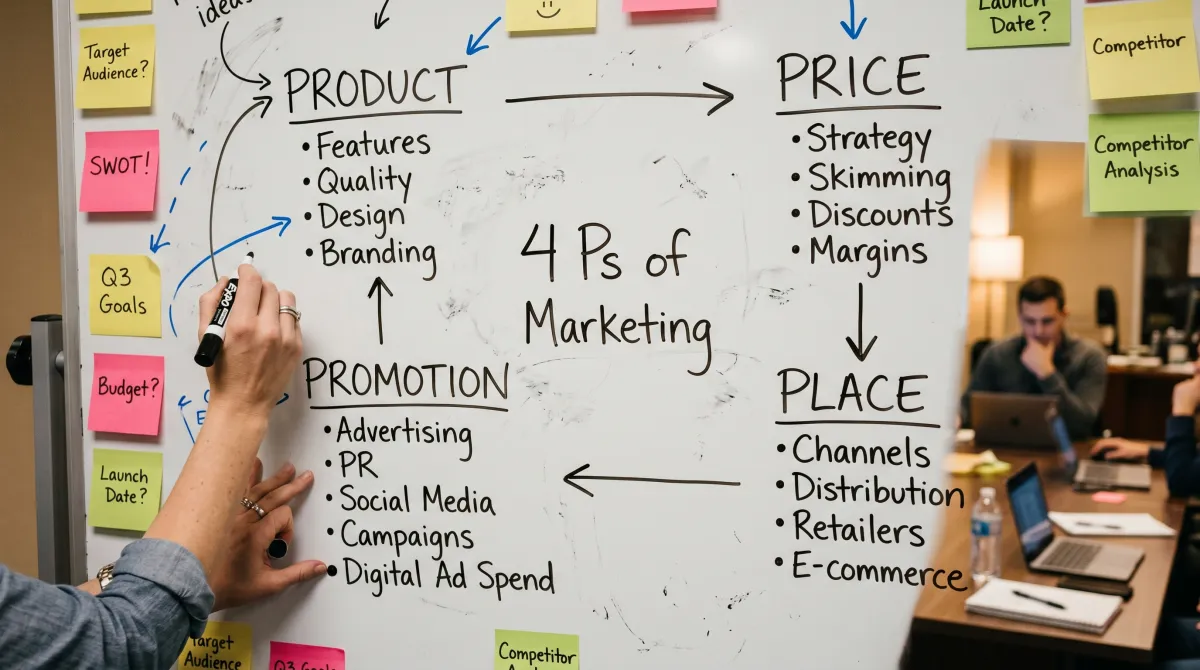
Every solid marketing strategy starts with the marketing mix. Professor E. Jerome McCarthy introduced the 4 Ps in 1960, and they remain the backbone of strategic marketing today.
The marketing mix forces you to make four decisions before you spend a dollar. Get these right and your marketing efforts compound. Get them wrong and no campaign saves you, a point we unpack in our breakdown of the 5 Ps of marketing.
| The P | The question it answers | Operator note |
|---|---|---|
| Product | What product or service do you offer, and what need does it meet? | Start here. Marketing a weak product just speeds up failure. |
| Price | What will the customer pay, and what does the price signal? | Price is positioning, not just a number. |
| Place | Where do they buy it (distribution channels, store, app)? | The best products and services die in the wrong place. |
| Promotion | How do you tell the target audience it exists? | This is where ads, content, and SEO live. |
Service businesses often extend this to the 7 Ps, adding People, Process, and Physical Evidence (Booms and Bitner, 1981). For most products, mastering the original 4 Ps of marketing is enough to build a real plan.
Types of Marketing: Traditional Marketing and Digital Marketing
There are dozens of forms of marketing, but they sort cleanly into two families. The first split is traditional marketing versus digital marketing. The second is inbound versus outbound.
Traditional marketing
Traditional marketing strategies use offline marketing channels. Think print marketing, direct mail, TV and radio spots, billboards, and event marketing. It still works for local reach and brand awareness, especially when your target audience is not glued to a screen.
Public relations sits here too. Earning press coverage builds trust in a way a paid ad cannot match, and guerrilla marketing (low-budget, high-surprise stunts) can punch far above its cost when the idea is sharp.
Digital marketing
Digital marketing moves all of that online, where you can measure every click. This is where most marketing budget now flows, and where modern marketing lives. Different marketing approaches stack inside it, each with its own strengths.
The major digital marketing strategies include:
- SEO and search engine marketing: ranking in a search engine so a potential customer finds you when they search. SEO marketing is the highest-leverage channel for most businesses.
- Content marketing: blogs, guides, and video that answer real questions. Content marketing strategies attract people before they are ready to buy.
- Social media marketing: building an audience and running ads on the platforms they already use.
- Email marketing: the highest-ROI channel for nurturing leads into customers.
- Affiliate, influencer, and viral marketing: letting other people carry your message for reach you could not buy directly. Affiliate marketing pays partners per sale; influencer marketing rents their trust.
Other digital tools include direct marketing, relationship marketing, product marketing, and keyword marketing. Learning marketing means knowing which of these areas of marketing fits your goal, because each is a route to the same end: connect the right offer to the right person.
Inbound vs Outbound Marketing: The Marketing Process
The second way to sort a marketing campaign is by who starts the conversation. This is the core of the modern marketing process, and it shapes how all the marketing work gets done day to day.
Inbound marketing pulls people in. You publish useful content, rank in search, and let a potential customer come to you on their terms. SEO and content marketing are inbound. It is slower but builds lasting trust.
Outbound marketing pushes your message out. Cold email, display ads, and sponsored posts reach a large audience fast. It is more expensive per lead but unbeatable for launching a product or service quickly.
In 2026, the smartest marketing team blends both. Data and AI now make outbound feel almost as targeted as inbound, so the old debate matters less than a clean, integrated funnel.
The Best Marketing Tools to Run This in 2026
Strategy is nothing without execution. Based on vendor documentation and public user reviews, these marketing tools cover SEO, email, and the full marketing communications stack. Prices verified as of June 2026; check each vendor for your contact tier.
Best all-in-one platform
HubSpot Marketing Hub Free; Starter from $15/seat/mo
The default for teams that want CRM, email, forms, and automation in one place. Starter drops to $9 per seat on the annual plan; the jump to Professional ($890/mo, 3 seats and 2,000 contacts) is steep, so grow into it.
Pros
- True all-in-one for marketing professionals
- Generous free tier to learn marketing on
- Strong AI and reporting
Cons
- Contact-based pricing climbs fast
- Pro tier carries a one-time $3,000 onboarding fee
Best for SEO and search
Semrush Pro from $139.95/mo
The toolkit we open every morning for keyword marketing, site audits, and competitor research. Guru ($249.95/mo) adds the Content Marketing Toolkit and historical data.
Pros
- Deepest SEO and search engine marketing data
- Tracks AI search visibility across Google AI Overviews, ChatGPT, and Gemini
- One platform for most marketing techniques
Cons
- Pro includes only one seat ($45/mo per extra user)
- Add-ons like Local SEO and AI Visibility stack up fast
Best for email beginners
Mailchimp Free; Standard from $20/mo
Still an easy on-ramp for email marketing. Pick Standard, not Essentials ($13/mo): multi-step automation lives only on the Standard tier and up.
Pros
- Fast to launch your first campaign
- Built-in AI creative assistant
- Free plan for quick testing
Cons
- Free plan cut to 250 contacts in January 2026
- Bills for unsubscribed contacts
Why the Importance of Marketing Goes Beyond Sales
Plenty of founders treat marketing as a cost. That is backwards. The importance of marketing is that it is the engine of business growth and business success.
Marketing encompasses customer research, positioning, and the full customer experience, not just the closing sale. A strong marketer studies customer needs first, then shapes the product, price, and message around them. This overview of marketing is what separates a brand from a logo.
Investing in marketing is investing in demand. Without it, even a great product sits unseen. Marketing is essential because the goal of marketing is simple: make the selling part easier by building genuine want.
Across every area of marketing, from brand to performance, that principle holds. Marketing is important precisely because it compounds: each campaign teaches you who your buyer is.
A marketing budget is not an expense line. It is the difference between a product people find and a product people never hear about.
Best Practices: How to Market Your Business in 2026
You do not need a marketing degree to apply the fundamentals. You need discipline and a few best practices that effective marketing teams follow.
- Define the target audience before the channel. Specific marketing goals beat spray-and-pray every time.
- Pick two channels, not ten. One inbound (SEO or content) and one outbound (ads or email) beat doing everything badly. Layering various marketing strategies too early just burns cash.
- Measure what matters. Track cost per customer, not vanity metrics. AI-driven measurement makes this cheaper than ever.
- Use AI as a tool, not a pilot. AI Overviews and generative search are reshaping SEO, so write for humans and let AI speed up the work.
- Build the marketing communications loop. Listen, adjust, repeat. Marketing today rewards teams that learn fast.
These marketing techniques scale from a solo founder to a VP of marketing running a full department. The marketing skills change in size, not in principle, which is also why the societal marketing concept matters more as you grow: long-term trust beats short-term clicks.
Related guides
What Is Marketing: FAQ
What is the simple definition of marketing?
Marketing is the process of getting the right product or service in front of the right people, then convincing them to buy. In short, it is matching what you offer to what customers need, and communicating that value clearly.
What is marketing about?
Marketing is about value and exchange. It covers researching customer needs, building an offer around them, setting a price, choosing where to sell, and promoting it through the right marketing channels so the business grows.
What are the 4 types of marketing?
The four basics are often framed as the 4 Ps: Product, Price, Place, and Promotion. By approach, the four common types are content marketing, social media marketing, email marketing, and search engine marketing (SEO).
What is digital marketing?
Digital marketing is any marketing done through online channels: SEO, social media, email, content, and paid ads. It lets you reach a target audience and measure every result, which is why it now takes most of the marketing budget.
What is the marketing mix?
The marketing mix is the set of decisions a business makes to market a product, classically the 4 Ps: Product, Price, Place, and Promotion. Service businesses extend it to 7 Ps by adding People, Process, and Physical Evidence.
What is market segmentation?
Market segmentation is dividing a broad market into smaller groups that share needs or traits, such as age, location, or behavior. It lets you target each segment with a tailored message instead of one generic pitch.
What is SWOT analysis?
SWOT analysis maps your Strengths, Weaknesses, Opportunities, and Threats. In marketing, it is a quick way to audit where you can compete and where rivals or market shifts could hurt you before you set strategy.
What is the best definition of marketing?
The most trusted is the American Marketing Association's: marketing is the activity, set of institutions, and processes for creating, communicating, delivering, and exchanging offerings that have value for customers, clients, partners, and society at large.