Software
Ecommerce Automation Tools (2026): 10 We Tested
Compare the best ecommerce automation tools for 2026, from Klaviyo to Shopify Flow, with real pricing so you can pick the right stack for your store.

Running an online store without automation today means losing money to abandoned carts, missed follow-ups, and manual busywork that eats your week. The right ecommerce automation tools fix that by handling repetitive marketing, support, and fulfillment tasks while you focus on growth.
This guide breaks down the ecommerce automation tools worth using in 2026, what each one costs, and how to pick the right stack for your store. The tools available in 2026 span every ecommerce business stage, from a first marketing automation tool purchase to a full marketing automation platform rollout.
Quick answer
The best ecommerce automation tools in 2026 are Klaviyo and Omnisend for email and SMS marketing, Shopify Flow and Zapier for backend workflows, and Gorgias for customer support. Most stores should start with one abandoned cart flow before adding more automation.
Key takeaways
- Klaviyo and Omnisend lead ecommerce email and SMS automation, both with usable free plans.
- Shopify Flow now ships free on every Shopify plan except the entry-level Starter tier.
- Automating cart recovery alone can recover 5 to 10 percent of lost revenue.
- Most stores need two to three tools, not a single all-in-one platform.
- Start with the workflow that protects revenue you are already losing.

What Are Ecommerce Automation Tools?
Ecommerce automation tools are software platforms that trigger marketing, operations, or support actions automatically based on customer behavior, removing the need for a person to send every message or update every record by hand.
At its core, an ecommerce automation tool replaces manual work: sending email marketing campaigns, tagging an ecommerce store's inventory, or routing a request to customer service software without a person clicking send. Whether you spell it ecommerce automation or e-commerce automation, the tools solve the same problem.
Most ecommerce platforms connect to these tools through an API or a native app, so an event like "customer abandoned cart" or "order shipped" can trigger an email, a text message, or an internal task within seconds.
Under the hood, most stacks combine marketing automation software for campaigns with separate automation platforms for backend workflows. Layering in automation solutions like these keeps ecommerce businesses of all sizes from outgrowing a single tool too quickly.
The category also includes automation tools to optimize checkout, email automation for lifecycle messages, and social media automation for organic posting, alongside familiar software tools like Zapier and Make. Not every one of these tools for ecommerce fits every store, so start with the workflow costing you the most revenue today.
The category spans several jobs: email and SMS marketing, inventory syncing, customer support routing, review requests, and reporting. Few stores need every category on day one.
These tools sit alongside other productivity tools for teams that founders already rely on to run a lean operation.
Why Ecommerce Automation Has Become Essential
Cart abandonment sits around 70 percent across ecommerce according to the Baymard Institute, and a single automated recovery email typically wins back 5 to 10 percent of that lost revenue.
Automation can help well beyond recovery emails. It can automate marketing tasks like list segmentation, schedule social media marketing posts, and trigger sms marketing automation the moment a shopper opts in at checkout.
Customer expectations have shifted too. Shoppers expect order updates, personalized product recommendations, and fast support responses regardless of your team size.
A marketing platform designed for ecommerce also cuts manual marketing efforts, freeing a small team to focus on strategy instead of repetitive sends. These automation tools can help a two-person team compete with brands running a full marketing department.
Automation reduces cost per action as your store scales. The right automation tools help ecommerce business owners spend more time on product and less on repetitive admin work.
Email marketing automation and an email marketing platform built for ecommerce, like Klaviyo or Omnisend, remove most of the manual work behind email marketing efforts. The right email marketing tool also protects deliverability as email marketing campaigns scale, and pairing that with clear marketing strategies matters more than adding software.
Budget still matters. A five-figure enterprise stack rarely fits a store doing $10,000 a month in revenue, so match tool cost to your current order volume, not your five-year plan.
Ecommerce Automation Tools Explained
Most ecommerce automation tools fall into three buckets: marketing (email, SMS, social), operations (inventory, fulfillment, workflow connectors), and support (chat, tickets, reviews).
These automation workflows are not limited to email. Popular automation categories now include sales and marketing automation and a comprehensive marketing automation platform that bundles both under one login.
Aligning marketing and sales around the same customer data keeps automated messages consistent, whether a shopper buys today or returns next month. The costs associated with ecommerce automation range from a free Zapier plan to a five-figure annual HubSpot contract, so match spend to order volume.
The tools that win in 2026 are the ones that automate the boring, repetitive parts of running a store, not the ones with the longest feature list.
Workflow tools like Shopify Flow, Zapier, and Make sit in the operations bucket. They connect apps that were never built to talk to each other, moving data between your store, spreadsheet, and inbox automatically.
Marketing automation capabilities vary widely between tools. These automation tools help most when they match your actual workflow, not just the flashiest automation software tools or marketing automation systems on the market.
All-in-one platforms like HubSpot bundle marketing, sales, and support automation into a single system, trading some ecommerce-specific depth for broader functionality across a growing business.
A marketing automation solution built specifically for ecommerce, like Klaviyo, differs from a general marketing automation system designed for B2B lead nurturing. Teams researching best marketing automation and marketing automation software should test free tiers before signing an annual contract.
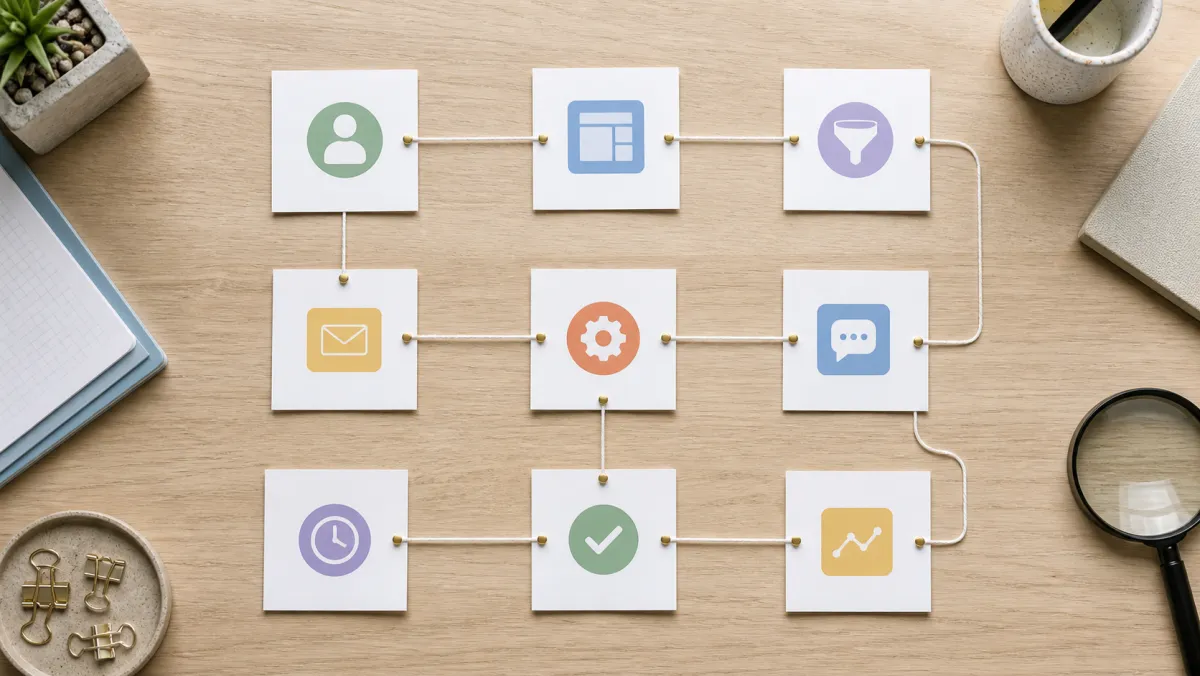
10 Ecommerce Automation Tools Examples
1. Klaviyo
Klaviyo is an ecommerce marketing automation platform built for online retailers, and it remains the default choice among popular ecommerce platforms like Shopify, BigCommerce, and WooCommerce for lifecycle email. The free plan covers up to 250 active profiles with 500 email sends and 150 SMS credits a month, and paid Email plans start around $20 per month once you pass 250 profiles, or roughly $35 per month once you add the SMS credit add-on.
Pre-built flows for welcome series, cart recovery, and post-purchase upsells make it fast to launch without a developer.
That native fit makes it easy to automate your ecommerce store's welcome series without hiring a developer, which is why it stays the default pick for brands investing in ecommerce automation early.
2. Omnisend
Omnisend covers similar ground to Klaviyo, with a free plan for up to 250 contacts and 500 emails a month, and a Standard plan starting near $16 per month. Since May 2026, SMS is bundled only into the Pro tier, which starts at $59 per month with a 2,500-contact minimum and includes SMS credits matching the subscription price.
Its pre-built automation library leans slightly more visual, which helps teams without a dedicated email marketer build flows quickly. Both let you create automated marketing campaigns from templates in minutes instead of building flows from scratch.
Both tools are built specifically for ecommerce rather than adapted from general marketing software, which is why their templates already match cart, browse, and post-purchase flows out of the box.
3. HubSpot Marketing Hub
HubSpot suits stores that also run a longer B2B sales cycle alongside direct-to-consumer sales, combining CRM, email, and reporting in one dashboard. The Starter tier runs about $15 per seat per month billed annually, around $20 per month month-to-month, for 1,000 marketing contacts, with ecommerce-specific workflow automation gated behind the pricier Professional tier.
Expect a steeper learning curve than Klaviyo or Omnisend if ecommerce is your only use case, since deeper automation and reporting live several tiers above the entry plan.
4. Shopify Flow
Shopify Flow is a free workflow automation tool built into every standard Shopify plan: Basic, Grow, Advanced, and Plus. It is only excluded from the entry-level Starter plan, which is built for selling through social and marketplaces rather than running a full store.
Flow lets you connect triggers like "product low in stock" to actions like "tag customer" or "send Slack alert" without code. It works only within the Shopify ecosystem, so non-Shopify stores need Zapier or Make instead.
Paired with Klaviyo, Flow creates a powerful ecommerce automation setup that covers marketing and backend workflows without extra middleware.
5. Zapier
Zapier connects thousands of apps through simple trigger-and-action "Zaps," making it the go-to glue for stores running tools that do not natively integrate. The free plan covers 100 tasks a month with two-step Zaps only, and the Professional plan begins around $19.99 per month billed annually for 750 tasks and multi-step Zaps.
It is not ecommerce-specific, which is both its strength and its limitation. You will need to configure most workflows yourself.
These no-code tools to create simple links between apps are why Zapier remains a default pick for lean ecommerce teams.
6. Make
Make, formerly Integromat, offers similar connector-based automation to Zapier, using a credit system instead of tasks. Its Core plan typically runs $9 to $12 per month depending on billing cycle, with a more visual workflow builder than Zapier's.
The tradeoff is a steeper learning curve for non-technical users compared to Zapier's simpler interface.
7. ActiveCampaign
ActiveCampaign combines email marketing, CRM, and automation in one platform, with ecommerce-specific triggers for Shopify and WooCommerce stores. The Starter plan runs around $15 per month, billed annually, for 1,000 contacts and basic email automation.
Its automation builder is one of the most flexible in this list, supporting complex branching logic that outgrows simpler tools.
ActiveCampaign helps ecommerce businesses combine CRM data with automation, so a support agent can see a customer's full purchase and email history before they automate the next follow-up.
8. Gorgias
Gorgias automates customer support for ecommerce specifically, pulling order data directly into the support ticket so an agent, or an AI macro, can answer "where is my order" without switching tabs. The Starter plan runs around $10 per month for 50 tickets, with higher tiers scaling by ticket volume.
It integrates natively with Shopify, BigCommerce, and Magento, and connects to Klaviyo for shared customer data.
9. Attentive
Attentive focuses entirely on SMS marketing automation, with enterprise-grade compliance and deliverability features. Pricing is custom and scales with SMS volume, making it a better fit for larger stores than small ones.
Attentive is a marketing platform specifically designed for ecommerce brands that need SMS volume no small-business tool can match.
10. ManyChat
ManyChat automates conversations on Instagram DM, Facebook Messenger, and WhatsApp, often used for giveaways, product drops, and abandoned cart reminders sent through chat instead of email. Since a March 2026 pricing overhaul, the free plan covers just 25 active contacts a month, down sharply from the older 1,000-contact allowance, with paid tiers starting around $17 per month for higher contact limits.
ManyChat is not designed specifically for ecommerce businesses the way Klaviyo is, but its store-connect templates still make it a practical fit for brands running frequent giveaways.
Choosing the Right Ecommerce Marketing Automation Platform
Not every automation tool that helps a SaaS company fits an online store. The best ecommerce marketing automation software is designed to help ecommerce store owners manage carts, subscriptions, and reviews, not just generic email sends.
The best ecommerce automation software combines marketing and operations instead of forcing you to duplicate data entry across two systems. Choosing the right platform for ecommerce marketing depends more on your order volume than your budget.
When comparing a variety of ecommerce automation tools, look for a marketing automation platform that helps with both email and SMS, since running two disconnected tools often duplicates work instead of saving time.
A few questions narrow the list fast: does the automation tool that helps your team most also integrate with your ecommerce platforms, and will it still work once you grow your ecommerce revenue past six figures a month?
Whatever the answer, there are ecommerce automation tools available for nearly every price point. The tools you need at 50 orders a month rarely match the tools you can use once you pass 5,000, so revisit this list as you scale.
Ecommerce Automation Tools Comparison
These are the tools to consider once you have outgrown spreadsheets and manual email sends. Here is how the ten tools above compare on price, focus, and free plan availability.
| Tool | Best For | Starting Price | Free Plan |
|---|---|---|---|
| Klaviyo | Email and SMS marketing | $20/mo | Yes |
| Omnisend | Email and SMS marketing | $16/mo | Yes |
| HubSpot Marketing Hub | Combined B2B and ecommerce | $15/mo per seat (annual) | Yes |
| Shopify Flow | Backend workflow automation | Free (Basic plan and up) | N/A |
| Zapier | App-to-app connectors | $19.99/mo | Yes |
| Make | Visual workflow automation | $9 to $12/mo | Yes |
| ActiveCampaign | Email plus CRM automation | $15/mo | No |
| Gorgias | Customer support automation | $10/mo | No |
| Attentive | SMS marketing at scale | Custom | No |
| ManyChat | Chat and DM automation | Free (25 contacts) | Yes |

How to Apply Ecommerce Automation Tools
Start by choosing the tools to automate first: pick the workflow that protects revenue you are already losing. An abandoned cart flow in Klaviyo or Omnisend usually pays for the subscription within the first month, which makes it the natural first build for most stores.
Next, connect your ecommerce platform to one workflow tool, whether that is Shopify Flow for a Shopify store or Zapier or Make for any other platform, so inventory and order data stay in sync automatically.
Most platforms ship pre-built automation workflows for cart recovery, so start from a template and edit the copy instead of building a flow from a blank canvas.
Add support automation once marketing flows are stable. Gorgias or a similar tool can resolve simple "where is my order" tickets without a human touching them.
Automating your ecommerce business does not mean replacing every manual task at once. Start with the highest-revenue workflow and expand from there once it is working reliably.
Review permissions and data access before connecting new tools, following the same checklist covered in our small business security software guide.
Review your stack quarterly. Tools that made sense at $5,000 a month in revenue often need replacing by $50,000, and our software category hub tracks new options as they launch.
Ecommerce Automation Tools: FAQ
What are ecommerce automation tools?
Ecommerce automation tools are software platforms that trigger marketing, support, or operations actions automatically based on customer behavior, such as sending a recovery email after an abandoned cart.
How much do ecommerce automation tools cost?
Most ecommerce automation tools cost between $10 and $50 per month for small stores, with usage-based pricing that increases as your contact list or order volume grows.
What is the best ecommerce automation tool for a small business?
Klaviyo or Omnisend are the best starting points for most small stores because both offer usable free plans and pre-built flows for cart recovery and welcome series.
Can I automate my ecommerce store for free?
Yes. Klaviyo, Omnisend, Zapier, Shopify Flow, and ManyChat all offer free or fully included tiers that cover basic automation for stores with small contact lists or low order volume, though ManyChat's free tier is now limited to 25 active contacts.
What is the difference between marketing automation and ecommerce automation?
Marketing automation focuses specifically on email, SMS, and ad campaigns, while ecommerce automation is the broader category that also includes inventory, support, and fulfillment workflows.
What is the best ecommerce platform for a small business?
Shopify and BigCommerce lead for small businesses because both connect natively to Klaviyo, Gorgias, and Shopify Flow without custom development work.
Are there free ecommerce automation tools available?
Yes. Klaviyo, Omnisend, Zapier, and Shopify Flow all offer free or fully included tiers that cover basic cart recovery and workflow automation.