Management
Skill Enhancement: Build Competency and Leadership Skills
Skill enhancement builds competency, skill set, and soft skills for real professional development. See why the importance of skill enhancement matters now.

Skill enhancement sounds like a training slide, but on a real team it is the quiet difference between people who build real competency and grow into bigger roles, and people who quietly stall. Across product, ops, and support teams, common management guidance points to the same pattern: managers who treat skills as a living system tend to see better results.
Disclaimer: This article is for general information only and isn’t medical, mental-health or safety advice. If you are struggling, talk to a qualified healthcare professional; in the US you can call or text 988 for crisis support.
Quick answer
Skill enhancement is the deliberate process of improving an employee's existing abilities and adding new ones through targeted practice, feedback, and stretch work. Done well, it builds a stronger skill set, fuels professional development, and ties to a real business outcome instead of a generic training slide. It sits at the heart of any modern management routine.
Key takeaways
- Skill enhancement closes the gap between what your team can do today and what the role demands next.
- The best plans are specific: one or two skills, a measurable outcome, and a deadline.
- On-the-job practice beats passive courses; people learn by shipping, not by watching.
- Building adaptability into every plan keeps the team ready for the next tool, process, or reorg.
- Managers who track progress and give frequent feedback see skills stick; the rest see them fade in weeks.
What Skill Enhancement Actually Means
Skill enhancement is a form of skill development: improving the competency someone already has and layering on new skills they will need soon. It covers hard skills like data analysis, and soft skills like running a tense conversation under pressure.
The word that matters is deliberate. People pick up skills by accident all the time. Enhancement is when you decide a skill matters, name it, and build a path toward real proficiency.
It is not the same as onboarding, which gets someone competent at the basics. Enhancement starts where competence ends and pushes toward mastery or range. A new hire learning the ticketing tool is onboarding, not enhancement.
It is also broader than upskilling, which usually means adding skills for a specific near-future role. Enhancement includes sharpening what someone already does well, often the faster win for professional growth.

Why Competency Building Belongs at the Center of Management
Markets shift, tools change, and technological advancements move faster than most training calendars. If you are not actively building capability, your team quietly falls behind.
Teams that treat lifelong learning as normal stay relevant when a new platform, regulation, or competitor arrives. Teams that do not, scramble, and scrambling is expensive.
There is a retention angle too. People stay where they grow. Investing in their development signals that you want them to stay competitive and see a future for them here.
Good development habits also feed better collaborative decision making, because a team that keeps learning argues from evidence instead of ego.
Building Leadership Skills Through Experiential Learning
Classroom slides rarely build leadership skills. Experiential learning does: put someone in charge of a real decision, a real deadline, and a real-world consequence, then debrief what happened.
Rotate people through a stretch project every quarter and leadership skills compound faster than any course could deliver alone. A messy handoff, handled well, teaches more than a full-day workshop.
How Adaptability and Conflict Resolution Build Key Skills
Two key skills show up fastest under real pressure: problem-solving and conflict resolution. Both are hard to fake in a workshop and easy to spot on the job.
An adaptable employee treats a messy handoff or a client complaint as practice, not a crisis. That adaptability turns a difficult work environment into a training ground instead of a source of burnout.
Give people room to problem-solve on their own before stepping in. That short struggle is usually where the skill actually forms.
A Simple Framework That Holds Up
Skip the 12-step model. Most teams need four moves, run in a loop you repeat each quarter.
| Step | What you do | What good looks like |
|---|---|---|
| 1. Diagnose | Run a self-assessment against the required skill | One or two named gaps, not ten |
| 2. Plan | Pick a method and a measurable outcome | A deadline and a way to prove it worked |
| 3. Practice | Build proficiency through real work | Stretch tasks, not just courses |
| 4. Review | Give feedback, adjust, repeat | Frequent check-ins, visible progress |
The diagnose step trips most managers up. They confuse a performance problem with a skill gap. If someone can do the work but does not, that is motivation, not a missing skill.
The plan step fails for the opposite reason: it stays vague. Naming existing skills honestly, then deciding which ones need acquiring new depth, is what makes step two concrete.
A skill plan without a deadline and a measurable outcome is just a wish list with a manager's name on it.
Mentorship and the Skill Enhancement Journey
No one builds every skill alone. A good mentor shortens the distance between reading about a skill and using it under pressure.
Create mentorship opportunities on purpose. Pair a junior employee with someone two steps ahead of them, and check in monthly on what actually changed.
Seeking mentorship should not feel like admitting weakness. Frame it as a normal part of the professional journey, tied to both personal growth and advancement.
Employees who actively participate in mentorship, showing up prepared with real questions, see the fastest personal and professional growth on the roster.
Methods That Actually Build Skills
Not all development is equal. Roughly 70 percent of growth comes from doing the work, 20 percent from coaching and feedback, and 10 percent from formal training.
- Stretch assignments. Hand someone a task slightly above their level with support. This is where most real growth happens.
- Coaching and feedback. Short, frequent, specific. A two-minute correction beats a quarterly review.
- Peer learning. Pair a strong operator with someone building the same technical skills. Both improve.
- Targeted online courses. Useful for fundamentals and certifications, weak for behavior change on their own.
The trap is leaning on the 10 percent because it is the easiest to buy. A course is a line item; a stretch assignment is your time and attention.
Diversify the learning experiences you offer. A team fed only online courses gets bored, and a team fed only live projects burns out. Log the learning opportunities somewhere people can see them.
Borrow best practices from teams a stage ahead of yours instead of inventing every method from scratch. One discipline carries outsized weight: strong time management skills determine whether anyone has the hours to practice at all.
Where L&D, Training Programs, and AI Fit In
Most companies past a certain size run an L&D function to formalize what good managers already do informally, turning scattered training and development into repeatable training programs.
Strong development programs share one trait: training strategies tied to a specific business result, not a generic curriculum bought off the shelf. A rapidly changing market punishes anyone still running last year's playbook.
Continuous skill development works best inside a culture of continuous learning, where trying a new approach and failing safely is normal, not punished.
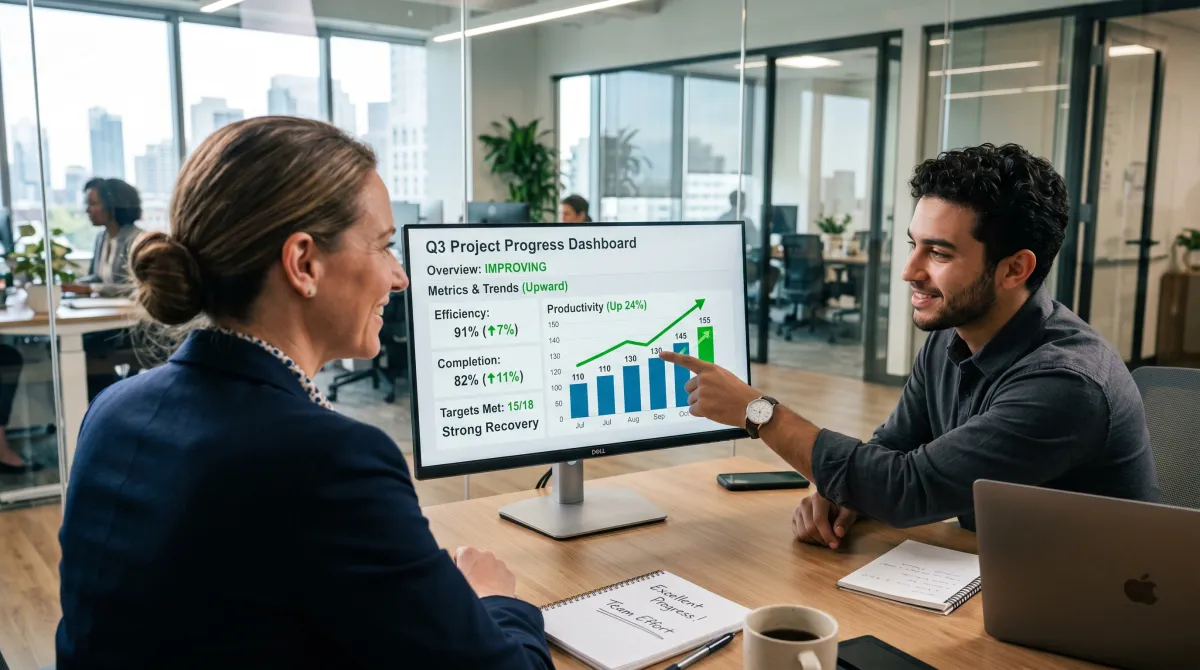
Modern L&D teams increasingly use AI to shorten the loop. Analytics and a data-driven view of skill gaps replace guesswork, and simple visualization of progress keeps managers honest.
A shared knowledge base, tracking the team's collective knowledge and expertise, helps everyone stay current on the latest trends instead of relearning the same lesson twice.
None of this replaces emotional intelligence. A dashboard can flag a gap; only a manager who reads the room can prepare someone for the future challenges and opportunities that gap represents.
How to Measure It Without Theater
If you cannot measure a skill, you cannot manage it. Pick a signal before you start: a faster cycle time, fewer errors, or a deliverable they could not produce last quarter.
Avoid vanity metrics like courses completed or hours logged. Those measure activity, not capability. The honest test is simple: can they now do something valuable they could not do before?
Name areas for improvement out loud, then refine the plan every few weeks instead of waiting for an annual review to notice drift.
Tie the outcome back to organizational goals, not just current roles. A clearer link to results makes the case for good decision making on where to invest your development budget next.
Where Managers Go Wrong
The most common failure is scope. Managers try to enhance five skills at once and finish none. Pick one or two per person per quarter and protect them.
The second is set-and-forget. They write a plan in January and never mention it again. Skills need reinforcement, so put progress on the agenda of your regular one-on-ones.
The third is forgetting the human side. Pushing growth without trust backfires, including how you discuss employees with other employees.
The fourth is treating enhancement as a reward for top performers only. The biggest gains often come from a steady middle performer who finally gets a focused push.
The fifth, and most expensive, is missing the importance of skill enhancement entirely. In today’s competitive job market, a team that does not equip people for career advancement loses them to one that does.
This shows up hardest on a sales team, where career growth stalls fast without new material to sell. Give people opportunities for growth in professional settings that matter to them, and the skill enhancement journey takes care of most retention problems on its own.

Frequently Asked Questions
What are the top 3 skills to improve?
Most people get the fastest return from communication, problem-solving, and adaptability, since these three show up in almost every role and compound with everything else you build.
What is another word for skill enhancement?
Common alternatives include skill development, upskilling, and professional development. They overlap heavily, though skill enhancement covers both improving existing abilities and adding new ones.
How do you enhance your skills?
Pick one skill, set a measurable outcome, and practice it through real work such as a stretch assignment. Add coaching or a course only to fill the specific gap that practice alone cannot close.
What does "enhanced skills" mean?
Enhanced skills means an ability has been deliberately improved past its previous level, usually verified by a clear before-and-after result rather than just a completed course.