Workplace & Career
Interview Questions To Ask Candidates: 42 With Red Flags
42 interview questions to ask candidates, sorted by skill, with what to listen for, red flags, legally safe wording and a 1-5 scoring rubric to copy.

The best interview questions to ask candidates make them describe real work they have done, then give you room to dig into the details. Below are 42 questions sorted by skill, each with what a strong answer sounds like and the red flag to watch for, plus legally safe wording and a 1-5 scoring rubric you can copy into your next interview.
Disclaimer: This article is for general information only and isn’t legal, financial or tax advice. Laws vary by state and change; check the official source or talk to a qualified professional about your situation. Nor is it medical or mental-health advice; if you are struggling, talk to a qualified healthcare professional.
Quick answer
Ask every candidate the same core set: 2 openers, 3-4 behavioral questions ("Tell me about a time..."), 2 situational questions, 2-3 role-specific questions, and 5-10 minutes for their own questions at the end. Score each answer from 1 to 5 right after the interview, before you compare notes with anyone.
Key takeaways
- Questions about past actions give you evidence you can probe. Hypotheticals give you intentions.
- Write down what a 5-point answer looks like before the first candidate arrives, not after.
- One good follow-up ("What did you do yourself?") often tells you more than three new questions.
- Ask about the job's requirements, never about age, family plans, religion, health or national origin.
- Tell every candidate when they will hear back, then keep that date.
What Are the Best Questions To Ask in an Interview?
Good questions to ask candidates share three traits. They are open-ended questions, so "yes" or "no" does not fit. They ask for specific examples from real jobs. And each one links to a duty in the job description, so every answer tells you something about whether the person can fit the role.
A weak question tests how well someone rehearsed. "What is your greatest strength?" has a stock answer on every career site. "Tell me about the project you are proudest of and what you did on it personally" does not.
Good interview questions are designed to get evidence you can compare. Before interviewing a candidate, read their job application and résumé again, then cut any question whose answer is already on paper. Pick questions to get proof of the skills the job needs, not confidence.
The strongest format is a structured interview: asking candidates the same questions in the same order, with the same scoring guide. The job interview overview on Wikipedia summarizes the research comparing structured and unstructured formats.
The interview is one step in a longer interview process. Our workplace and management guides cover the steps around it, from writing the job post to running the first week.
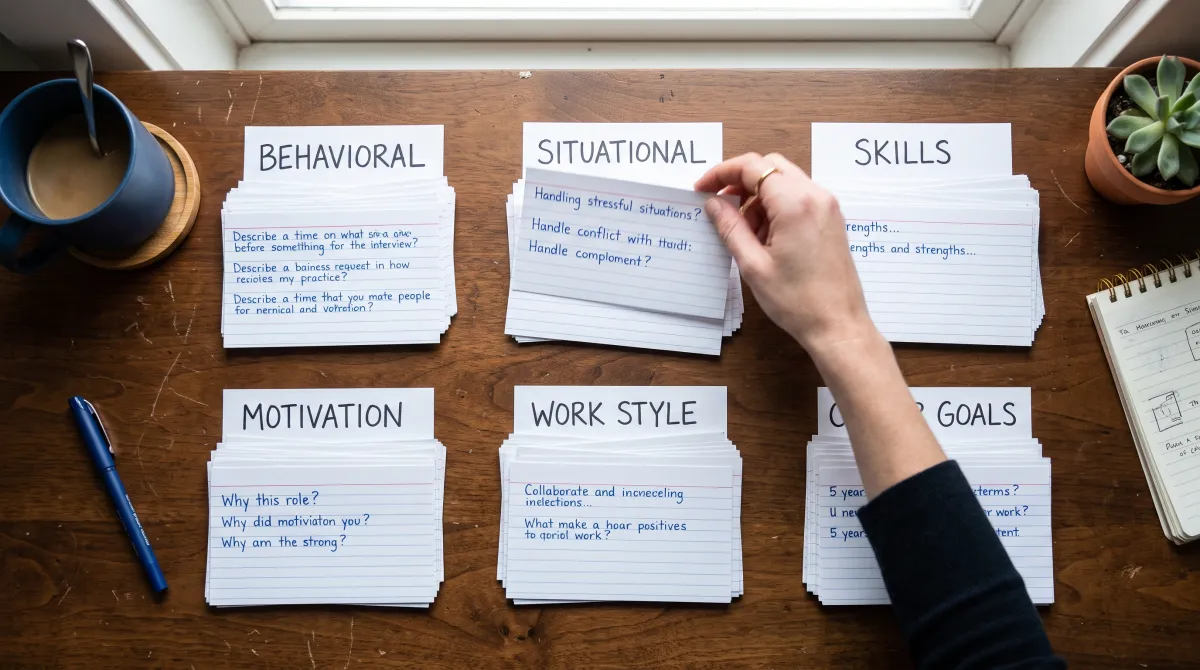
Types of Strategic Interview Questions To Ask
There are six types of questions worth mixing. Each reveals something the others miss.
| Type | What it reveals | Example |
|---|---|---|
| Behavioral | How they acted in real situations | "Tell me about a time you missed a deadline." |
| Situational | How they reason through a new problem | "A client asks for a refund outside policy. What do you do?" |
| Skills and technical | Whether they can do the core tasks | "Walk me through how you would reconcile this account." |
| Motivation | Interest in the position and staying power | "What made you apply for this role?" |
| Work style and culture add | How they work with other people | "How do you like to get feedback?" |
| Career goals | Whether the role fits where they are heading | "What do you want to be doing in two years?" |
Use strategic interview questions from at least three types. A slot filled only with behavioral questions misses whether the person can do the technical work. Only skills questions miss how they handle a difficult coworker.
Review your question bank whenever the job description changes. A list written in 2025 for an office team may not fit the same role once it goes remote.
Opening Questions: Tell Me About Yourself and Why This Job
Openers settle nerves and show you how the candidate talks when relaxed. Keep them to five minutes.
- "Walk me through your background in two minutes." This is the tell me about yourself interview question with a time limit. Listen for: a clear thread that leads to this job. Red flag: a full life story with no link to the role.
- "What made you apply, and what do you know about us?" Listen for: details from your job post, product or website. Red flag: an answer that would fit any company.
- "What do you want in your next job that you do not have now?" Listen for: something your role offers. Red flag: only complaints about a current boss.
- "Which part of this job sounds least appealing to you?" Listen for: an honest answer and a plan to handle it. Red flag: "Nothing, I love all of it."
Behavioral Interview Questions (STAR Method)

Behavioral interview questions ask what a candidate did in a real past situation. Most start with "Tell me about a time..." or "Describe a situation where...". Good candidates often answer with the STAR method: situation, task, action, result.
STAR interview questions work best when you push past the story to the candidate's own part in it. If every sentence starts with "we", ask "What did you do yourself?"
The most important questions to ask during an interview are behavioral ones tied to the hardest part of the job. If the role lives or dies on deadlines, start with question 5.
- "Tell me about a time you missed a deadline. What happened next?" Listen for: owning the miss, warning people early, a change they made afterward. Red flag: blame on others and no lesson.
- "Describe a situation where you disagreed with your manager." Listen for: they raised it privately, with evidence, then accepted the final call. Red flag: they went around the manager, or claim they never disagree.
- "Tell me about a time you had to learn something fast." Listen for: the method, such as who they asked, what they read and how they practiced. Red flag: "I'm a fast learner" with no example.
- "Give me an example of a mistake that cost your team time or money." Listen for: a real mistake, ideally with a number attached. Red flag: a disguised strength like "I care too much."
- "Tell me about a time you helped a coworker who was struggling." Listen for: inclusive behavior they chose without being asked. Red flag: no example comes to mind.
- "Describe the hardest feedback you have received. What did you change?" Listen for: a specific change in how they work. Red flag: they still argue the feedback was wrong.
Situational Interview Questions That Test Problem-Solving Skills
Situational interview questions describe a scenario and ask how the candidate would handle it. They suit early-career job candidates with little work history, and they show problem-solving skills in real time.
Build them from problems your team faced last quarter. You already know which answers worked, so scoring is easier.
- "In your first week, two senior colleagues give you conflicting instructions. What do you do?" Listen for: clarifying with both, then taking options to the manager. Red flag: silently picking one.
- "A customer is angry about an error that was not your fault. Walk me through the call." Listen for: listening first, a fix, a follow-up. Red flag: explaining whose fault it was.
- "You have three tasks due Friday and time for two. How do you decide?" Listen for: asking about priorities and telling people early. Red flag: "I'd just work the weekend" as the only plan.
- "You spot an error in a report your manager already sent to a client. What now?" Listen for: telling the manager privately and fast, with a correction ready. Red flag: ignoring it.
- "If you had to cut this team's budget by 10%, where would you look first?" Listen for: questions before answers. Red flag: an instant answer with no information.
Work Style and Cultural Fit Questions
Hiring for "cultural fit" can slide into hiring people who are like you, and a corporate culture built that way stops learning. Ask about culture add instead: how the person works and what they would bring that your team lacks.
The right fit is someone whose way of working suits the job, not someone you would enjoy a coffee with. Tie every question to a real feature of your company culture, such as remote work, fast turnaround or heavy written communication. Vague questions about "values" get vague answers.
- "Describe the best manager you have had. What did they do?" Listen for: a style close to how your team is run. Red flag: they only liked managers who left them alone, when your role needs close coordination.
- "How do you prefer to receive feedback?" Listen for: a clear preference and an example of acting on feedback.
- "Tell me about working with someone whose work style was very different from yours." Listen for: what they adjusted. Red flag: the other person was simply "difficult."
- "Our team works mostly in writing across time zones. How have you handled that before?" Listen for: named tools and habits, like written updates at the end of each day.
- "What would your last team say you brought that nobody else did?" Listen for: one specific contribution, not a list of adjectives.
Interview Questions To Ask Candidates for Leadership Roles
For managers, you want evidence of leadership style under pressure: hiring, letting people go, conflict and missed targets. Ask for the numbers behind each story, such as team size, budget or turnover.
Our guide to interview questions for manager roles goes deeper on this level.
- "Tell me about the hardest hiring decision you have made." Listen for: the criteria they used and what they would change. Red flag: "I go with my gut."
- "Describe a time you put someone on a performance plan or let them go." Listen for: early conversations, documentation, respect. Red flag: the employee was surprised, or they avoided it for months.
- "How do you spend your first 30 days with a new team?" Listen for: one-to-ones and listening before changing things.
- "Tell me about a target your team missed. What did you tell your boss?" Listen for: an early warning and a recovery plan. Red flag: they found out at the deadline.
- "How do you decide what to delegate?" Listen for: matching tasks to people's growth, not only offloading the boring work.
Role-Specific Interview Questions: Sales, Tech, Admin and Service
Generic lists stop at behavior, and many bad hires pass a generic interview. Add two or three questions that only someone who has done the job could answer well.
Sales
- "Walk me through your pipeline last quarter: deals in, deals closed, and why the rest stalled." Listen for: they know their numbers. Red flag: they only talk about wins.
- "Sell me a renewal. I'm a customer who just complained about price." Listen for: questions about the customer before any pitch.
Software and technical
- "Tell me about a bug that took you more than a day to find. How did you find it?" Listen for: a method, such as reading logs, isolating the change or asking for review.
- "Explain a technical decision you made to me, a non-engineer, in two minutes." Listen for: plain words and the trade-off they accepted.
Administrative and operations
- "How do you track deadlines for several people at once?" Listen for: a named system they use every day. Red flag: "I just remember."
- "Tell me about a process you made faster. How much time did it save?" Listen for: a before and after, even a rough one.
Customer service
- "What do you do when you do not know the answer to a customer's question?" Listen for: saying so, finding out, and getting back by a stated time.
- "Tell me about a customer you could not make happy. What did you learn?" Listen for: limits they respected and what they would try next time.
Strengths and Weaknesses Interview Questions That Skip the Script
Of all job interview questions, "What is your greatest weakness?" gets one of the most rehearsed answers. Rephrase the interview question so the stock answer does not fit.
- "What skill would your last manager say you most need to build?" Listen for: a real gap and what they are doing about it.
- "Which part of your current job do you put off?" Listen for: a candid answer and a coping method, like doing it first thing on Monday.
- "What do you do better than most people in your role, and how do you know?" Listen for: evidence, such as a metric, an award or repeated feedback.
For the language people use to describe these skills, see our guide to communication strengths and weaknesses.
Promotion Interview Questions for Internal Candidates
Internal candidates already know the company, so skip the openers. Focus on the jump between their current job duties and the new ones.
- "What would you stop doing in your current role if you got this job?" Listen for: a realistic hand-off, not "I'd keep doing both."
- "Who could replace you, and how would you train them?" Listen for: a name and a plan.
- "What decision made above you this year would you have made differently?" Listen for: a reasoned view stated with respect.
Give unsuccessful internal candidates specific feedback in person. They stay on your team, and a vague "we went another way" costs trust you will need later.
Decide what a great answer sounds like before the first candidate walks in, or you will end up scoring charm instead of evidence.
Questions To Ask at the End of the Interview
Leave 5-10 minutes at the end of the interview for the candidate. It is also your time to ask what you missed. These are questions you can ask in that slot:
- "What have I not asked that you think I should know?" Listen for: a relevant skill or story you missed.
- "Is there anything about this role that worries you?" Listen for: a fair concern you can answer now, before an offer.
- "What questions do you have for me?" Listen for: questions about the work, the team and how success is measured. Red flag: no questions at all.
Candidates who ask good questions show interest in the position and how they think about the work. "How will you judge my first 90 days?" tells you more than "How much vacation do I get?"
Questions That Are Risky or Illegal To Ask
In the US, federal laws enforced by the Equal Employment Opportunity Commission prohibit hiring discrimination based on race, color, religion, sex (including pregnancy, sexual orientation and gender identity), national origin, age (40 or older), disability and genetic information, as of November 2026.
Not every question on these topics is banned outright under federal law. The same EEOC page explains that answers can be used as evidence of discrimination, and that disability-related questions are generally not allowed before a job offer. Many states and cities add their own rules, so check yours or ask an employment lawyer.
The safe approach: ask about the job's requirements, never about the person's traits. The rule covers anything you ask during the interview process, including small talk over lunch or on the walk to the meeting room.
| Avoid asking | Ask this instead |
|---|---|
| "How old are you?" or "When did you graduate?" | "Are you at least 18?" (only if the job has a legal minimum age) |
| "Do you have kids or plan to?" | "This role travels two weeks a month. Can you meet that schedule?" |
| "Where are you from originally?" | "Are you authorized to work in the US?" |
| "Is English your first language?" | "This role writes reports in Spanish. Tell me about your written Spanish." (only if the job requires it) |
| "Do you have any health conditions?" | "Can you perform the essential duties of this job, with or without reasonable accommodation?" |
| "Do you go to church on Sundays?" | "This role covers one weekend shift a month. Can you work that schedule?" |
Questions about age are the easiest to slip into by accident. "How many years until you retire?" and "Would you be happy reporting to someone younger?" both point at a protected trait.
How To Score Candidate Answers: A 1-5 Rubric

Score each answer right after the interview, alone, before any panel discussion. If you talk first, the most confident interviewer tends to set everyone's scores.
| Score | What the answer shows | Example for "Tell me about a time you missed a deadline" |
|---|---|---|
| 5 Strong | Specific situation, their own actions, a clear result and a lesson applied later | Names the project, warned the client three days early, cut scope, now plans a buffer into every estimate |
| 4 Good | Specific and owned, but the result or lesson is thin | Clear story and actions, no change made afterward |
| 3 Acceptable | Real example, vague on their own role | "We were behind, so we all pushed hard" |
| 2 Weak | Generic or hypothetical | "I usually just make sure I'm organized" |
| 1 Concerning | No example, blame on others, or a red flag | "The client kept changing things, so it wasn't on me" |
Turn the rubric into a scoresheet with one row per question. Copy these columns:
| Question | Skill tested | Weight | Score (1-5) | Evidence (their words) |
|---|---|---|---|---|
| Missed a deadline | Ownership | x2 | ||
| Angry customer call | Customer handling | x2 | ||
| Three tasks, time for two | Prioritizing | x1 | ||
| Best manager you had | Work style | x1 |
Set the weights before interviews start. For example, a support team might double the customer questions. Then multiply each score by its weight and add them up: with the four rows above, the maximum is 30.
The evidence column is what makes a hiring decision defensible a week later. Write the candidate's own words, not "good answer."
How To Structure a 45-Minute Interview
A simple plan keeps you on time and leaves room to ask follow-up questions.
- 0-5 minutes: introduce yourself and explain how the interview will run.
- 5-10 minutes: one or two openers.
- 10-30 minutes: three or four behavioral and situational questions, with follow-ups.
- 30-38 minutes: two or three role-specific questions.
- 38-45 minutes: the candidate's questions, then next steps and when the next interview or decision will happen.
Prior to the interview, the hiring manager should share the list of questions with the panel and give each interviewer one or two skills to own. Candidates notice when three people ask them the same thing.
Why Follow-Up Questions Beat a Longer List
The first answer to a behavioral question is the polished version. The second and third questions on the same story show you what happened. Strategic questions come in pairs: the main question and the follow-up that tests it.
- "What did you do yourself, as opposed to the team?"
- "How did you know it worked?"
- "Who disagreed, and what did they say?"
- "What would you do differently now?"
- "What happened a month later?"
3 questions with good follow-ups beat 10 answered on the surface. If you run short on time, cut a question, not the probing. Asking the right questions twice, from two angles, is how you tell rehearsal from experience.
Reference Check Questions
Reference calls confirm what you heard in the interview. Ask the same questions about every finalist.
- "In what capacity do you know the candidate, and for how long?"
- "What were their main duties, and how did they do?"
- "What would help their next manager get the best from them?"
- "Would you hire them again? Why or why not?"
Start with "In what capacity do you know the applicant?" because a peer and a former manager see different things. A manager can speak to results; a peer can speak to how the person treats colleagues.
After the Interview: Feedback, Thank-You and Follow-Up Emails
Many candidates send a thank-you email within a day. Read it, but do not score it. A missing note says little about how someone will do the job.
Your own emails carry more weight with the candidate. Send a follow-up email after the interview with a clear date for the next step, and keep that date. A short follow-up email beats silence, even when you need more time:
"Thanks again for meeting with us on Tuesday. We are finishing interviews this week and will update you by Friday, [date]."
If you turn someone down after a final round, offer brief, specific feedback. Our interview feedback examples show wording that is useful and fair.
Once you hire, put employer expectations for the first 90 days in writing: the three results you want by day 90 and who they can ask for help.
Interview Questions To Ask Candidates: FAQ
Can you give me three examples of weaknesses I can discuss in a job interview?
Three common weaknesses you can discuss truthfully are public speaking, delegating and saying no to extra work. Pair each with what you are doing about it, for example: "I volunteer to present at our monthly team meeting so I get more practice."
What are the 5 C's of interviewing?
There is no single official list. A common version is competence, character, chemistry, communication and commitment. Map at least one question from this guide to each C so your interview covers all five.
What are the 10 common interview questions?
The ten that come up most are: tell me about yourself, why this job, why are you leaving, your strengths, your weaknesses, a challenge you faced, a conflict with a coworker, where you see yourself in five years, why we should hire you, and what questions you have.
What are 20 interview questions to ask candidates?
Pick 20 from the list above: 2 openers, 6 behavioral, 3 situational, 3 work style, 3 role-specific and 3 for the end. That covers a full structured interview with room for follow-ups.
What is a good thank you email after interview example?
Keep it to three or four sentences: "Hi Dana, thank you for your time today talking about the operations coordinator role. I enjoyed hearing about the new scheduling system and would be glad to help roll it out. Let me know if you need anything else from me. Best, Sam."
How many questions should you ask in an interview?
For a 45-minute interview, plan 8 to 10 core questions plus follow-ups. More than 12 leaves no time to probe, and you end up with surface answers.
Should you ask every candidate the same questions?
Yes, for the core questions. The same questions and the same rubric make candidates comparable and the decision easier to explain. Your follow-ups can differ.
What is the single best question to ask in an interview?
"Tell me about a time you..." applied to the hardest part of the job. For a support role, that might be "Tell me about a time a customer stayed angry after you fixed the problem."