Software
Best Help Desk Software For Small Business (2026)
The best help desk software for small business in 2026, ranked by free tier, real pricing, and fit. Compare Zoho Desk, Freshdesk, Zendesk and more.

Picking the best help desk software for small business is less about feature checklists and more about honest fit: how many agents you have, what you already pay for, and whether a free tier actually holds up past month six. Based on vendor documentation and public user reviews, the best fit for teams of two or teams of twenty is rarely the loudest brand.
Disclaimer: This article is for general information only and isn’t financial, investment or tax advice. Rates, fees and rules change; check the provider’s or regulator’s official source or talk to a qualified professional about your situation.
Quick answer
For most small teams in 2026, Zoho Desk offers the strongest permanent free plan (3 agents) and the lowest cost as you scale. Freshdesk wins on cleaner onboarding, and Zendesk fits only when you need full omnichannel and have the budget. Help Scout keeps a real free tier, so it competes on both polish and price.
Key takeaways
- Zoho Desk: best free tier (3 agents, permanent) and cheapest at scale, Express from $7/agent/mo.
- Freshdesk: fast to learn, a 2-agent free program that expires in 6 months, Growth from $19/agent/mo.
- Help Scout: real free plan (5 users, 100 contacts), paid Standard from $25/user/mo, inbox-first workflow.
- HubSpot Service Hub: free for 2 users, Starter around $15/seat/mo, then Professional jumps to $90 plus a $1,500 onboarding fee.
- Zendesk: most powerful omnichannel, no free plan, Support from $19/agent/mo before add-ons stack up.
What Is Best Help Desk Software For Small Business?
Help desk software turns scattered customer emails, chats, and forms into a single queue of tickets your team can track, assign, and close. Think of it as a shared inbox plus accountability.
For a small business, the right pick balances three things: a usable free or low-cost tier, channels your customers actually use, and reporting that tells you where tickets pile up. Anything heavier is money you will not recoup.
The best help desk software for small business gets an agent productive on day one, not after a slow rollout. That is the bar these tools have to clear. If you want the wider context, our small business software hub maps how support fits the rest of your stack.
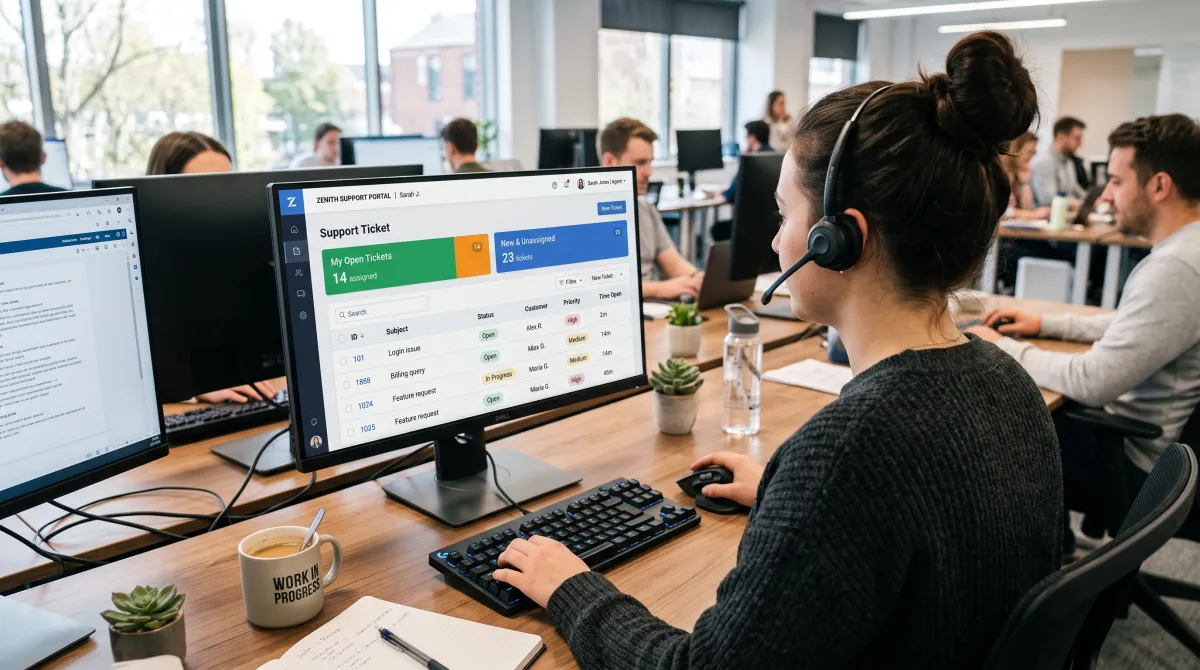
Best Help Desk Software For Small Business Explained
Here is a breakdown based on vendor documentation and public user reviews. Prices below reflect annual billing, verified against vendor pages in early 2026, with notes where monthly billing flips the math.
| Tool | Free plan | Entry paid | Best for |
|---|---|---|---|
| Zoho Desk | 3 agents, permanent | $7/agent/mo (Express) | Zoho users, tight budgets |
| Freshdesk | 2 agents, 6-month limit | $19/agent/mo (Growth) | Fast onboarding |
| Help Scout | 5 users, 100 contacts | $25/user/mo (Standard) | Inbox-style support |
| HubSpot Service Hub | 2 users | ~$15/seat/mo (Starter) | Existing HubSpot CRM |
| Zendesk | None | $19/agent/mo (Support) | Full omnichannel at scale |
Zoho Desk: best value overall
Zoho Desk gives you 3 agents free forever with email ticketing and a knowledge base. Paid plans start at $7 per agent monthly on Express, with Standard at $14, and stay cheap as you grow.
One caveat on AI: the full Zia toolkit sits on the $40 Enterprise plan, so a small team wanting deep automation pays up. Standard at $14 and Professional at $23 cover SLAs and round-robin for most shops. If you already use Zoho CRM, this is an easy yes.
Freshdesk: fastest to onboard
Freshdesk keeps a free program for up to 2 agents with a 6-month expiry, which stings. But the interface is the cleanest here, and most agents are productive within hours, not days.
One gotcha: standalone Freshdesk is email and social ticketing, while Freshdesk Omni (chat, phone, messaging) is paid from day one at $29 per agent. Compare Omni against Zendesk Suite, not the cheaper standalone Growth plan at $19 per agent.
Help Scout and HubSpot: the inbox picks
Help Scout keeps a genuine free plan in 2026: 5 users, one inbox, and a Docs site, capped at 100 contacts a month. Paid Standard runs about $25 per user, and it feels like a smarter shared inbox rather than a rigid ticket system.
HubSpot Service Hub stays free for 2 users and adds a shared inbox. Starter runs around $15 per seat, but the trap is Professional at $90 per seat plus a mandatory $1,500 onboarding fee. It fits teams already living inside HubSpot.
The cheapest sticker price rarely wins. The tool that fits your existing stack and billing cycle almost always does.
Zendesk: power at a price
Zendesk has no free plan, only a 14-day trial. Support starts at $19 per agent, but real omnichannel lives in Suite Team at $55 and Suite Professional at $115. Add-ons like Copilot bill separately at about $50 per agent, so budget carefully.
Choose Zendesk when volume and multichannel routing justify the spend, not before. For a two-person shop, it is overkill you will feel every month on the invoice.
Best Help Desk Software For Small Business Examples
Software never lives alone. A help desk sits inside a wider small business toolkit, and the smart move is choosing tools that talk to each other.
Many owners pair a help desk with hr software for onboarding support agents, and with a project tool for escalations. If you track delivery timelines, gantt chart software keeps ticket-driven fixes visible to the whole team, a habit we cover in our team productivity tools guide.
Operations-heavy shops often connect support to the inventory management software small business owners rely on, so a "where is my order" ticket links straight to stock levels. The right small business inventory management software closes that loop, and even a lightweight small business inventory software beats a spreadsheet when tickets spike.
For lean startups, inventory software small business plus free accounting software covers the back office while the help desk handles the front. It is the same philosophy: start free, scale only when the tickets or the revenue justify it. Keeping your security software current matters just as much, since a support inbox is a common phishing target.

How to Apply Best Help Desk Software For Small Business
Buying support software is a financial decision as much as a technical one. Treat it like any other line item on your books.
- Start on a free tier. Run 30 days of real tickets before you pay a cent.
- Match channels to customers. Do not pay for voice and WhatsApp if 90 percent of tickets are email.
- Check annual vs monthly. The ranking above changes if you pay monthly, so model both.
- Mind your credit. Software subscriptions add up, and putting them on the right card matters.
On that last point: paying for tools with a card that reports to bureaus helps your business credit score over time, a metric tracked by the three major credit bureaus. If you are new, a secured business credit card is the usual on-ramp before you qualify for premium rewards cards.
Some owners also lean on membership perks. A costco membership business tier gives discounts on office supplies and services from Costco, and if you shop in person, knowing your costco business center locations saves trips.
Checking costco business centers locations near you is worth two minutes before a bulk run. None of this replaces good software, but every dollar saved funds the tools that grow the business.
Culture counts too, so read our note on good manager reviews to keep agents happy while you scale support.
Related guides
Best Help Desk Software For Small Business FAQ
What are the best business credit cards for funding software?
The best business credit cards for tool subscriptions reward recurring spend. Cards from Chase Ink, Amex Business, and Capital One Spark lead most 2026 rankings for cash back on software and office categories.
Is there a single best business credit card for startups?
There is no one best business credit card, since the winner depends on spend. New owners often start with a secured card to build history, then move to a rewards card once approved.
Which are the best credit cards business owners actually use?
The best credit cards business owners use pair no-fuss rewards with reporting to bureaus. Flat-rate cash-back cards suit simple stacks, while tiered cards reward heavy software and travel spend.
How do I compare the best credit card business options?
Compare the best credit card business options by annual fee, reward category, and whether it reports to build your business credit score. Match the card to where you actually spend.
Where can I find top rated business credit cards?
Top rated business credit cards appear on issuer sites and independent review roundups updated for 2026. Filter by your biggest expense category, then confirm current terms directly with the issuer.