Business Concepts
Proforma Invoice vs Commercial Invoice (+ Free Template)
A proforma invoice is a priced offer, not a bill. See how it differs from a commercial invoice, what it must include, and copy a free template.

A proforma invoice is a preliminary bill that a seller sends before anything ships. It lets the buyer see exactly what an order will cost and commit to it. It looks like an invoice, with prices, quantities and payment terms, but it is really a quote dressed as an invoice.
That gap matters the moment a bank, a customs broker or an accountant gets involved. This is the proforma invoice explained with the rules that decide whether the document helps your deal or stalls it.
Quick answer
A proforma invoice is a document a seller issues before delivery so the buyer can approve the price, arrange payment or apply for an import license. It is not a legally binding demand for payment and it is not used for accounting or tax. Once goods ship, it is replaced by a commercial invoice or sales invoice.
Key takeaways
- Think of a proforma invoice as a priced offer to sell, not a request for money that is already owed.
- It never goes into revenue or receivables. Only the final invoice does.
- In cross-border trade it often unlocks the deal: deposits, letters of credit and import permits.
- The final commercial invoice must match it on price, Incoterm and description, or banks and customs start asking questions.
What Is a Proforma Invoice? The Pro Forma Invoice Meaning
The name explains the document. Pro forma in Latin stands for “as a matter of form”: the paper follows the form of an invoice without the force of one. You will see it written as proforma, pro forma or pro-forma, and all three are accepted.
A proforma invoice is a preliminary invoice sent by a seller after the buyer shows serious interest but before the sale is final. The invoice highlights the deliverables: which goods or services the customer will get, at what price, by which delivery date and under which payment terms. It is one of those core business concepts that looks trivial until a shipment gets stuck.
Read the proforma invoice as a document of intent. The buyer uses it to get internal sign-off, release budget or line up financing. The seller uses it to lock the scope before committing stock or production time. Neither side should treat it as the bill.
Proforma Invoice vs Commercial Invoice: The Real Difference
The difference between a proforma invoice and a commercial invoice comes down to timing and legal weight. The proforma invoice is issued before shipment and says “this is what it will cost.” The commercial invoice is typically issued with the shipment and says “this is what was sold, and this is what you owe.”
Here is how proforma invoices and sales invoices compare, point by point.
| Feature | Proforma invoice | Commercial or sales invoice |
|---|---|---|
| When it is issued | Before delivery, often before payment | At or after shipment or delivery |
| Demand for payment | No, it is an offer | Yes, it records a debt |
| Used for accounting | No, never booked as revenue | Yes, creates revenue and a receivable |
| Tax or VAT | Cannot be used to reclaim VAT | Valid tax invoice if it meets local rules |
| Invoice number | Separate series (PF-0142) or none | Sequential series, required in most tax systems |
| Customs clearance | Accepted only in limited cases | Standard document for clearance |
| Changes | Revise and reissue freely | Corrected only with a credit note |
The commercial vs proforma split is the same in a domestic business, where proforma invoices and sales invoices follow the same logic. A regular invoice, called a tax invoice, official invoice or formal invoice depending on the country, is the type of invoice your bookkeeping runs on.
A proforma invoice doesn’t belong in your accounts receivable ledger, because nobody owes you anything yet. The final invoice is a legally binding record of a completed sale. By contrast, a proforma invoice is not legally binding as a demand for payment, although an accepted one can still be evidence of the agreed price.
Tax authorities draw the same line between proforma invoices and invoices. HMRC's VAT Notice 700/21 says a pro forma invoice should be clearly marked “This is not a VAT invoice”, because a buyer cannot use it to reclaim VAT (as of November 2026). In most VAT systems, a proforma invoice cannot stand in for the tax document.
When Proforma Invoices Are Used: 5 Invoice Use Cases

Businesses use proforma invoices whenever a buyer needs a firm number before committing cash. In each invoice use case below, a loose quote is too informal and a final invoice would be premature.
- Deposits and prepayment. A custom manufacturer asks for 30% upfront. The proforma invoice is used to request payment of the deposit and get paid early without booking a sale that has not happened.
- Letters of credit. The importer's bank uses the proforma to set the amount, currency and terms of the credit.
- Import licenses and foreign exchange. In some countries the buyer needs a proforma invoice to obtain an import permit or to buy the foreign currency for payment.
- Procurement approval. Purchasing teams often require a proforma invoice from the supplier before they raise a purchase order.
- Samples and free shipments. Goods sent at no charge still need a declared value for the shipment, and a proforma often carries it.
If none of these apply, you probably don't need a proforma at all. When the proforma invoice is not used for financing, permits or a deposit, it adds paperwork without adding certainty. A small domestic order paid on delivery is better served by a plain quote followed by a regular invoice.
Proforma Invoice Format: What It Must Include (+ Template)
There is no single legal form of a proforma invoice. In theory a proforma invoice could contain anything from a two-line estimate to a full trade file. In practice, a useful proforma invoice contains the same fields as the final invoice, so the invoice format carries straight over and the later conversion is a copy job, not a rewrite.
A proforma invoice must make three things impossible to misread: that it is not the final bill, exactly what is being sold, and how long the price holds. Everything else is supporting detail. Here is a proforma invoice template you can copy into any document or spreadsheet.
| Field | What to write | Hypothetical example |
|---|---|---|
| Heading | “Proforma Invoice”, plus “not a tax invoice” | PROFORMA INVOICE |
| Reference | Own series, never your real invoice number | PF-0142 |
| Dates | Issue date and price validity | Valid 30 days from issue |
| Seller and buyer | Legal names, addresses, tax IDs | Northfield Fixtures (fictional) |
| Description | Goods and services, quantity, unit price | 400 steel brackets at $11.50 |
| Trade terms | Incoterm and named place | FOB Savannah, Incoterms 2020 |
| Logistics | Estimated shipment and delivery date | Ships within 4 weeks of deposit |
| Origin and code | Country of origin, HS code for goods | USA, HS 7326.90 |
| Payment terms | Deposit, balance, method | 30% deposit, 70% before shipment |
| Totals | Subtotal, freight, insurance, tax estimate, currency | $4,600.00 USD |
Most invoice templates and invoice generator tools offer a proforma or estimate invoice type, so you can create the invoice online in minutes. Whether you have used Zoho Invoice to create quotes or work from a spreadsheet, check one setting: proformas need their own number series so they never collide with real invoice numbers.
How to Create a Proforma Invoice in 5 Steps
- Confirm the order. Agree quantities, specifications and the Incoterm with the buyer before pricing anything.
- Price it in full. Include freight, insurance and any duties you will carry under the chosen Incoterm. Leaving out freight is the classic reason a final invoice surprises the buyer.
- Label and number it. Title it “Proforma Invoice” and use a PF- prefix.
- Set a validity date. Material costs and exchange rates move. Thirty days is a common default, shorter for volatile commodities.
- Send a proforma invoice as a PDF. Ask the buyer to confirm in writing or by paying the deposit, so the agreed scope is on record.
When using invoicing software to issue a proforma invoice, check that it does not post to sales. A proforma that leaks into revenue inflates your profit and loss statement for a sale that may never close.
A proforma invoice is a promise about price, not a request for money. Treat it as a bill and your books, your bank and your customs file stop agreeing.
Proforma Invoice Example: From Quote to Final Invoice
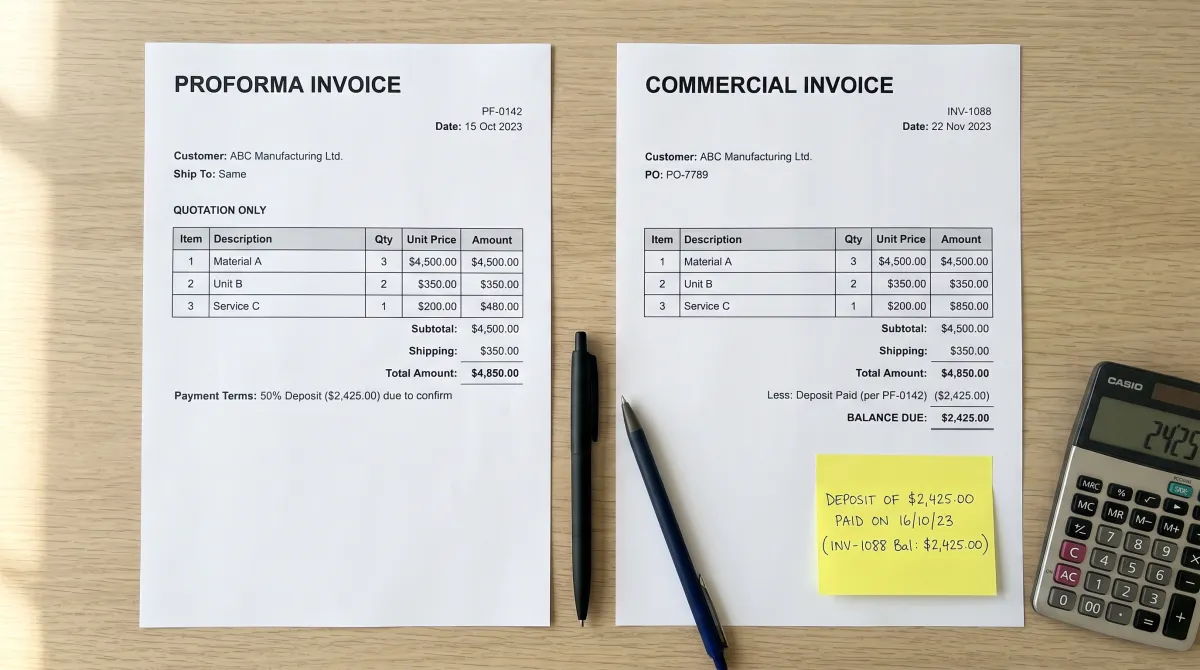
Here is a proforma invoice sample carried all the way through to the final bill. It is hypothetical. Imagine Northfield Fixtures, a small US manufacturer, quoting 400 steel brackets to a distributor in Colombia at $11.50 each, FOB Savannah.
The proforma invoice issued, PF-0142, totals $4,600 and asks for a 30% deposit of $1,380. The buyer pays it. Northfield does not record a sale. The $1,380 generally sits in a customer deposits account, a liability, until the goods ship.
The cash still shows up as an operating inflow on the statement of cash flows, which is exactly why deposits are worth asking for. Revenue waits, cash does not.
Before shipment the buyer adds 50 units. The final commercial invoice, INV-1088, shows 450 brackets and $5,175. It references PF-0142, deducts the $1,380 deposit and shows a balance due of $3,795.
That is how you turn the proforma invoice into a commercial invoice: copy the fields, then correct them to what actually shipped. Unlike an invoice, the proforma describes intent. The final invoice must describe reality, even when reality differs from the quote.
To create a sample proforma invoice for your own business, fill the template table above with one real order and run it through these same steps. If the deposit, the change order and the final balance all reconcile on paper, your process is ready for a live buyer.
Proforma Invoices in International Trade: Customs and Banks
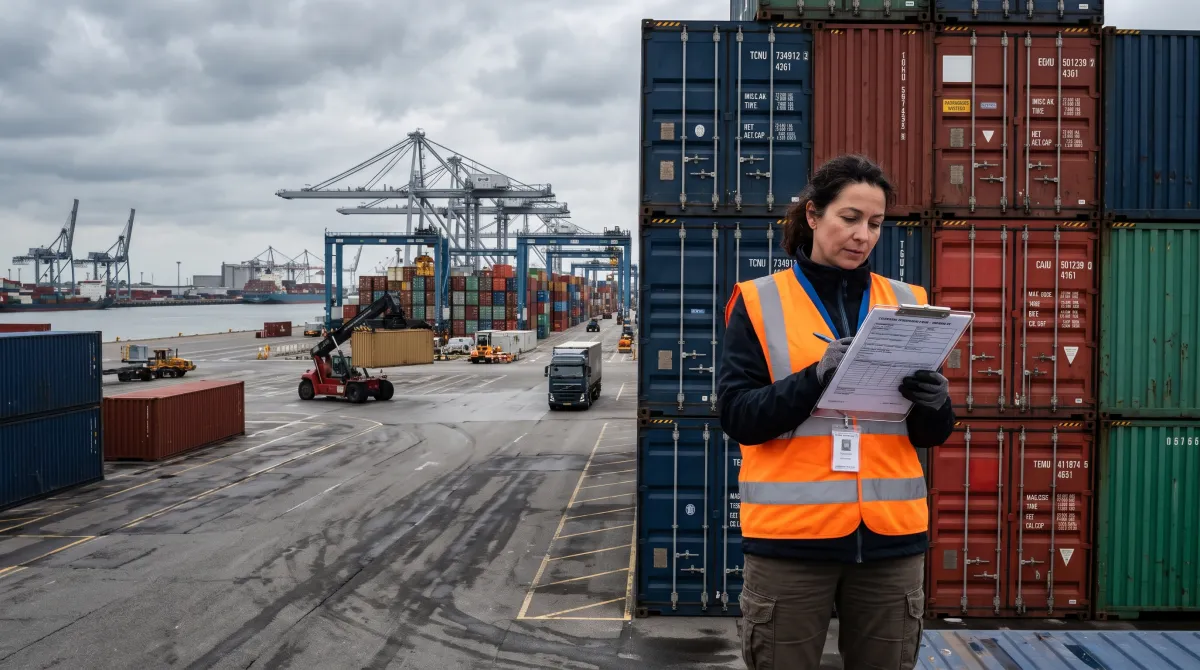
For cross-border goods, the standard commercial invoice is the official commercial record customs relies on. US Customs and Border Protection lists what a commercial invoice must contain in 19 CFR Part 141, Subpart F, including buyer and seller, a detailed description, quantities, purchase price, currency and country of origin (as of November 2026).
Under 19 CFR 141.91, a US importer may file a pro forma invoice, in the format set out in 19 CFR 141.85, only when the required commercial invoice is not available at entry. That is an exception, not a shortcut: the importer generally must post a bond to produce the commercial invoice later. A proforma is a placeholder, not a substitute for a commercial invoice.
Banks are stricter still. Article 18 of the International Chamber of Commerce's UCP 600 rules, in force since July 1, 2007, requires the description of goods in the commercial invoice to correspond with the description in the credit. If the final invoice drifts from what the credit was opened on, payment can be held up as a discrepancy.
The trade term is the third trap. The ICC's Incoterms 2020 set out 11 rules, and the one written on the proforma decides who pays freight and insurance. Switch from FOB to CIF between the proforma and the final invoice and the buyer is comparing two different prices.
When to Use Proforma Invoices, and When They Backfire
A proforma invoice can help most on large, custom or international orders, where the buyer must secure money or permission before saying yes. In those deals it shortens the sales cycle, because the buyer's finance team gets a document it can act on.
It backfires when sellers use it as a soft payment reminder, or send one for every small domestic order. Buyers then pay against a proforma, wait for a tax invoice that never comes, and your team spends the month reconciling. If you rely on deposits, set up a dedicated deposits line in your chart of accounts.
Pressure to book proformas as sales before quarter end is a quieter risk. It is a textbook case among business ethical dilemmas, because the revenue looks real on paper until the order is cancelled.
Lenders, investors and the buyer all rely on those numbers. That is the point stakeholder theory makes about whom a business answers to: a booked proforma misleads every one of them at once.
The invoice may look similar to other trade paperwork, but a bill of sale is a different document again. It transfers ownership of a specific item, usually a vehicle or equipment, and is signed after payment. Don't confuse the two.
Proforma Invoice FAQ
What does a proforma invoice mean?
A proforma invoice is a preliminary invoice that a seller sends before delivery to confirm the price and terms of a sale. It works as a formal quote: the buyer can approve, finance or pay a deposit against it, but the invoice is not a legal demand for payment and is not used for tax.
What is PI in purchase?
In purchasing, PI stands for proforma invoice. Buyers request a PI from a supplier to raise a purchase order, open a letter of credit or apply for an import permit before the goods ship and the final invoice is created.
Can a buyer pay against a proforma invoice?
Yes, buyers often pay a deposit or full prepayment against a proforma invoice. The seller should record that money as a customer deposit, not revenue, and must still issue a final invoice once the goods ship so the buyer has a valid tax document.
How can I make a proforma invoice?
Make a proforma invoice by copying your normal invoice layout, titling it “Proforma Invoice” and giving it a separate number series. Add the buyer, the goods or services, unit prices, Incoterm, delivery date, payment terms and a price validity date, then send it as a PDF.
Is a proforma invoice legally binding?
Generally, no: a proforma invoice is not legally binding as a demand for payment, while a final invoice is. Once a buyer accepts it in writing or pays a deposit, it can become evidence of the agreed price, so write it as carefully as any contract.
What is the difference between proforma invoices and commercial invoices at customs?
The difference between proforma invoices and commercial invoices at customs is that the invoice used as the standard entry document is the commercial invoice. In the US, 19 CFR 141.91 allows a pro forma invoice only when the commercial invoice is unavailable, usually with a bond to produce it later.