Marketing
SWOT Analyses: Definition, Template & Examples (2026)
What is SWOT analysis? It maps strengths and weaknesses against opportunities and threats in one matrix. See the framework, a free template, and real examples.

Strategy & Planning
What Is SWOT Analysis
Ask ten managers what is SWOT analysis and you get ten vague answers about a four-box grid. Here is the operator version. SWOT is a planning tool that forces you to name what is true about your business before you bet money on a plan.
Quick answer
SWOT analysis is a strategic planning technique that maps your internal strengths and weaknesses against external opportunities and threats. You list each one in a four-quadrant SWOT matrix, then turn the patterns into an informed strategy. It works because it separates what you control from what you do not.
Key takeaways
- SWOT analysis = Strengths, Weaknesses, Opportunities, Threats, split into internal and external factors.
- Strengths and weaknesses are internal capabilities; opportunities and threats are external forces you react to.
- The SWOT framework is credited to Albert Humphrey, who developed it at Stanford in the 1960s.
- Best used as an ongoing process tied to real data sources, not a one-time exercise.
- Pair it with a PESTLE analysis when external challenges dominate the picture.
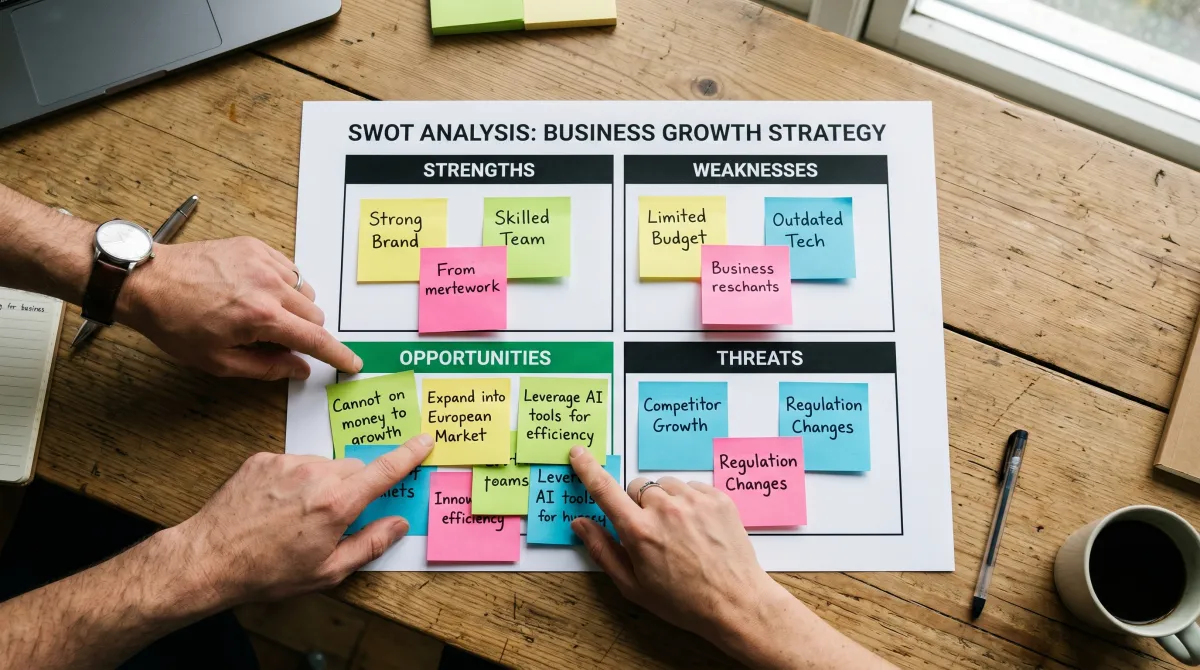
SWOT Analysis Definition and Meaning
The plain SWOT analysis definition: it is a technique for auditing your organization's position by listing four sets of factors. Two look inward, two look outward. That split is the whole point.
Put simply, a SWOT analysis is a technique that maps the position of a company at a single moment in time. The clearest way to learn it is alongside our wider marketing strategy hub, where SWOT analyses feed almost every plan we build.
The SWOT analysis meaning gets distorted when people treat all four boxes the same. Strengths and weaknesses describe internal capabilities, your team, capital, and brand identity. Opportunities and threats describe the external environment you do not control.
Done well, SWOT analyses show you where your competitive position is strong and where market realities expose you. Run consistently, SWOT analyses also track how that position shifts as the business environment moves.
That is why SWOT analyses remain a core planning tool in business strategy after sixty years.
The Four SWOT Elements (Internal and External Factors)
Every SWOT matrix has four quadrants. Two cover internal factors, two cover external considerations. The trick is to look both inside and outside the business and keep each item in the right box, or the analysis collapses.
| SWOT element | Internal or external | Question it answers | Example |
|---|---|---|---|
| Strengths | Internal | What internal capabilities give us a competitive advantage? | Strong brand, loyal customer base |
| Weaknesses | Internal | Where do our advantages and disadvantages hurt us? | Lack of capital, weak operational efficiencies |
| Opportunities | External | What external factors could we exploit? | Emerging markets, technological advancements |
| Threats | External | What external forces could damage us? | Increased competition, economic downturns |
Strengths and weaknesses cover both tangible and intangible assets. Cash and equipment are tangible; brand identity and a unique selling proposition are intangible but just as real. Both shape your competitive edge.
Opportunities and threats track market trends and market conditions. New markets, shifting regulation, or a rival's price war all live here. These external forces set the limits on any informed strategy.
This inside and outside split is what makes SWOT analyses more honest than a wishlist. The internal columns are about what you own; the external columns are about what the world is doing to you whether you like it or not.
A SWOT analysis is only useful when the strengths embarrass you and the threats keep you up at night. Comfortable boxes mean you skipped the hard part.
How to Conduct a SWOT Analysis Step by Step
Here is the SWOT analysis step by step process we run with operators. It takes one focused session plus real data, not a brainstorm of opinions. The best SWOT analyses start from evidence, not a whiteboard mood.
- Define the decision. A SWOT for entering a new market is different from one for a product launch. Name the business decision first.
- Pull data sources. Sales numbers, customer feedback, financial and human resources, competitor moves. Evidence beats guesses.
- Fill internal factors. List strengths and weaknesses honestly, covering operational efficiencies and capital.
- Fill external factors. Map opportunities and threats from the business environment and external challenges.
- Turn it into action. Match strengths to opportunities, then build contingency plans to address each major threat.
That last step is where most teams quit. A SWOT matrix that never becomes an actionable strategy is wallpaper. Use a SWOT analysis to drive real business decisions or skip it.
If you want to use SWOT well, run the session live with the whole team in one document. The arguments over which box an item belongs in are where the real insight hides, not in the tidy final grid. The messiest SWOT analyses often produce the sharpest strategy.
Tools to Run Your SWOT Analyses
You can run SWOT analyses on a whiteboard, but two tools make the live session and the follow-through far cleaner. We use both with clients to keep SWOT analyses moving from grid to action.
Best for the live workshop
Miro From $8/user/mo
Operator verdict: the fastest way to fill a four-quadrant SWOT matrix with a remote team, then vote on the entries that matter. The infinite canvas keeps internal and external factors visible at once.
Pros
- Ready-made SWOT analysis template
- Real-time voting on priorities
- Free tier handles 3 active boards
Cons
- Overkill for solo use
- Viewer seats can hit your bill
Best for turning SWOT into action
ClickUp From $7/user/mo
Operator verdict: where your threats become contingency plans and your opportunities become owned tasks. This is the bridge from a static grid to an ongoing process with deadlines.
Pros
- Turns each quadrant into trackable work
- Docs and tasks in one place
- Free Forever plan for small teams
Cons
- Steeper learning curve
- AI features are a paid add-on

SWOT Analysis Template and Sample
A SWOT analysis template is just the four-quadrant grid with prompts. The value is in the prompts, which stop you writing one-line clichés in each box.
Here is a SWOT analysis sample for a mid-size SaaS company, written the way we would actually fill it.
| Quadrant | Sample entries |
|---|---|
| Strengths | Loyal customer base (92% retention); strong brand in our niche; low churn from operational efficiencies |
| Weaknesses | Lack of capital for paid growth; thin senior bench; single revenue line |
| Opportunities | Emerging markets in LATAM; technological advancements in AI tooling; partner channel untapped |
| Threats | Increased competition from funded rivals; economic downturns squeezing budgets; platform dependency |
Notice every entry is specific. "Good team" is useless; "thin senior bench" tells you what to fix. A sample of SWOT analysis only teaches if the entries are concrete enough to act on.
The same template scales down. A solo consultant and a 200-person firm fill the identical four boxes, only the stakes and the data sources change. That portability is why SWOT analyses outlived flashier frameworks.
Benefits of SWOT Analysis (and When It Fails)
The benefits of SWOT analysis are real when you respect its limits. It is cheap, fast, and forces a structured view of your company's competitive position.
- Clarity: a SWOT analysis helps separate internal capabilities from the external environment in one view.
- Alignment: the SWOT framework gives a team shared language for business needs.
- Risk-spotting: the threats quadrant surfaces external challenges early.
- Strategy input: it feeds directly into broader strategic planning.
Repeated each quarter, SWOT analyses also become a cheap early-warning system for shifts in market conditions. SWOT analyses fail when treated as a one-time exercise. Markets move, so SWOT should be an ongoing process. They also fail without data; opinions in four boxes are not analysis.
For heavy external forces, pair SWOT with a PESTLE analysis, which digs into political, economic, and technological factors in depth. SWOT is the summary; PESTLE is the detail behind the opportunities and threats. It also sits naturally beside the 5 Ps of the marketing mix once you move from analysis into a plan.
SWOT Analysis Best Practices and Common Mistakes
After running dozens of these, the same patterns separate a useful SWOT from a filler slide. These best practices keep your SWOT analyses sharp.
- Limit each quadrant to your top 4-5 items so priorities stay visible.
- Back every entry with a data source, not a hunch.
- Keep internal and external factors strictly separated.
- Convert findings into contingency plans, not a static document.
The most common SWOT analysis mistakes are mixing internal and external factors, listing vague strengths, and never revisiting it. Avoid those three and your SWOT analyses sit ahead of most teams using this strategic planning technique.
One more habit pays off: connect the analysis to your values. Our take on the societal marketing concept shows why a strength that ignores customer wellbeing is a threat waiting to surface. Strong SWOT analyses bake that honesty in from the first box.
Related guides
What Is SWOT Analysis: FAQ
What is SWOT analysis in simple words?
SWOT analysis is a simple planning tool that lists your strengths and weaknesses (things inside your business) against opportunities and threats (things outside it). You use the four lists to make smarter strategic decisions.
What is the main purpose of a SWOT?
The main purpose is to assess an organization's position by comparing internal capabilities with the external environment, so leaders can build an informed strategy and contingency plans.
What are 5 examples of strength in SWOT analysis?
Five common strengths are a strong brand, a loyal customer base, healthy financial and human resources, operational efficiencies, and a clear unique selling proposition that gives a competitive advantage.
What are the 4 key components of SWOT?
The four components are Strengths, Weaknesses, Opportunities, and Threats. Strengths and weaknesses are internal factors; opportunities and threats are external factors.
What is marketing in relation to SWOT?
Marketing is how a business creates and delivers value to customers, and a SWOT analysis is one of the first tools marketers use to assess their position before planning campaigns.
What is the marketing mix and does SWOT inform it?
The marketing mix is the set of levers (product, price, place, promotion, people) a business controls. A SWOT analysis informs the mix by clarifying which strengths and opportunities to lean on.
What is digital marketing and where does SWOT fit?
Digital marketing is promotion through online channels like search, social, and email. A SWOT analysis often opens a digital strategy by flagging internal capabilities and external market trends.
Sources: SWOT analysis (Wikipedia), Strategic planning (Wikipedia), Strategic management (Wikipedia).