Marketing
SWOT Analysis Examples (2026): 7 Real Grids + Free Template
SWOT analysis examples that actually drive decisions: 7 real grids, a step-by-step method, and a free template. See which fits your business.

Most SWOT analysis examples you find online are useless. They list "good team" under strengths and "competition" under threats, then stop. A real SWOT analysis example shows the messy part, how you turn an internal weakness into a decision, and how a threat becomes a plan.
I have run dozens of these sessions with startup founders and marketing teams. The grid is easy. The thinking is not. Below are seven worked SWOT analyses, each pulled from a different business model, plus a step by step method, a free template, and the mistakes that quietly ruin the exercise. If you are building a wider plan, start at our marketing strategy hub first.
Quick answer
A SWOT analysis is a technique that organizes your business into four quadrants: internal strengths and weaknesses, plus external opportunities and threats. The best SWOT analysis examples do not just fill boxes, they connect each quadrant to a strategic decision, so the matrix drives action instead of decorating a slide.
Key takeaways
- SWOT stands for Strengths, Weaknesses, Opportunities, and Threats; the first two are internal factors, the last two are external factors.
- Strong SWOT analyses turn each quadrant into a move: build resilience against threats, seize opportunities tied to your strengths.
- A SWOT matrix works for a startup, an e-commerce store, a personal career plan, or a full strategic plan.
- The benefits of SWOT analysis come from honesty and different perspectives, not from a pretty template.
- Run it as a step by step process with your team, then prioritize the items that actually move business performance.
SWOT Analysis Definition and Meaning
The SWOT analysis definition is simple. It is a strategic planning tool that helps you assess a business, product, or person across four areas. The SWOT analysis meaning sits in the acronym itself: Strengths, Weaknesses, Opportunities, and Threats.
Strengths and weaknesses are internal. They are things you control, like your team, brand recognition, cash, or product line. Opportunities and threats are external. They come from the business environment: market trends, regulatory changes, increased competition, or economic downturns.
According to the standard SWOT framework, the goal is structure. You separate what you control from what you do not, so your strategic decisions rest on a thorough analysis instead of a gut feeling. This is why SWOT analyses sit at the start of most strategic planning processes.
Timing matters here. A SWOT analysis is used best at the very start of planning, before budgets or roadmaps lock in. Run these SWOT analyses early and every later decision gets a clearer brief.
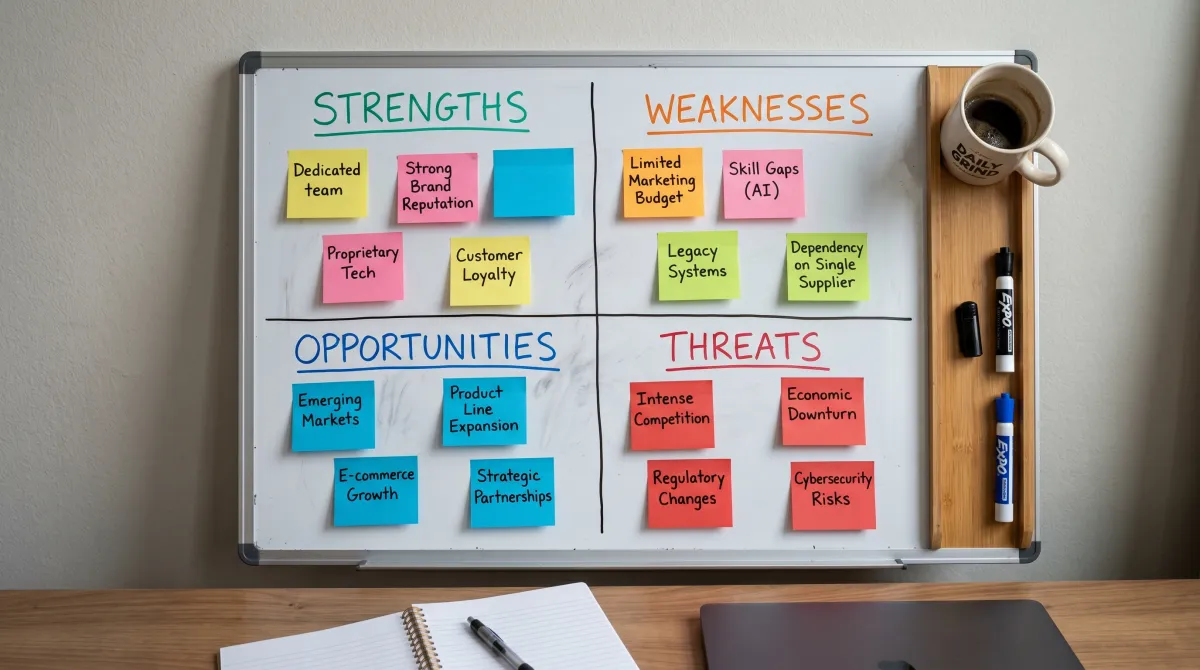
Think of the components of a SWOT analysis as a conversation, not a spreadsheet. The way a SWOT analysis organizes the chaos of a complex business into something you can act on is the whole point. That is why a good SWOT analysis is a powerful tool inside any business plan.
One more thing before the grids. SWOT analyses are not a one-time ritual. Teams that get value run them again whenever the business model or the market shifts, treating each round as a fresh read on reality.
It also scales down. The same four quadrants that map a billion-dollar firm map a freelancer deciding whether to niche. SWOT analyses earn their keep because the logic does not change with company size, only the entries do.
Components of a SWOT Analysis: The Four Quadrants
Before the examples, fix the structure in your head. Every SWOT matrix has four quadrants, and each one answers a different question about your overall business.
| Quadrant | Type | Question it answers |
|---|---|---|
| Strengths | Internal | What do we do better than rivals? Where is our competitive advantage? |
| Weaknesses | Internal | Where do internal weaknesses slow us down or cost us money? |
| Opportunities | External | What external opportunities or market changes can we seize? |
| Threats | External | What potential threats could hurt us, and how do we counteract threats? |
Internal strengths and weaknesses come from your business model, people, and resources. Threats are external, and so are opportunities. Keeping internal and external factors in their own rows is the single most useful habit when you perform a SWOT analysis. Used well, it helps you identify opportunities and threats long before they hit the numbers.
The line between internal and external trips people up. A simple test: if you can change it with a memo, it is internal; if it changes whether you act or not, it is external. That one question keeps your SWOT analyses honest and keeps strengths from leaking into the opportunities box.
7 SWOT Analyses From Real Business Models
Here is where most guides fall apart. They give one generic grid. These examples of SWOT analysis each come from a different context, so you can borrow the one closest to your situation. Read seven real SWOT analyses side by side and the logic stops feeling abstract.
A pattern also shows up. Good SWOT analyses always end in a decision, never in a tidy box. Watch how each grid below pushes toward one concrete move.

1. SWOT Analysis Example: An E-commerce Startup
A two-year-old e-commerce brand selling skincare. This example swot shows a young company with a strong brand but thin operations.
| Strengths | Weaknesses |
|---|---|
| Strong brand on social, loyal repeat buyers, high margin product line | One supplier, no warehouse, founder-dependent decision-making |
| Opportunities | Threats |
| New market in the EU, retail partnership talks, rising clean-beauty market trends | Increased competition from big retailers, ad costs, regulatory changes on cosmetics |
The move: the founder used the strong brand (strength) to land the retail partnership (opportunity). That is the strengths and opportunities pairing in action, where a SWOT analysis helps you assess what to do next, not just what is true.
2. SWOT Analysis Example: A SaaS Company Launching a New Product
A software business adding a second product. This example of a swot analysis is about a new product line stretching a small team.
- Strengths: recurring revenue, low churn, deep engineering talent, real-world product data.
- Weaknesses: small sales team, weak marketing, long onboarding.
- Opportunities: identify opportunities in adjacent industry trends, upsell existing users, AI features.
- Threats: a funded rival, market changes in pricing, talent poaching.
The SWOT analysis can identify a clear gap: great product, no go-to-market. So the strategic plan prioritized hiring sales before shipping more features.
3. SWOT Analysis Example: A Local Restaurant
Not every SWOT framework is for a tech startup. A neighborhood restaurant uses the same SWOT matrix to make business decisions.
- Strengths: location, chef reputation, low rent.
- Weaknesses: no online ordering, tight cash, small menu.
- Opportunities: delivery apps, catering, a new office block opening nearby.
- Threats: economic downturns, two new rivals, rising food costs.
A SWOT analysis is only as honest as the people in the room are willing to be.
4. Personal SWOT Analysis Example: A Career Plan
You can use a SWOT analysis on yourself. A personal SWOT analysis maps your career the way a company maps its business strategies, and it is one of the most underused examples of swot.
- Strengths: strong network, niche data skills, calm under pressure.
- Weaknesses: weak public speaking, no management experience.
- Opportunities: a stretch project, an internal opening, a mentor.
- Threats: automation of your role, a reorg, a stronger internal candidate.
The point is the same: turn them into strengths. The person above used a stretch project (opportunity) to build the management experience (weakness) they lacked.
5. SWOT Analysis Example: A Nonprofit
- Strengths: committed volunteers, trusted brand, clear mission.
- Weaknesses: one funding source, no full-time marketer.
- Opportunities: corporate partnership, grants, new donor segments.
- Threats: funding cuts, donor fatigue, regulatory changes.
This swot example shows how the framework forces a single-funding risk into the open, so the board can mitigate it before it becomes a crisis.
6. SWOT Analysis Example: A Manufacturer
- Strengths: owned factory, long client contracts, quality reputation.
- Weaknesses: aging machines, slow to adopt new technology.
- Opportunities: export markets, automation, a supply partnership.
- Threats: cheaper imports, raw-material prices, regulatory changes.
The thorough analysis here exposed an internal weakness, old equipment, that threatened the competitive advantage built on quality.
7. SWOT Analysis Example: A Marketing Agency
- Strengths: award-winning creative, retained clients, strong culture.
- Weaknesses: client concentration, thin processes, no recurring product.
- Opportunities: productized services, a new market segment, AI tooling.
- Threats: in-house teams, freelancers, a slow economy.
The agency used its creative reputation to launch a productized retainer, a classic case of using a SWOT analysis to identify a defensible business model.
Notice what these seven SWOT analyses share. Different industries, same logic: name the internal and external factors honestly, then pair them into one strategic decision you can defend.
Turning the Four Quadrants Into Business Strategies
A grid is not a plan. The step that separates useful SWOT analyses from wall art is pairing the quadrants, sometimes called a TOWS matrix. You cross internal factors with external ones and read the move that falls out.
| Pairing | Strategy it produces |
|---|---|
| Strengths + Opportunities | Attack. Use a strength to seize opportunities, like the e-commerce brand landing retail. |
| Strengths + Threats | Defend. Lean on a strong brand to counteract threats from new rivals. |
| Weaknesses + Opportunities | Invest. Fix an internal weakness so you can chase external opportunities. |
| Weaknesses + Threats | Protect. Mitigate where a weak spot meets a real risk before it compounds. |
This is how a SWOT analysis is a powerful engine for business strategies rather than a status report. Every cell points at a decision, and the four together cover offense, defense, and repair.
When clients ask what good SWOT analyses look like, this is my answer: four pairings, four owners, four dates. If you cannot name who acts on each, the matrix is decoration. Strengths and opportunities should read like a roadmap, not a wish list.
Tools to Build and Run Your SWOT Matrix
You can run a SWOT analysis on a whiteboard. But when the conversation needs to live somewhere your team can update it, a shared workspace beats a stale slide. Here are the two I actually use with clients, with current pricing as of June 2026.
Best for collaborative SWOT boards
Miro From $8/user/mo
An infinite whiteboard with ready SWOT templates. I use it when sales, ops, and finance are remote and need to brainstorm the four quadrants live.
Pros
- Drag-and-drop SWOT analysis template built in
- Real-time voting to prioritize entries
- Free plan with 3 boards to test it
Cons
- Overkill for a solo personal SWOT
- Guest viewing can trigger extra charges
Best for turning SWOT into action
ClickUp From $7/user/mo
Once the matrix is done, the items become tasks. ClickUp is where I move each prioritized opportunity or threat into an owner, a date, and a strategic plan.
Pros
- Whiteboards plus task tracking in one tool
- Docs to store the full thorough analysis
- Free Forever plan for small teams
Cons
- Steep learning curve at first
- ClickUp Brain AI is a paid add-on
My honest take: start free in both. A SWOT analysis template in Miro plus a task list in ClickUp covers 90% of teams, and you only pay once the SWOT analyses become a recurring habit rather than a one-off meeting.
How to Conduct a SWOT Analysis Step by Step
An example is useless if you cannot reproduce it. Here is how to conduct a SWOT analysis as a repeatable process, the same way I run it with teams. Conducting a SWOT well is a discipline, not a one-off.
Step 1. Set the goal. A SWOT analysis to assess a new product is different from one for a strategic plan. Define what business goals you are testing before you brainstorm.
Step 2. Gather different perspectives. Put sales, ops, and finance in the room. A SWOT analysis may look neat on paper, but its value comes from people who see different internal and external issues.
Step 3. Brainstorm each quadrant. Start with internal strengths and weaknesses, then move to external factors that may help or hurt. Creating a swot analysis works best when you separate the two clearly.
Step 4. Prioritize. A list of forty items is noise. Rank the three or four that most affect business performance, so the matrix drives strategic decisions.
Step 5. Convert to action. Pair quadrants. Match strengths to opportunities, and build resilience against the threats include in your list. This is the step almost everyone skips.
Want a starting grid? Grab a simple SWOT analysis template, four boxes, and fill it live in the meeting. The template is just scaffolding; the conversation is the product. For broader frameworks, see how it fits the 5 Ps of the marketing mix.
Once you have run a few SWOT analyses this way, the process gets faster. The first one feels clumsy, the third one feels like second nature, and the grid stops being a school exercise.
A small habit makes the SWOT analysis is the first step land harder: write the date and the decision at the top of the grid. Six months later you can see whether the call was right, which is how the framework compounds over time.
Benefits of SWOT Analysis (And When It Fails)
The benefits of SWOT analysis are real, but only when you use the SWOT honestly. Use SWOT analysis as a thinking tool, not a reporting tool, and the payoff shows up fast: a quick way to align a team and surface risk.
- It organizes a complex business into four readable quadrants.
- It forces you to name internal weaknesses you would rather ignore.
- It connects market trends and external opportunities to a strategic plan.
- It helps you identify areas for improvement before rivals do.
- It supports better decision-making by making trade-offs visible.
Where it fails: when it becomes a slide. A SWOT analysis is a powerful tool, but a swot analysis is the first step, not the strategy. If you stop after the grid, you wasted the meeting.
The matrix also gets stale. Repeat your SWOT analyses when market changes or regulatory changes shift the ground under you, the way the societal marketing concept reframes what "value" even means.
Common SWOT Analysis Mistakes to Avoid
I see the same errors in nearly every first attempt. Avoid these and your SWOT matrix will actually be useful.
| Mistake | Fix |
|---|---|
| Confusing internal and external factors | Strengths and weaknesses are internal; threats are external, so are opportunities |
| Vague entries like "good team" | Be specific: "three senior engineers with payments experience" |
| Listing forty items | Prioritize the few that change business decisions |
| Stopping at the grid | Pair quadrants and make strategic moves |
| One person filling it alone | Use different perspectives across the team |
Get those right and the four quadrants stop being a school exercise. The strongest SWOT analyses become a working map of your competitive advantage and your potential threats.
Related guides
SWOT Analysis Examples: FAQ
What is SWOT analysis?
SWOT analysis is a technique that maps a business or person across four quadrants: internal strengths and weaknesses, plus external opportunities and threats. It is a strategic planning tool used to assess your situation and make better strategic decisions.
What are SWOT analysis examples?
SWOT analysis examples include an e-commerce startup with a strong brand but thin operations, a SaaS company launching a new product, a local restaurant, and a personal career plan. Each example pairs internal factors with external opportunities and threats to drive action.
What are 5 examples of strength in SWOT analysis?
Five common strengths are a strong brand, a loyal customer base, a clear competitive advantage, skilled internal talent, and healthy cash flow. Strengths are internal factors you control and can build on.
What are some examples of opportunities in SWOT analysis?
Opportunities include entering a new market, a partnership, favorable market trends, new technology, and gaps left by a weaker competitor. Opportunities are external factors that could grow the business.
What are some examples of personal SWOT analysis?
A personal SWOT analysis lists strengths like a strong network or niche skills, weaknesses like weak public speaking, opportunities like a stretch project or mentor, and threats like automation or a reorg. It turns your career into a clear strategic plan.