Marketing
South Africa Suspends American Business: Why It Happens
South Africa suspends American business when boycotts, policy, and reputational risk outweigh profit. Here is the marketing logic behind every country exit.

The phrase south africa suspends american business sounds like a single dramatic headline, but it almost never is. It is the visible end of a slow campaign of consumer pressure, reputational risk, and political signaling that builds for months or years before any company packs up.
Quick answer
South Africa suspends American business when consumer boycotts, government policy, or reputational risk make staying more costly than leaving. The clearest historical example is the anti-apartheid disinvestment movement, when scores of US firms withdrew under public and shareholder pressure. The mechanism is societal marketing: brands respond to the values of the market, not just its wallet.
Key takeaways
- Suspensions are rarely sudden; they follow sustained boycott and disinvestment pressure.
- The anti-apartheid era is the textbook case of American firms pulling out of South Africa.
- Consumer boycotts work by attacking brand equity, not just short-term sales.
- Societal marketing explains why companies weigh public values alongside profit.
- Marketers should treat country exits as risk management, not just politics.
What "suspends American business" actually means
A suspension can take several shapes. A company may halt new investment, freeze hiring, stop selling a product line, or fully divest its local operations. Each is a different level of retreat.
The word "suspends" matters. It implies a pause that could reverse, not a permanent exit. Brands often use suspension language to keep options open while public pressure cools.
For marketers, the distinction is strategic. A frozen ad budget is reversible in a quarter. A divested factory is not. Reading which lever moved tells you how serious the underlying pressure really is, a judgment our marketing strategy guides return to again and again.
There is also a reputational layer to the wording. A company that says it is suspending rather than leaving signals to activists that it heard them, while signaling to shareholders that the revenue line is not gone for good. The vocabulary is itself a marketing decision.
The historical anchor: the disinvestment movement
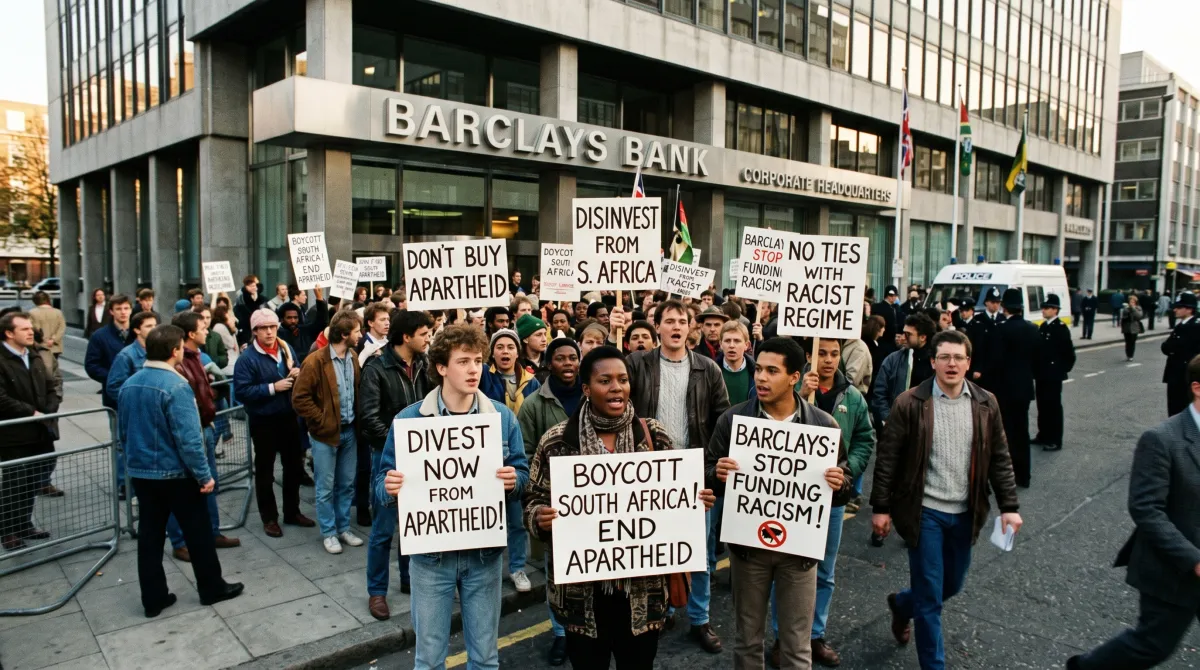
The most documented case sits in the anti-apartheid era. During the 1980s, a global campaign pushed American companies to cut ties with South Africa over its system of racial segregation.
The pressure was coordinated. Universities sold their holdings, pension funds screened portfolios, and cities passed procurement rules against firms operating in the country. The movement is captured in the broader history of disinvestment from South Africa.
By the late 1980s, dozens of well-known US corporations had reduced or ended their presence. Some sold local subsidiaries to management. Others stopped exporting entirely. The combined effect was a measurable squeeze on the apartheid economy.
What made the campaign durable was its patience. Organizers did not expect a single boycott to topple a company. They built year over year, adding institutions until the cost of staying outran the cost of leaving. That slow accumulation is the real lesson for any modern market.
Companies did not leave South Africa for moral clarity alone. They left because staying had become a brand liability they could no longer price.
Why boycotts force the decision
A boycott rarely bankrupts a company on its own. Its real weapon is brand damage. When a brand becomes a symbol of something customers reject, the cost compounds across every market, not just the contested one.
This is the logic behind the modern boycott as a marketing-era tool. Activists understand that a CMO fears a poisoned brand more than a single bad quarter.
I have watched this play out in client work. A regional controversy stays contained until a hashtag links it to the parent brand. The moment headquarters sees the name trending negatively, the local question becomes a global one.
The math is what makes it work. A boycott that dents sales by a few percent in one country is survivable. A boycott that teaches a younger global audience to associate your logo with harm is not. Leadership pays to protect the second number.
| Pressure type | Primary target | Typical company response |
|---|---|---|
| Consumer boycott | Brand equity | Suspend marketing, distance the brand |
| Shareholder activism | Stock value | Review or divest local operations |
| Government policy | Market access | Comply, relocate, or exit |
| Reputational risk | Long-term trust | Issue statements, pause expansion |
Societal marketing: the framework behind the headlines
The cleanest way to read these events is through societal marketing. The concept holds that firms should balance company profit, customer wants, and society's long-term welfare.
When those three fall out of alignment in a market like South Africa, something gives. A brand cannot serve a customer base while being seen to harm the wider society those customers belong to.
If you want the full model, our explainer on the societal marketing concept breaks down how companies weigh public welfare against revenue. It is the lens that makes a country suspension feel predictable rather than random.
The framework also predicts the timing. Firms tend to suspend when the welfare gap becomes visible to their own customers, not when it first appears. Visibility, not the harm itself, is the trigger that moves a marketing team to act.

How a suspension fits the marketing mix
A country exit touches every part of the 5 Ps of the marketing mix. Place disappears, promotion freezes, and pricing power evaporates overnight.
Product is hit hardest. A line tied to the suspended market may be discontinued, reformulated, or rebranded elsewhere to shed the association.
People, the fifth P many operators add, carries the human cost. Local staff lose jobs, distributor relationships break, and rebuilding trust later can take years. Smart firms plan the exit as carefully as they planned the entry.
Promotion deserves special attention. The moment a suspension is public, every old ad becomes evidence. Marketers scramble to pull campaigns that suddenly read as tone-deaf, which is why pausing promotion is almost always the first visible move.
What modern marketers should learn
Treat country risk as a marketing problem, not only a legal or political one. Your brand reputation is the asset most exposed when a market turns hostile.
Build an early-warning system. Track sentiment, activist campaigns, and policy signals in every market where your brand is visible. The companies caught flat-footed are the ones that ignored slow-building pressure.
Decide your red lines before a crisis. Know in advance what level of reputational risk triggers a suspension, and rehearse the messaging. A planned, principled exit protects brand equity far better than a panicked one.
Finally, document the why. Customers forgive companies that leave for a clear, stated principle far faster than those that slip out quietly. A suspension framed as a values decision can even strengthen a brand in its remaining markets.
Frequently asked questions
Why does South Africa suspend American business?
Most suspensions happen because consumer boycotts, government policy, or reputational risk make staying more expensive than leaving. The pressure usually builds over time rather than appearing overnight.
What is the most famous example of US firms leaving South Africa?
The anti-apartheid disinvestment movement of the 1980s is the clearest case. Dozens of American companies cut ties under coordinated pressure from activists, universities, and shareholders.
Is suspending business the same as a permanent exit?
No. A suspension is a pause, such as freezing investment or halting sales, and can be reversed. A full divestment, like selling a factory, is far harder to undo.
How do boycotts actually pressure companies?
Boycotts work mainly by damaging brand equity. A brand seen as complicit in harm loses trust across all its markets, which alarms leadership more than a single region's lost sales.
How is this connected to societal marketing?
Societal marketing says firms must balance profit, customer needs, and society's welfare. When those conflict in a market, companies often suspend operations to protect long-term trust.