Workplace & Career
Out Of Office Email Message (2026): 12 Templates
Write an out of office email message that works: 12 copy-paste templates plus the 3 lines every auto-reply needs. Pick the right one in 30 seconds.

A good out of office email message does one job well: it tells people you are away, when you are back, and who to contact in the meantime. Most auto-replies fail because they bury that in vague phrasing or skip the backup contact. This guide gives you 12 templates you can paste, edit in 30 seconds, and forget.
Quick answer
An out of office email message is an automatic reply that fires while you are away. The strong ones state three things in the first two lines: your return date, an alternate contact with their email, and whether you will reply at all when you are back. Keep it under 80 words and never promise a reply you will not send.
Key takeaways
- Lead with the return date, not a greeting. People scan for it first.
- Always name a backup contact and their email, or say clearly there is none.
- Match the tone to the audience: clients get formal, teammates get casual.
- Set the end date so the auto-reply switches itself off on your return.
- Never write "I will reply on my return" unless you actually will.
What Is Out Of Office Email Message?
An out of office email message is the automatic reply your email client sends to anyone who writes to you while you are away. Outlook calls it Automatic Replies, Gmail calls it Vacation responder, but the job is identical.
The point is to manage expectations. A sender who gets a clear out of office message email knows not to wait by the inbox, and knows exactly who can help in your absence. That clarity is the whole value of the reply.
Three parts carry that clarity. The dates frame the absence, the contact gives an exit route, and the tone tells the reader how seriously you mean it. Get those three right and the wording almost writes itself.
To see how the reply fits alongside chat, calls, and handovers, our workplace communication hub maps the full picture of staying reachable while you are out.
The best out of office reply answers one question before the reader even finishes reading: who do I talk to right now?
Out Of Office Email Message: The Practical Guide
Before the templates, here is the anatomy that every sample email out of office message should follow. Treat it as a checklist, not a script.
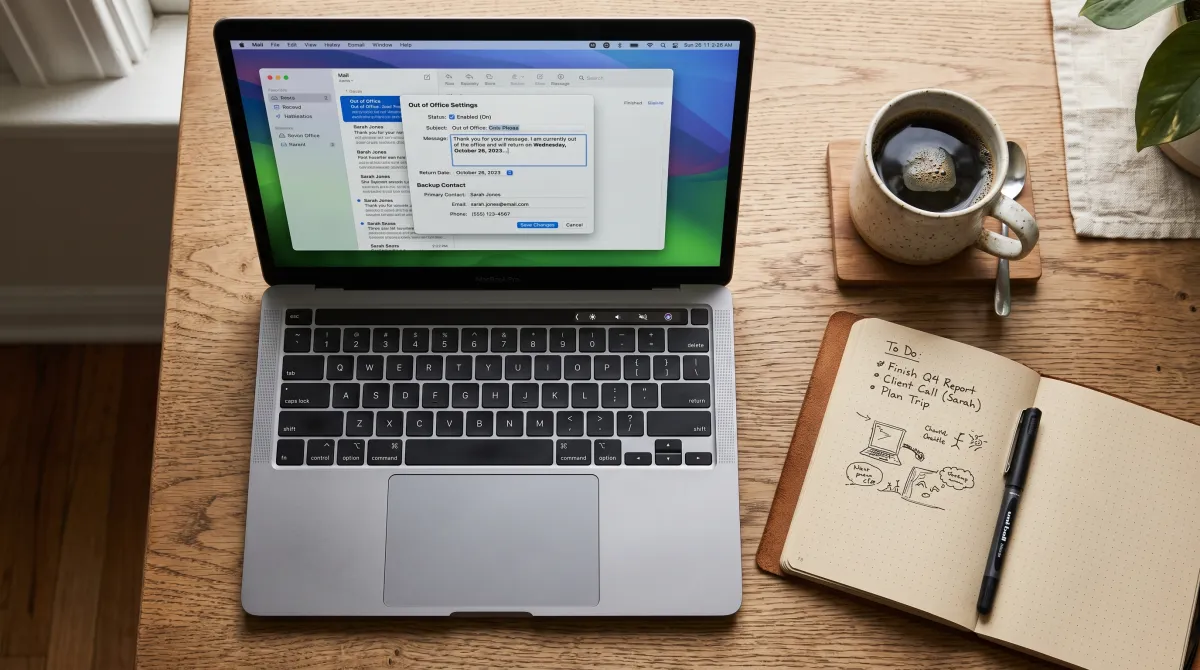
- Return date: a real date, not "soon" or "shortly". "Back on Monday, June 16" beats "back next week".
- Reply intent: say whether you will read messages on return or whether the sender should resend.
- Backup contact: name plus working email, ideally split by urgency.
- Scope: one line on what you are away for, only if it adds context, never a life story.
One honest rule, learned the hard way. If you write that you will respond to everything when you return, you are signing up to clear a backlog of hundreds.
Most operators are better served by asking senders to resend anything still live. It is kinder to your future self and more truthful to the reader. The out of the office email message sample blocks below build that honesty in by default.
Most email clients send one reply to everyone, so write for the stricter audience if yours does. Set the start and end dates in your client so the reply turns itself off the moment you walk back in.
The other half of the job happens before you leave: brief your backup, hand over live threads, and say how long you expect to be out. Good email habits at work mean coverage is sorted early, so the auto-reply is the last step, not the whole plan.
Sample Email Out Of Office Message Templates
Below are 12 ready-to-use blocks. Each out of the office email message sample is written to be pasted and lightly edited, and every out of office email message sample runs from formal to casual so you can match the reader.
Treat any email out of office message sample here as a starting point, then swap the bracketed fields for your own. Each one front-loads the date and contact so a scanning reader gets what they need in two lines.
1. Standard vacation
Thank you for your email. I am out of the office until [Monday, June 16] with limited access to email. For anything urgent, please contact [Name] at [[email protected]]. I will respond to your message after I return.
2. Vacation, no reply on return
I am away until [June 16] and will not be monitoring this inbox. If your message still needs attention when I am back, please resend it then. For urgent matters, contact [Name] at [[email protected]].
3. Client-facing, formal
Thank you for reaching out. I am currently out of the office and will return on [date]. Your message is important and will receive my full attention on my return. For immediate assistance, please contact [Name], [role], at [email] or [phone].
4. Internal team, casual
Hey, I am off until [date] and mostly offline. Ping [Name] in [channel] if it cannot wait, otherwise I will catch up when I am back. Thanks.
5. Sick leave
I am out of office due to illness and not checking email. For anything time-sensitive, please reach [Name] at [email]. I will reply to your message once I am back and well.

6. Parental leave
I am on parental leave from [start date] until [end date] and will not be reading email during this time. For all matters, please contact [Name] at [email], who is covering my work. I will not respond to messages sent during my leave.
A multi-month absence needs a fuller handover than a week off. Spell out who owns which thread, not just a single catch-all contact, so live work keeps moving while you are gone.
7. Conference or travel
I am traveling for [event] from [start] to [end] with patchy connectivity. Expect slower replies. For anything urgent, [Name] at [email] can help straight away.
8. Public holiday
Our office is closed for [holiday] and reopens on [date]. We will respond to your message in the order received once we are back. Thank you for your patience.
9. Short same-day absence
I am away from my desk today and will reply tomorrow. For urgent items, contact [Name] at [email].
10. Role transition
I have moved into a new role and no longer manage this inbox. Please direct your message to [Name] at [email], who now handles [area]. Thank you.
11. Reduced hours
I am working reduced hours until [date] and checking email once a day. Replies may take 24 to 48 hours. For faster help, contact [Name] at [email].
12. Warm and human
Thanks for your note. I am taking a real break until [date] to step away from the screen. I will not see this until I am back, so if it matters now, [Name] at [email] is your person. Talk soon.
Treat these as out of office email message examples you can mix and match. Template 1 doubles as a clean out of office email message example to keep on file, since it covers the date, contact, and reply intent in four lines.
We keep these email out of office message examples deliberately short, because a reader who scans wants the date and the contact, not paragraphs. The same logic applies to out of the office email message examples for extended leave. Stack a clear dates block onto a named coverage contact and the longer version still reads in a single glance.
How To Pick The Right Template
The hardest part is rarely the wording. It is matching the message to who reads it. A client who emails about a contract should never land on the same casual reply your teammate gets in chat.
Sort your senders into three rough buckets. External clients and partners need the formal blocks with a named contact and a phone line. Internal colleagues do fine with the casual versions. Vendors and cold outreach can get the shortest reply you have.
When in doubt, default to the more formal version. A slightly stiff auto-reply reads as professional, while an over-casual one to the wrong reader reads as careless. Pick the tone first, then fill the brackets.
If chat is your team's main channel while you are out, point people there instead of email. Our roundup of the best business messaging apps shows where a quick ping beats a queued inbox reply.
Common Mistakes To Avoid
A few patterns turn a useful auto-reply into a liability. They are easy to miss because the message looks fine to you, the person who already knows the context. The sender does not. These are the ones worth fixing first.
| Mistake | Why it hurts | Fix |
|---|---|---|
| Vague dates | Sender cannot plan around "soon" | State the exact return date |
| No backup contact | Urgent issues stall completely | Name a person plus email |
| Over-promising replies | You drown in backlog on return | Ask senders to resend if still live |
| Leaving it on too long | People think you are still away | Set the end date in the client |
| Sharing too much | Reads as unprofessional | One line of context, maximum |
If you manage people, the stakes are higher. A team with no coverage plan ends up routing every absence through one overloaded person. Our guide to leading a team covers how to set coverage up so nobody is left guessing.
One more, often missed. Auto-replies can loop with mailing lists and other auto-replies, flooding inboxes. Most clients limit this by design, and you can read how the email auto-reply mechanism handles it, but confirm your reply fires once per sender, not once per message.
Run a quick test before you leave. Send yourself a message from another address and check the reply reads cleanly, lists the right contact, and shows the correct return date in the first line. If a thank-you lands while you are out, a short note like our appreciation reply examples can wait until you return without seeming cold.
FAQ
What is an out of-office email message?
It is an automatic reply your email sends while you are away, stating your return date, who to contact in your absence, and whether you will respond when you return. It manages sender expectations without any manual effort from you.
What should an out of office message email include?
Three essentials: the exact date you return, a named backup contact with a working email, and a clear statement on whether you will reply to messages received during your absence. Anything beyond that is optional polish.
Can you give a sample email out of office message?
"Thank you for your email. I am out of the office until June 16 with limited access. For urgent matters, contact Sara at [email protected]. I will respond to your message after I return." Swap the name and date and it is ready.
How long should an out of office reply be?
Keep it under 80 words. Senders scan rather than read, so front-load the return date and backup contact in the first two lines. Longer messages bury the only details that matter.
Should you say why you are away?
Only if it adds useful context, like parental leave or a holiday closure, and only in one line. For routine vacations, the reason is irrelevant to the sender and best left out.