Workplace & Career
Employee Recognition Award (2026): 12 Ideas That Work
An employee recognition award works when it's specific and timely. See the award types, plaque vs trophy, and 12 recognition ideas to run this quarter.

An employee recognition award is one of the cheapest levers a leader has, and one of the easiest to get wrong. Done well, it tells a person their work was seen. Done lazily, it becomes a dusty plaque nobody mentions twice.
This guide covers what makes an award land, the categories that work, and 12 recognition ideas you can run this quarter. We keep it practical, with real wording you can copy.
Quick answer
An employee recognition award is a formal or informal way to single out an employee for specific, valued work. The best ones are timely, specific about what the person did, and tied to a behavior you want repeated. The medium, whether a trophy or a Slack shout, matters far less than the specificity.
Key takeaways
- Specificity beats budget: "closed the Riley account under pressure" lands harder than a generic employee of the month award.
- Mix peer-to-peer recognition and leader-nominated awards so it does not flow only from the top.
- Timing decays fast. Recognize within a week, not at the annual gala.
- Run a small set of named awards consistently rather than inventing a new one each time.
- Public for the win, private for the gratitude. Read the person first.
What Is an Employee Recognition Award?
An award for employee recognition is a deliberate acknowledgment that ties a named person to a named contribution. It can be a plaque, a trophy, a bonus, an extra day off, or a public note from the CEO. The form is flexible, the intent is not.
The point is reinforcement. You are telling the whole team what good looks like by pointing at someone who did it. That is why vague employee recognition awards fail. "Great attitude" teaches nobody anything.
"Rebuilt the onboarding flow and cut setup time in half" teaches everyone. Recognition is one piece of a healthy company culture, and it works best when the wider systems that shape workplace culture reinforce the same behaviors.
An award in isolation is a nice moment. An award that echoes what you reward day to day is a signal. It draws on the human need for esteem at the heart of any healthy organization, the wish to be respected and valued by peers.
Why an Award for Employee Recognition Matters
People do not leave jobs only over pay. They leave when effort goes unseen. A consistent employee award recognition habit is one of the few retention tools that costs almost nothing and compounds over time.
When a company awards employee recognition in public, it does two jobs at once. It rewards the individual, and it signals priorities to everyone watching. Recognizing small wins quietly rewires what the team treats as normal, lifting both employee engagement and employee satisfaction.
Consider a support agent who defuses an angry enterprise client over a weekend. Pay does not move for that. A named award, given Monday morning, tells everyone that calm judgment under pressure is the outstanding performance this company prizes.
The lesson on employee engagement spreads further than any gift card. There is also a productivity dividend. Recognition that names real teamwork rewards the people who lift the group, not just the lone star.
Staff recognition is also a low-stakes way for managers to practice seeing their people clearly. Teams that already share words that celebrate teamwork tend to find the smaller awards feel natural rather than forced.
Types of Employee Recognition Awards
Most employee awards and recognition efforts fall into a handful of categories. You do not need all of them. You need two or three that you actually run on schedule as a real recognition program.
| Award type | Who nominates | Best for |
|---|---|---|
| Performance award | Manager | A measurable result or hard target hit |
| Peer-to-peer award | Colleagues | Quiet helpers the org chart misses |
| Values award | Anyone | Living a stated company value out loud |
| Service awards | HR | Years of service, anniversary, big milestone |
| Spot award | Manager on the spot | Immediate, in-the-moment effort |
The strongest programs blend top-down and bottom-up. Leader-only recognition feels political fast. A peer-nominated lane keeps the system honest, because the people doing the work usually know who carried the load and went above and beyond.
Service awards deserve their own note. A clean milestone award at one, three, and five years of service marks loyalty without much effort, and these corporate recognition awards are easy to make scalable across a growing headcount.
Performance awards work best when the bar is public. If everyone knows the threshold for the quarterly performance award, the trophy stops looking like a favor and starts looking like a standard worth chasing.
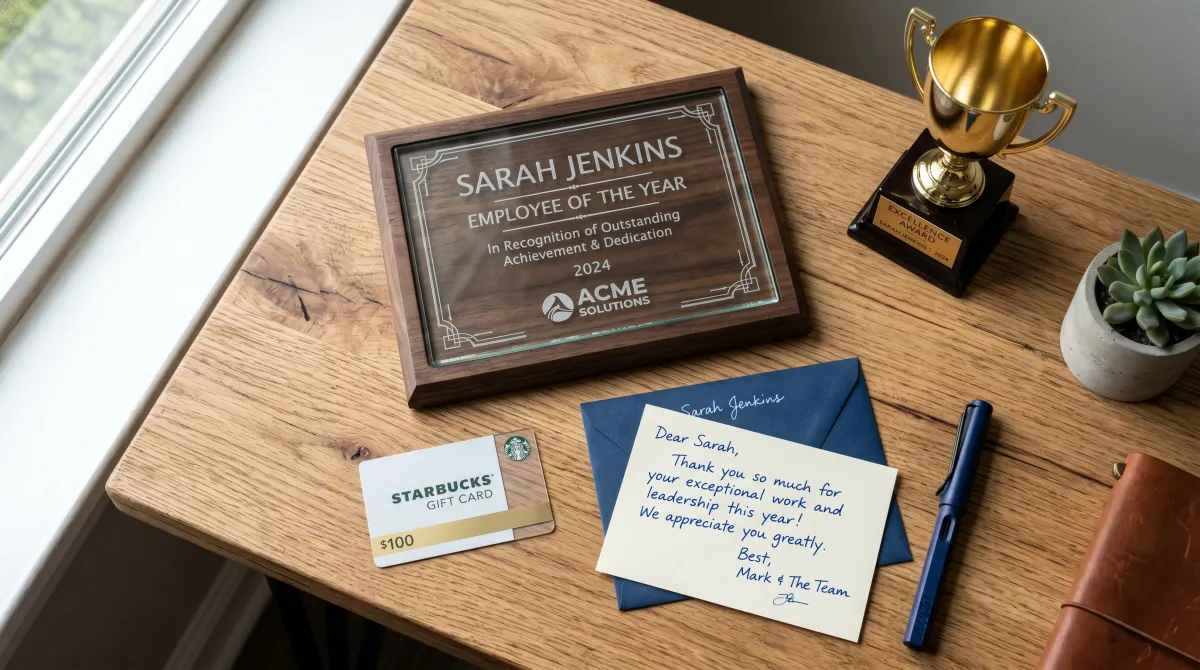
One detail people skip: match the physical object to the moment. A glass trophy or engraved award plaque suits a once-a-year milestone, while a quick spot award rarely needs more than a card and a few honest sentences. Spend where the memory will last.
Best Employee Recognition Award Ideas to Run
Here are 12 recognition ideas spanning free, low-cost, and budgeted. Pick a few, name them, and run them long enough to become a ritual. These are the best employee recognition formats we have seen actually stick.
- The Closer: for the person who got a stuck deal or project over the line.
- Unsung Hero: peer-nominated, for invisible work that kept things moving.
- Customer Champion: for a standout moment of looking after a client.
- Ship It award: for shipping something hard on time, often paired with a custom award plaque.
- Bug Slayer: for the messy fix nobody else wanted to touch.
- Mentor of the Month: for lifting a teammate's skills through real mentorship.
- Rising Star: the rising star award celebrates a newer hire showing fast, meaningful contributions.
- Idea of the Quarter: for a suggestion that actually got adopted.
- First Year, First Class: a service award at the one-year mark.
- Extra Mile: a flexible spot award with gift cards or a half-day off attached.
- Culture Carrier: a values award decided by team vote, tied to company values.
- Founder's Note: a handwritten card from leadership, no trophy needed.
Notice that few of these need a budget. A culture of appreciation is built on attention, not spend. Custom awards and corporate awards help on the milestones, but the day-to-day employee appreciation runs on words.
Name two or three formats, put them on a calendar, and resist the urge to invent a fresh award every time. The discipline of a short, repeated list is what turns a one-off gesture into an employee of the month award people actually want.
A predictable rhythm beats a surprise that arrives once and disappears. Pairing these formats with clear leadership roles and ownership keeps them from quietly fading after month two.
The best awards for employee recognition are specific enough that the whole room learns what good looks like.

How to Name and Word the Employee Award Recognition
Naming is where most awards for employee recognition go flat. A generic title is forgettable. A name with personality, like "The Closer" or "Calm Under Fire", makes the award feel like it belongs to your team.
The wording matters even more than the name. Effective employee recognition names the specific thing the person did. Compare these two:
- Weak: "Thanks for all your hard work this quarter."
- Strong: "You caught the billing error before it hit 400 customers and stayed late to fix it. That is judgment we can't train."
The second one is the entire game. It celebrates great work that is specific, recent, and tied to a behavior you want more of. That is what separates a real employee awards recognition moment from corporate noise, and it anchors any set of recognition strategies that actually change behavior.
Keep a short script for whoever presents it: name the person, name the act, name the impact, name the value it reflects. Four beats, under thirty seconds. The same words work whether you hand over an award plaque or a trophy.
Building a Successful Recognition Program
Ideas are easy. A successful recognition program is a system that survives a busy quarter. The goal is consistent recognition that runs on rails, not on the goodwill of one enthusiastic manager who eventually burns out.
Start with three named awards, a clear nomination path, and a fixed cadence. Writing it down on a single page removes the guesswork that quietly kills an employee recognition program past month two.
Write down who decides, how a nomination is submitted, and when winners are announced. Light recognition tools matter here too. Many teams run a peer shout-out channel in Slack or Microsoft Teams before they need anything heavier.
As headcount grows, dedicated employee recognition software earns its place. Platforms like Bonusly, Nectar, or Workhuman let peers send points, tie awards to company values, and report on who is being recognized, which keeps employee awards programs scalable across sites. You can also lean on broader HR and recognition software when it fits the wider stack.
Whatever the recognition solutions you pick, tie every award back to company values and the specific employee achievements behind it. The strongest programs reward the exact behaviors you want to see more of, not just those who hit a number.
That link is what makes scalable recognition possible without it turning generic. When awards mirror clear employee values, even a fast-growing team reads them the same way. Wiring this into a steady rhythm is what keeps meaningful recognition teaching rather than fizzling out.
Measure it lightly, too. Track how many awards go out each month and whether peers, not just managers, are nominating. If the numbers drift toward zero, the program is dying quietly, and a short reset beats a grand relaunch.
Common Mistakes With Employee Awards and Recognition
A few patterns quietly kill these programs. Watch for them.
- Rotation by fairness: handing the award around so everyone gets a turn drains it of all meaning.
- Delay: recognizing great work three months later reads as an afterthought.
- Top-down only: if leaders are the sole nominators, it starts to look like favoritism.
- Over-engineering: a 12-step nomination form kills momentum. Keep it light.
- Public when it should be private: some people dread a spotlight. Ask, or read the room.
The fix for all five is the same. Keep the system small, fast, and specific, and let real work drive it rather than a calendar quota. A steady weekly or monthly rhythm beats a once-a-year gala every time.
One last note on choosing formats. The best awards for staff recognition reward people who go above and beyond in ways that fit your culture, so borrow ideas freely but word every one in your own voice. The same discipline that builds strong team management applies to recognition.
Recognition is, after all, a leadership habit before it is a program. Managers who notice well in private tend to run the best public awards, because the instinct is already there. For vendor-neutral background on how this affects morale, the overview of teamwork is a useful starting point.
Related guides
FAQ
What is an example of an employee recognition award?
An example is a peer-voted "Unsung Hero" award given to a colleague who quietly kept a project moving. Other examples include a "Closer" award for sealing a hard deal, a service award for five years of service, and a spot award with gift cards attached. The key trait is specificity about what the person did.
What are employee awards and recognition?
Employee awards and recognition are the formal and informal ways a company acknowledges valued work, from trophies and plaques to public shout-outs and bonuses. A good program mixes manager-nominated and peer-to-peer recognition, ties each award to company values, and runs on a consistent cadence rather than a one-off annual event.
What are the 4 types of recognition in the workplace?
The four common types are public recognition, private recognition, peer-to-peer recognition, and milestone or service awards. Strong programs use a blend: public awards signal priorities to the team, private notes deliver personal gratitude, peer recognition keeps it honest, and milestones mark loyalty and years of service.
What is a catchy name for employee recognition?
Catchy names give an award personality and make it memorable. Examples include "The Closer", "Unsung Hero", "Rising Star", "Culture Carrier", and "Calm Under Fire". A specific, branded name beats a generic employee of the month award because it tells people exactly which behavior earned it.