Marketing
What Is Digital Marketing (2026): 8 Types We Run
What is digital marketing? It's using digital channels, content marketing, and paid ads to reach buyers. See the 8 types, tools, and strategies that work.

Marketing fundamentals
What Is Digital Marketing
Digital marketing is the practice of promoting a product or service to potential customers through digital channels: search engines, email, social media, websites, and apps. Ask 10 people what is digital marketing and you get 10 vague answers. Here is the operator version, with the types that actually move revenue and the tools we run.
Quick answer
Digital marketing is the use of digital channels and digital advertising to reach buyers, generate demand, and drive sales. It covers SEO, content marketing, email, social media, paid ads, and affiliate marketing. Done right, digital marketing allows small teams to compete with budgets ten times their size because every dollar and every click is measurable.
Key takeaways
- Digital marketing refers to any marketing effort that runs over the internet or a connected device.
- The eight core types are SEO, content marketing, email marketing, social media marketing, search engine marketing, affiliate marketing, influencer marketing, and mobile marketing.
- The biggest benefit of digital marketing is measurement: you see cost per lead, not guesses.
- A successful digital marketing strategy starts with clear marketing goals, not with picking channels.
- You do not need every channel. Two done well beat six done badly.
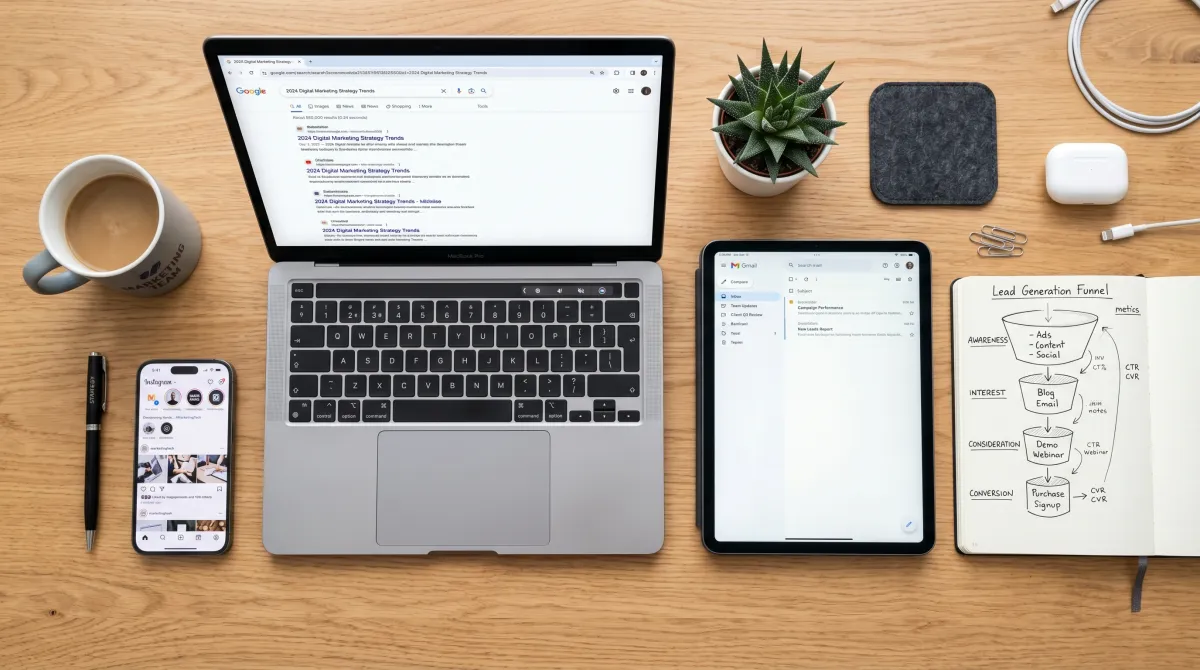
Digital Marketing Meaning: A Plain Definition
Let's nail the marketing definition first. Marketing is the work of connecting what you sell to the people who need it. That marketing meaning hasn't changed in a century. What changed is the channel.
Traditional marketing used print, TV, radio, and billboards. Digital marketing is the use of internet marketing channels instead: a Google search, an email inbox, a Reel, a retargeting ad. Same goal, measurable delivery. Our wider guide to modern marketing strategies covers how these pieces fit together.
The American Marketing Association frames marketing as the activities and processes for creating and exchanging offerings that have value. Understanding digital marketing means applying that same concept of marketing through digital platforms where attention now lives.
So the short marketing meaning for our purposes: digital marketing promotes a product or service using digital channels you can track, optimize, and scale. Digital marketing uses email, search, and social to do this, and the use of digital marketing is rising precisely because that measurability is why marketing is important to modern businesses. The classic 4 Ps of marketing still apply, only now the promotion runs digital first, and digital marketing spend keeps climbing.
One quick note on terms. Online marketing and digital marketing mean the same thing in everyday use, so we treat them as synonyms. Digital marketing is often the label inside agencies, while online marketing efforts is the phrase you hear from founders. Both describe how digital marketing works in practice.
Traditional marketing tells you something happened. Digital marketing tells you exactly what, to whom, and for how much.
How Digital Marketing Works in Practice
Understanding digital marketing is easier when you watch a single buyer move. Someone types a question into a search engine, lands on an article, joins an email list, gets a sequence, then buys. Every step is a digital marketing channel doing one job.
That is the core of how digital marketing works: a chain of touchpoints, each measurable. Traditional marketing methods could never show you which billboard drove a sale. Digital marketing efforts log every click, open, and conversion, so you fix the weak link instead of guessing.
This is why digital marketing requires a tracking layer from day one. Analytics, a pixel, and clear goals turn raw traffic into a story you can act on. Without that, you are just running ads in the dark.
The other half is the offer. Marketing strategy decides what you say and to whom. The channel only delivers the message. Get the message wrong and no amount of digital advertising saves it, which is why successful digital marketing always starts upstream of the tactics.
Types of Digital Marketing: The 8 That Matter
There are dozens of buzzwords, but every form of digital marketing fits into a handful of categories. Here are the eight types of digital marketing we actually run, with where each one earns its place. Each type of digital marketing below uses different digital marketing channels to reach a specific buyer.

1. Search Engine Optimization (SEO)
Search engine optimization is the practice of earning free traffic from search engines like Google. You match content to what people type, then earn rankings with relevance and authority.
SEO is the slowest digital marketing channel to start and the cheapest to sustain. A page that ranks keeps sending potential customers for years without extra spend. That compounding is why we treat SEO as the spine of most digital marketing strategies.
2. Content Marketing
Content marketing means creating useful articles, videos, and guides that attract and convert buyers. It feeds SEO, email, and social at once, so a strong content marketing strategy multiplies every other channel.
Good content marketing strategies answer real questions before asking for a sale. Video marketing is a fast-growing subset of digital marketing because short clips travel further on social platforms than text.
3. Email Marketing
Email marketing is sending targeted messages to a list you own. It remains the highest-ROI digital marketing channel because you control the audience, no algorithm in between.
Modern email marketing software adds marketing automation: welcome sequences, cart recovery, and behavior triggers that run while you sleep. That is direct marketing at its most efficient, and a form of direct marketing every business should master.
4. Social Media Marketing
Social media marketing uses platforms like Instagram, LinkedIn, and TikTok to build audience and demand. Marketing and social media now overlap so heavily that most marketing campaigns assume a social layer by default.
The honest take: organic reach is hard. Social media marketing works best when paired with a clear content marketing strategy and a little paid amplification, not as a standalone miracle.
5. Search Engine Marketing (Paid)
Search engine marketing means paying for visibility at the top of search results, usually through Google Ads on a pay-per-click model. Where SEO is patient, search engine marketing is instant: you bid, you appear, you pay per click.
This is the fastest way to test demand. Run Google Ads for two weeks and you learn which keywords convert before committing months to SEO. Digital advertising like this buys data, not just clicks.
6. Affiliate Marketing
Affiliate marketing allows partners to promote your product for a commission on sales they drive. It is performance-based, so you only pay for results, which makes it low-risk for the brand.
For the marketer, affiliate marketing is also a revenue model: recommend tools you trust, earn when readers buy. We disclose every affiliate link on this site, a practice every honest digital marketer should adopt.
7. Influencer Marketing
Influencer marketing partners with creators whose audience trusts them. Done well, it borrows credibility you can't buy with a banner ad. Done lazily, it burns budget on vanity reach.
The rule we use: pick small, relevant creators over big, generic ones. Fit beats follower count in nearly every influencer marketing campaign we have measured.
8. Mobile Marketing
Mobile marketing reaches people through their phones: SMS, push notifications, and in-app ads. Since most digital marketing campaigns now get more than half their traffic from mobile, this is less a separate channel and more a design requirement.
Treat mobile marketing as the lens for everything else. If your email, landing page, and checkout fail on a phone, the rest of your digital marketing efforts leak conversions.
Digital Marketing Channels Compared at a Glance
Each of these digital marketing channels suits a different goal, speed, and budget. Before you pick, it helps to see them side by side. Use this to map your marketing efforts to the outcome you actually need.
| Channel | Speed | Cost | Best for |
|---|---|---|---|
| SEO | Slow | Low ongoing | Compounding organic traffic |
| Content marketing | Slow | Low to medium | Trust and lead nurture |
| Email marketing | Fast | Low | Owned-audience revenue |
| Search engine marketing | Instant | Pay per click | Demand testing, fast sales |
| Social media marketing | Medium | Variable | Brand and community |
| Affiliate marketing | Medium | Commission only | Low-risk reach |
No single row wins. The strongest digital marketing strategies stack two or three of these so the slow, compounding channels are funded by the fast ones while they mature.
Digital Marketing vs Traditional Marketing
The split between digital and traditional marketing is mostly about measurement and cost. Traditional marketing methods like TV reach broadly but blindly. Traditional marketing channels report precisely zero data back, while digital marketing channels reach precisely and report results.
Here is how the two compare on the factors that decide where your overall marketing budget should go.
| Factor | Digital Marketing | Traditional Marketing |
|---|---|---|
| Cost to start | Low, scalable | High, fixed |
| Targeting | Precise (interest, location, behavior) | Broad demographics |
| Measurement | Real-time marketing analytics | Slow, estimated |
| Speed to adjust | Same day | Weeks |
| Best for | Direct response, niche audiences | Mass brand awareness |
This isn't either/or. The strongest overall marketing strategy often blends both: a TV-style brand push amplified by precise digital marketing and digital advertising underneath. Most growing companies simply start digital because the cost of digital marketing is lower and the feedback is faster.
Benefits of Digital Marketing for Small Teams
The benefits of digital marketing all trace back to one thing: data. You learn what works fast and cheap, then put money behind it. That feedback loop is what lets a multifaceted digital marketing program outperform a bigger, slower competitor.

- Measurable: Marketing analytics show cost per lead and return per channel, so digital marketing can help you cut what fails.
- Affordable: Digital marketing offers entry points at any budget. You can start with $50 and a blog.
- Targeted: Reach potential customers by interest, not just demographics.
- Scalable: Double the spend on a winning campaign tomorrow.
- Flexible: Marketing allows you to test, kill, and relaunch in days.
For a lean team, that flexibility is the whole game. The smartest use of digital marketing isn't doing everything. It is finding the one or two channels where your buyers already are and going deep. Digital marketing helps you prove a channel before you scale it, which protects a tight budget.
What Does Digital Marketing Cost?
The cost of digital marketing scares people for no reason. Unlike traditional marketing, you set the floor. You can start with a free blog, a $20 email tool, and your own time, then scale digital marketing spend only once a channel proves itself.
A realistic small-team budget breaks into three buckets: tools, ads, and content. Tools might run $100 to $400 a month. Ad spend is whatever you can afford to test and measure. Content is mostly time, which is why effective digital marketing strategies favor it early.
The rule we follow: never scale digital marketing spend on a channel until marketing analytics show a positive return. Digital marketing allows that discipline because every channel reports its own cost per result. Pour money into winners, starve the losers.
How to Build a Successful Digital Marketing Strategy
A successful digital marketing strategy doesn't start with picking channels. It starts with marketing goals. Get the goal wrong and the best tactics still miss. Here is the sequence we use with every client to build a digital marketing strategy to help hit a number.
Step 1: Define the marketing goal
Pick one primary outcome: leads, sales, or sign-ups. A marketing strategy requires a single number to chase. Everything else hangs off it, including how marketing and sales hand off a lead.
Step 2: Know the customer
Map who buys, what they search, and where they spend attention. This is where many marketing plans fail, jumping to tactics before understanding the buyer.
Step 3: Choose 2-3 channels
Match channels to the customer, not to trends. If your buyers search Google, lead with SEO and search engine marketing. If they scroll Instagram, lead with social. Use the marketing channels to reach where attention already sits, and a focused digital strategy beats a scattered one every time.
Step 4: Create the content and creative
Build the assets each channel needs: articles for SEO, sequences for email, short video for social. This is where a content marketing strategy ties everything together.
Step 5: Measure and double down
Track results weekly with marketing analytics, kill losers, and reinvest in winners. Successful digital marketing strategies are not set once. They are tuned constantly. The companies that win in the marketing industry are simply the ones that measure honestly.
Most failed campaigns aren't failures of tactics. They are failures of patience: pulled before the data was in.
Common Digital Marketing Mistakes to Avoid
Most wasted budget comes from a short list of repeat errors. We see them in nearly every audit. Fix these and your existing marketing efforts often improve before you spend another dollar.
- Spreading too thin: Running six channels badly instead of two well. Focus is the cheapest growth lever in digital marketing.
- No tracking: Spending without analytics. If you can't measure it, you can't improve it.
- Chasing trends: Jumping to a new platform because it is hot, not because your buyers are there.
- Quitting early: Killing SEO or content before it compounds. Successful digital marketing rewards patience.
- Ignoring email: Skipping the one channel you own outright. That is leaving the highest-ROI tool on the table.
None of these are exotic. They are simply what happens when a team skips strategy and jumps to tactics. Understanding digital marketing well enough to avoid them is most of the battle.
Best Digital Marketing Tools We Actually Run
The right marketing platform turns strategy into execution. You don't need a 20-tool stack. You need one strong tool per core job. Various digital marketing tools overlap, so here are the three we run daily, with honest pros and cons.
Best for email marketing & automation
HighLevel From $97/mo
An all-in-one marketing platform that bundles email marketing software, marketing automation, CRM, and funnels. Best for agencies and operators who want fewer tools doing more.
Pros
- Replaces 5+ separate tools
- Strong marketing automation and pipelines
- Flat pricing, unlimited contacts on higher tiers
Cons
- Steeper learning curve
- Overkill for a simple newsletter
Best for project & content management
ClickUp From $7/user/mo
Where our content marketing strategy actually lives. We plan, assign, and ship every article and campaign here. Best for teams running a real content calendar.
Pros
- Flexible boards, docs, and goals in one
- Generous free tier
- Great for marketing team workflows
Cons
- Can feel busy at first
- Mobile app trails the desktop
Best for SEO & analytics
Semrush From $139.95/mo
The marketing analytics backbone for search engine optimization. Keyword research, competitor tracking, and audits in one place. Best for teams serious about organic traffic.
Pros
- Deep keyword and backlink data
- Covers SEO, ads, and content gaps
- Trusted across the marketing industry
Cons
- Pricey for solo users
- Data overload without focus
Disclosure: some links above are affiliate links. If you buy through them we may earn a commission at no extra cost to you. We only recommend tools we run ourselves.
Digital Marketing Skills Worth Building
If you want to become a digital marketer, a few digital marketing skills carry most of the weight. Digital marketing requires range, but you can grow into it one skill at a time. Compared with marketing in general, the digital side rewards measurement above all.
- Copywriting: The skill behind every email, ad, and landing page.
- Analytics: Reading marketing analytics to know what to scale.
- SEO basics: Understanding how search engines rank content.
- Paid ads: Running Google Ads and social campaigns without burning budget.
- Automation: Setting up flows so marketing efforts run without you.
You don't need a degree. A digital marketing certification plus real campaigns teaches faster than theory. The fastest way to learn is to use digital marketing on a project you own, then measure what happens.
Marketing is a great field to enter precisely because results, not credentials, prove your value. Today's current marketing landscape rewards people who ship and measure. The broader societal marketing concept is also worth understanding, since modern buyers reward brands that market responsibly.
What Is Digital Marketing FAQ
What is digital marketing in simple words?
Digital marketing in simple words is promoting a product or service using the internet: search engines, email, social media, and ads. It replaces or complements traditional marketing methods like TV and print, and every result is measurable.
How do I make money from digital marketing?
You make money from digital marketing in three main ways: working for a company or agency, freelancing for clients, or building your own audience and earning through affiliate marketing, ads, and products. Affiliate marketing allows beginners to start with no inventory.
How do I start digital marketing?
Start digital marketing by picking one channel you can learn deeply, such as SEO or email marketing. Build a simple project, like a blog or newsletter, measure the results, and expand from there. A free certification plus one real campaign beats months of passive study.
What are the 4 types of digital marketing?
The four most common types of digital marketing are search engine optimization (SEO), content marketing, social media marketing, and email marketing. Many teams add paid search engine marketing and affiliate marketing as the next layer.
What is marketing?
Marketing is the process of connecting a product or service to the people who need it, then communicating its value. The marketing definition spans research, messaging, pricing, and distribution. Digital marketing is the online subset of that broader concept of marketing.
What is marketing about, really?
Marketing is about understanding a customer well enough to offer something they genuinely want, then reaching them where they already are. Tactics change, but that core marketing meaning stays constant whether you use traditional or digital channels.
What is a SWOT analysis?
A SWOT analysis maps your Strengths, Weaknesses, Opportunities, and Threats. In marketing management it helps you decide where to focus marketing efforts before building marketing plans, so budget goes to your real advantages.
What is the marketing mix?
The marketing mix is the set of levers a business pulls to sell: Product, Price, Place, and Promotion, often expanded to 7 Ps. The marketing mix definition gives you a checklist so no part of your overall marketing strategy gets ignored.
What is market segmentation?
Market segmentation is dividing a broad audience into smaller groups by needs or behavior, so you can target each precisely. It is the foundation that makes effective digital marketing strategies possible, since you market to the right segment instead of everyone.