Leadership
Cursor AI Explained (2026): A Practical Guide for Teams
Cursor AI is the agent code editor non-devs now use for prototypes and data. See pricing, the SpaceX deal, and where it fits your team.

If you lead a team in 2026, you have heard the name Cursor more times than you can count. The hype is real, the price tag is wild, and the questions are piling up. This guide cuts through it.
Cursor is an AI code editor that, in its latest releases, became a platform for running AI agents from plain English. That shift is why product managers, marketers, and analysts now open it, not just engineers. If you are mapping where it fits, our guide to AI for business sets the wider context.
Quick answer
Cursor is an AI-native code editor (a fork of VS Code) built by the company Anysphere. In 2026 it works as an agent platform: you describe a task in natural language and it writes, edits, and runs code. For non-dev teams it shines at prototypes, data questions, and documentation, not shipping production software alone.
Key takeaways
- Cursor AI is a code editor with agents that act on natural-language instructions.
- Best for throwaway prototypes, stakeholder demos, and data analysis, not solo production builds.
- The Teams (Business) plan is $40 per seat per month, adding admin controls and shared rules.
- The AI does about 80% of the work; the last 20% still needs human review.
- On June 16, 2026, SpaceX agreed to buy Anysphere for $60 billion, so there is no Cursor stock to buy directly.
What is Cursor AI, in plain terms
Cursor looks and feels like a normal code editor because it is one. Anysphere forked Visual Studio Code and wired frontier AI models directly into the workflow. You can use Claude, GPT, Gemini, or Cursor's own model from inside the same window.
The big change came with Cursor 2.0, released in late October 2025. It introduced a multi-agent interface that can run up to eight agents in parallel and a proprietary model called Composer.
Composer has moved fast since then. The current version, Composer 2.5, shipped on May 18, 2026. It scores 79.8% on the SWE-Bench Multilingual benchmark, within a point of Claude Opus 4.7 while costing roughly ten times less per token.
One honest caveat: those benchmark numbers are partly self-reported, not yet reproduced on a neutral scaffold. Treat the percentages as directional, not gospel.
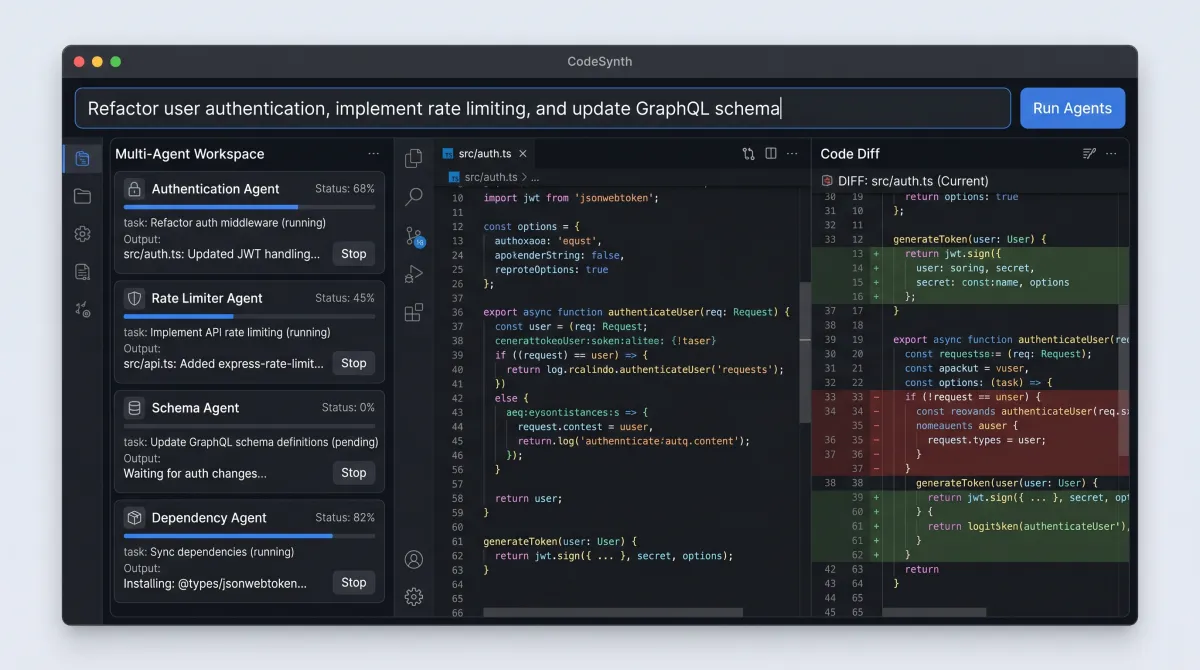
For a non-engineer, the speed is what matters. You can ask a question about a codebase or sketch a feature, and get a working answer in the time it takes to refill your coffee.
Who on your team should actually use cursor ai
Here is the honest take after watching teams adopt it. Cursor ai is not a replacement for your engineers. It is a fast lane for the people around them.
Product managers use it to build clickable prototypes before writing a single spec. Analysts query data and codebases without waiting in the engineering queue. Marketers spin up landing-page variants, often the same crowd already using AI for content creation.
Cursor lets non-engineers carry an idea 80% of the way; the last 20% is exactly where you still need a human who knows the system.
The pattern is consistent. Roughly 30 minutes is enough to get a functional prototype that proves or kills an idea. That speed of validation is the real value, not the code itself.
Where it works and where it fails
- Works: throwaway prototypes, quick demos for stakeholders, data exploration, drafting documentation, generating tickets.
- Fails: complex architecture decisions, production deploys without review, anything that assumes the AI never makes mistakes.
If you treat its output as a first draft, you win. If you treat it as final, you inherit bugs that someone has to debug later.
How to integrate Cursor into a team workflow
The teams that avoid chaos set rules before they hand out seats. Three habits separate the calm rollouts from the messy ones.
First, scope access. Give non-devs read-only branches or repos and treat their pull requests as drafts, never as merge-ready work.
Second, connect Cursor to your existing stack through MCP, the protocol that lets it read context and write to other tools.
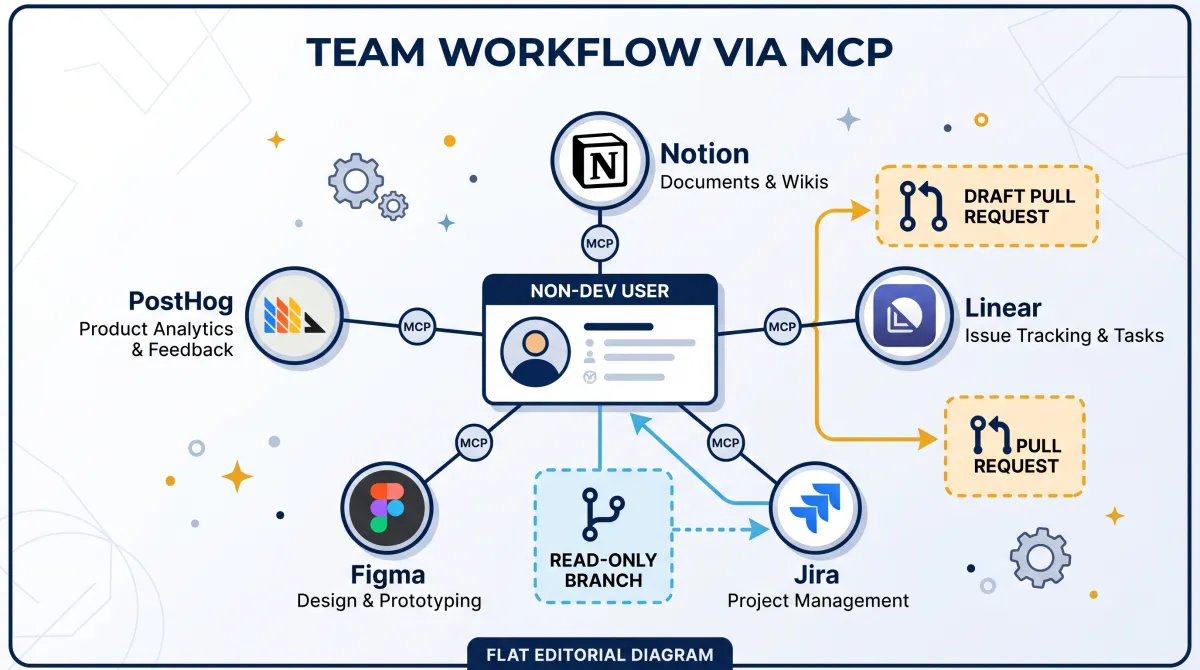
In early 2026 Cursor launched a Plugins marketplace that bundles Skills, Agents, and MCP integrations for Notion, Linear, Jira, PostHog, and Figma. That is what makes it useful for non-technical flows: it can pull a Figma file or write a Linear ticket on its own.
Third, define review habits. The AI takes you most of the way, so the question is always who checks the last mile. Name that person before anyone ships.
Pricing: what the Teams plan covers
Cursor offers a free Hobby tier, individual plans from $20 per month, and a Teams (Business) plan at $40 per seat per month. The Teams plan is the one built for groups.
| Plan | Price | Best for |
|---|---|---|
| Hobby | Free | Trying it solo |
| Pro | $20/mo | One power user |
| Pro+ | $60/mo | Heavy individual use |
| Ultra | $200/mo | Power users at max throughput |
| Teams | $40/seat/mo | Teams needing admin controls |
| Enterprise | Custom | Large orgs, SOC 2 needs |
The Teams tier adds centralized billing, admin controls, SSO, zero-data-retention mode, and shared team rules. Those shared rules matter more than they sound, because they keep ten people from generating ten incompatible styles of work.
One nuance to budget for: paid plans use credit pools tied to the plan price, and choosing frontier models manually draws them down faster than Auto mode.
If you are weighing Cursor against other tools, our roundup of the best AI image generators uses the same buy-for-the-job logic worth applying here.
Anysphere, the SpaceX deal, and cursor stock
Anysphere is the company behind Cursor, founded in 2022 in San Francisco. Its growth is the fastest software scaling on record: from $100 million ARR in January 2025 to roughly $2 billion by February 2026, with about 70% of Fortune 1,000 companies as customers.
That trajectory drew a remarkable buyer. On June 16, 2026, SpaceX agreed to acquire Anysphere for $60 billion in an all-stock deal, filed via an SEC Form 8-K. The merger is expected to close in the third quarter of 2026, subject to regulatory approval.
This answers the most common investor question directly. There is no cursor stock and no Anysphere ticker for retail buyers, because the company is private and now being absorbed by SpaceX.
At closing, each Anysphere share converts into SpaceX Class A stock, using a volume-weighted average price over the seven trading days before close.
The spacex cursor deal also reshapes the market. It hands xAI, the Grok maker SpaceX merged with in February 2026, its first real foothold in developer tools against GitHub Copilot and Claude Code. Cursor also gains access to the Colossus supercluster, solving its compute shortage.
The honest verdict for team leads
Cursor is genuinely useful and genuinely overhyped at the same time. It compresses the distance between an idea and a working demo, which is a real superpower for non-dev teams.
But it runs on one machine, for one person, with no native shared context. It makes mistakes that need human debugging.
Buy seats for the people who prototype and explore, set clear scope rules, and keep an engineer on the final review. Do that, and the $40 per seat pays for itself in saved cycles.
Frequently asked questions
What is Cursor AI?
Cursor is an AI code editor built on a fork of VS Code by the company Anysphere. In version 2.0 and later it became an agent platform that executes tasks from natural-language instructions, making it more accessible to people who are not developers.
Who is Cursor AI worth it for?
It is most worth it for non-dev professionals like product managers, marketers, and analysts. They use it to prototype ideas, query data and codebases, automate documentation, and create tickets, not to build production software on their own.
When is Cursor actually worth using?
It is ideal for throwaway prototypes, fast validation with stakeholders, and data analysis. About 30 minutes is enough for a functional prototype. It does not replace engineering judgment: the AI handles roughly 80% of a task, and the last 20% needs technical review.
How do you integrate Cursor into a team workflow?
Give non-devs read-only branches or repos and treat their pull requests as drafts. Connect Cursor through MCP to your existing tools like Notion, Linear, Jira, Figma, and PostHog so it can pull context and write back automatically.
Can you buy Cursor or Anysphere stock?
Not as a regular retail investor. Anysphere is private, and on June 16, 2026, SpaceX agreed to acquire it for $60 billion in an all-stock deal expected to close in Q3 2026. The only indirect exposure is owning SpaceX stock.