Management
Time Management Strategies: 8 Tips Operators Run (2026)
The time management strategies and techniques that actually free hours in the day. 8 methods plus the best tools. See which fits you.

Productivity
Time Management Strategies
Most advice on time management strategies treats your calendar like a Tetris board: jam more in and hope it fits. That is exactly how you burn out. The 8 time management methods below come from running real teams, and they work because they protect attention, not just fill slots.
Disclaimer: This article is for general information only and isn’t medical, mental-health or safety advice. If you are struggling, talk to a qualified healthcare professional; in the US you can call or text 988 for crisis support.
Disclosure: InterObservers may earn a commission if you buy through links on this page, at no extra cost to you. This doesn’t change what we recommend. How we make money.
Quick answer
The best time management strategies pair one prioritizing method (frog-first or the Eisenhower split) with one focus method (time blocking or the Pomodoro method). Pick one of each, protect deep work, and batch similar tasks. That alone recovers several hours in the day for most people.
Key takeaways
- Effective time management is prioritizing your most important tasks first, not trying to do everything.
- Block time on your calendar for deep work, then defend it like a meeting.
- The Pomodoro method and time limits beat willpower against procrastination.
- Learning to say "no" is the single highest-leverage time management skill.
- A good tool removes friction, but the habit is what gives you control of your time.

What Is the Best Time Management Strategy?
The time management definition is simple: planning how you spend your time so important tasks actually get done. The best strategy is the one you will repeat daily. If you want a single starting point, it is prioritizing tasks by urgency and impact before you touch your inbox.
Most time management tips fail because they add steps instead of removing them. The management tips that stick do the opposite: fewer decisions, clearer priorities, and a calendar you trust. Our wider management guide frames why that simplicity scales from one person to a whole team.
Poor time management is rarely a willpower problem. It is a prioritization problem dressed up as a busyness problem. You feel stressed, you stay late, and the work that matters keeps sliding because reactive tasks crowd it out.
Strong management skills here look boring on purpose. You decide the day before what the one task at a time is, you set time limits, and you build in time to relax so the system survives a bad Tuesday.
Done right, this is the productivity unlock most people never reach. They chase faster, not fewer, and never have enough time because they manage the clock instead of their priorities.
Start by naming the things you actually need to get done this week, not the noise. Three real outcomes beat a to-do list of thirty. Once you can find time for those three, the rest of your time management falls into place around them.
8 Time Management Strategies That Actually Work
These are eight widely recommended time management techniques. Each includes when it works and when it fails, because no single method fits every role or deadline. Together they are the time management tips to help you reclaim your week, not just rearrange it.
1. Eat the frog first
Do your hardest, most avoided task first thing in the morning, before email. The "frog first" rule kills procrastination because your willpower is highest early and nothing has hijacked your attention yet.
When it fails: if your mornings are meeting-heavy, set aside dedicated time for the frog in your first open focus slot instead of forcing it at 8am.
2. Time blocking
Block out time on your calendar for specific work, then treat each block as a real appointment. Time blocking turns a vague to-do list into a schedule, so you stop asking "what now" twenty times a day.
Carve your week into labelled time slots: deep work, calls, admin, breaks. Naming each slot is a quiet productivity win, because your brain stops negotiating what to do and simply follows the plan.
Leave buffer time between blocks. A calendar with zero slack breaks the first time a call runs long, and the whole system loses trust fast.
3. The Pomodoro method
Work in focused sprints, classically 25 minutes, then take a five-minute break. The Pomodoro method works because a short, fixed time limit makes starting easy and makes deep work measurable against the clock.
It is excellent for tasks you dread. Telling yourself "just one pomodoro" beats "finish the whole report" every time, and it builds in regular breaks so you do not crash by 3pm.
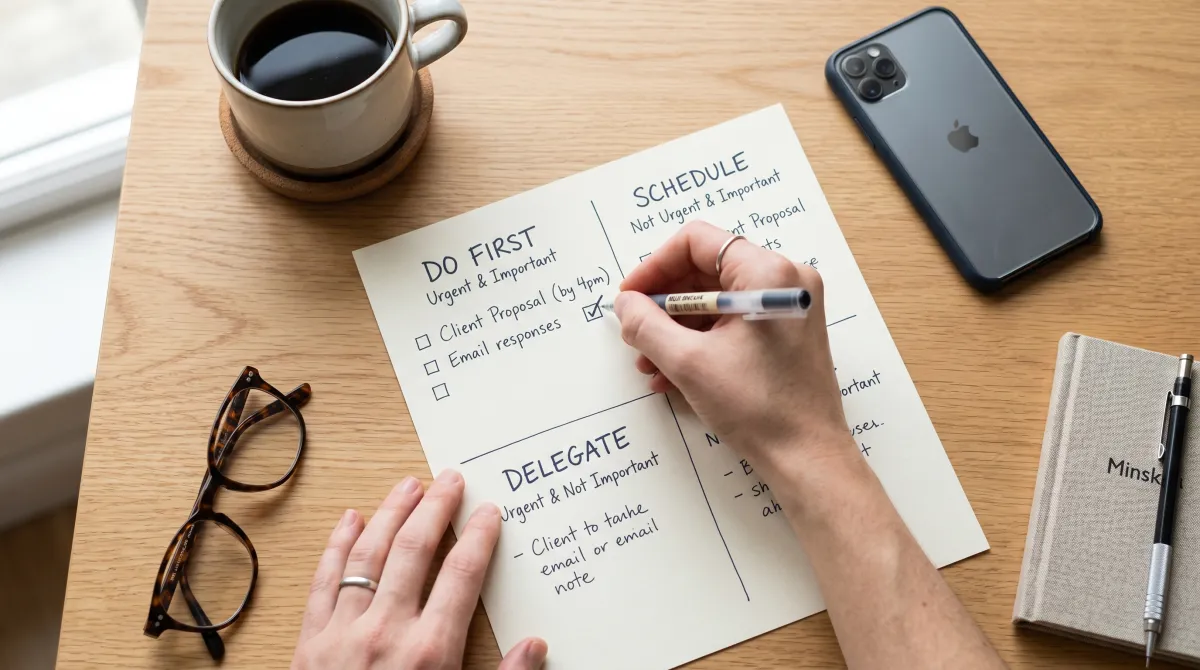
4. Prioritize with the Eisenhower split
Sort tasks based on their urgency and importance into four boxes: do, schedule, delegate, delete. This is the backbone of prioritizing your most important work and the fastest way to spot what you should never have agreed to.
The delegate box matters most for managers. Handing the right task to the right person is not losing control, it is how you find time for the work only you can do.
5. Batch similar tasks
Group similar tasks, like all your calls, all your invoices, all your Slack replies, into one window. Batching cuts the context-switching tax, so you spend less time reloading your brain and get more done with the same hours in the day.
6. Set time limits on everything
Give every task a hard stop and an honest estimate of the time to complete it. Work expands to fill the time you give it, so set time limits and a task that "needs all day" often gets done in ninety focused minutes.
Estimating the time required up front is half the battle. Naming the task at hand and the minutes it deserves stops it from quietly swallowing your afternoon, and it is how you manage time across multiple projects without one eating every hour.
7. Protect deep work and your energy
Schedule focus time when your energy is highest and silence every notification during it. Deep work is where the valuable, hard-to-replace output happens, and it cannot survive a phone that buzzes every notification. Guarding that valuable time is how you manage your time effectively rather than just looking busy.
This is where micro management quietly destroys teams. A manager who interrupts constantly fragments everyone's focus time, which is why the worst management styles produce the busiest, least productive people.
8. Learn to say "no"
The most underrated time management tip is a clean "no." Every time you say "no" to a low-value request, you hand that time back to the work that needs to get done. Learning to say "no" without guilt does more to effectively manage your time than any app you will download.
Saying "no" is a skill you practice, not a personality trait. Buy yourself a beat with "let me check my calendar," then protect the time you already committed to deep work.
You do not find time. You take control of your time by deciding, in advance, what does not get done.
Best Time Management Strategies Compared
Quick reference for matching a method to how you actually work and use your time.
| Strategy | Best for | Effort | Watch out for |
|---|---|---|---|
| Frog first | Chronic procrastination | Low | Meeting-heavy mornings |
| Time blocking | Fragmented days | Medium | Zero buffer time |
| Pomodoro method | Tasks you dread | Low | Deep flow getting cut short |
| Eisenhower split | Too many priorities | Low | Calling everything urgent |
| Batching | Context switching | Medium | Truly urgent items waiting |
For a hands-on view of these habits in practice, our breakdown of examples of time management skills shows what each strategy looks like day to day.
Best Time Management Tools to Run These Strategies
A strategy is the habit; a tool just removes friction. Based on vendor documentation and public user reviews, these management tools can help you schedule time, block time, and keep prioritizing tasks honest so you use your time more effectively.
Best for time blocking
Google Calendar From free
The simplest way to block out time and defend deep work. Consider a manager who color-codes blocks and treats them as unmovable as client meetings.
Pros
- Free and everywhere
- Drag-and-drop blocking
- Buffer-time settings
Cons
- No task prioritization
- Thin reporting
Best for prioritizing tasks
Todoist From $4/user/mo
Based on vendor documentation and public user reviews, a strong fit for an Eisenhower-style to-do list. Priority flags and filters make prioritizing your most important tasks fast, then it syncs cleanly to your calendar.
Pros
- Fast capture
- Priority levels and labels
- Calendar sync
Cons
- Best features are paid
- Light on team views
Best for managing multiple projects
ClickUp From $7/user/mo
When you juggle multiple projects and a team, ClickUp ties tasks, time tracking, and time limits together so nobody loses track of what needs to get done.
Pros
- Built-in time tracking
- Strong team views
- Generous free tier
Cons
- Steeper learning curve
- Can feel heavy solo
How to Choose Time Management Strategies for Success
Do not adopt all eight. Pick one prioritizing method and one focus method, run them for two weeks, then adjust. Stacking every technique at once is its own form of procrastination.
If you struggle with time management, start with the frog-first rule plus the Pomodoro method. If you struggle with too many priorities, start with the Eisenhower split plus time blocking. Either pairing covers the two failure modes that wreck most calendars.
Watch for the common time management trap of optimizing the wrong work. Getting faster at low-value tasks just lets you do more of what you should not be doing. Improve your time management by deleting and delegating before you try to speed anything up.
You do not need a time management course to start. A single specific time on your calendar tomorrow, reserved for your hardest task, teaches more than any week-long program.
Benefits of Time Management Done Well
The benefits of time management compound. You feel less stressed because the day has a shape, you protect time to relax, and your overall well-being and mental health improve when work stops bleeding into every evening.
You also get quick wins fast. Even two protected focus blocks a day recover time for the things that matter, and that early payoff is what makes the habit stick. That is how you manage time better without working longer.
Most of all, you maximize your time on the work only you can do. That is the real productivity dividend: not more output for its own sake, but more of your hours spent on what genuinely moves the needle.
For managers, the same logic scales. Clear priorities and protected focus time beat constant check-ins, a contrast we unpack in our guide on when managers discuss employees with other employees and the trust it quietly costs.
Related guides
Time Management Strategies: FAQ
What are 5 time management strategies?
Five proven time management strategies are: eat the frog first, time blocking, the Pomodoro method, prioritizing tasks with the Eisenhower split, and batching similar tasks. Pair one prioritizing method with one focus method for the best results.
What are the 5 P's of time management?
The 5 P's are Prioritize, Plan, Procrastinate-less, Protect (your focus time), and Pause (take breaks). They turn good intentions into a repeatable daily system rather than a one-off effort.
What is the 3 3 3 rule for time management?
The 3-3-3 rule means spending three hours on your most important deep work, completing three shorter must-do tasks, and handling three maintenance items each day. It keeps deep work central while still clearing smaller obligations.
What are the 5 time management skills?
The five core time management skills are prioritization, planning, goal setting, saying "no", and focus. Together they let you manage your time well instead of reacting to whatever shouts loudest.
What is project management?
Project management is planning, organizing, and leading work to deliver a defined outcome on time and budget. Strong time management underpins it, since project schedules live or die on protected focus time.
What is change management?
Change management is the structured approach to moving people and processes from a current state to a desired one. It pairs with time management because rollouts need dedicated, scheduled time to stick.
What is risk management?
Risk management is identifying, assessing, and reducing threats to a goal before they cause damage. Building buffer time into your schedule is a simple, daily form of it.
What is time management?
Time management is the practice of planning how you spend your time so important tasks get done with less stress. The time management meaning, in short: control of your time, not control of the clock.
Why is time management important?
Time management is important because it protects your most valuable, non-renewable resource: hours in the day. Done well, it lowers stress, prevents burnout, and frees time to focus on work that actually matters.
Sources: Time management (Wikipedia), Procrastination (Wikipedia), Occupational burnout (Wikipedia).