Software
Workplace vs Work Place: Why It's One Word (2026)
It is "workplace," one word in modern writing. Here is the rule, the rare case where "work place" fits, plus how it differs from workspace.

If you have ever paused mid-sentence wondering whether it is workplace vs work place, you are not alone. It is one of those tiny spelling decisions that quietly undermines confidence in an otherwise polished email or report.
Quick answer
Write workplace as one word. It is the dictionary-standard, closed-compound spelling recognized by Merriam-Webster and Cambridge. The two-word "work place" is not strictly wrong, but it looks dated and most readers will read it as an error.
Key takeaways
- Use one word: "workplace" is the accepted modern spelling in every professional context.
- "Work place" is archaic, not incorrect, but it signals out-of-date writing.
- The word followed the normal compound path: two words, then fused into one as it became common.
- Do not confuse workplace (the location) with workspace (your personal area) or work environment (the culture).
Workplace vs work place: the rule in plain English
English builds compound nouns in three stages. Words start open (two words), sometimes pass through a hyphenated stage, then settle as closed compounds once they become common enough.
"Workplace" has finished that journey. It is now a closed compound, the same way "baseball" left "base ball" behind. Writing "work place" today reads like an affectation, not a deliberate choice.
So for any office email, policy document, job listing, or article, default to workplace. There is no context where the two-word form gives you an edge in clarity, much like choosing the right tools your team actually uses: consistency beats novelty.
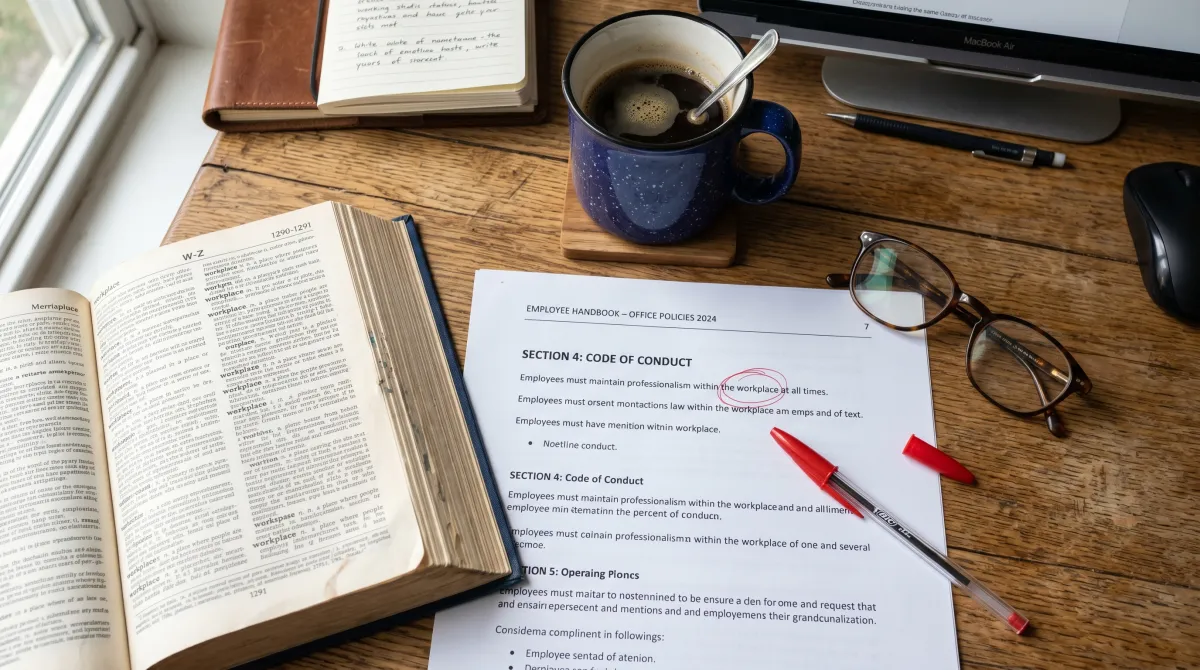
Both Merriam-Webster and Cambridge list only the single-word form. When the dictionary shows one spelling and no variant, that is your answer for professional writing.
When "work place" as two words is acceptable
There is a narrow exception. If you are using "work" as a modifier in front of a more literal "place," the space can be defensible: "Find a quiet work place at home." Here "work" describes the kind of place rather than naming the compound noun.
Even then, most editors would prefer "workspace" or just "a place to work." The two-word spelling survives mostly in older texts and legal phrasing, so treat it as the exception, not your habit.
Legal and contractual documents sometimes keep "work place" because they were drafted decades ago and never updated. That is tradition, not a rule you should copy. If you are writing fresh policy today, close the gap and write "workplace."
If you are deciding between the two, pick "workplace" every time and move on. The one-word form is never wrong; the two-word form often is.
Why "workplace" became one word
The shift was driven by frequency. The more often two words appear together, the faster English fuses them. Usage of the solid "workplace" climbed sharply in published books from around 1970 onward, tracking the rise of corporate and HR language.
This is the same compound-formation pattern behind "lifestyle," "doorbell," and "postcard." Each one was once spelled with a space before familiarity closed the gap.
"Workplace" simply traveled the road faster because modern work culture mentions it constantly. Health and safety law, remote-work debates, and HR handbooks all repeat the word, and repetition is exactly what fuses a compound.
The takeaway for writers: when a compound is everywhere, the closed form usually wins, and the dictionary follows. If you are unsure about a newer term, check whether the space has already disappeared in print.
Workplace vs workspace vs work environment
The bigger risk is not the space. It is mixing up three related terms that mean different things. Getting these right matters more than the spelling debate, especially in HR and management writing.
| Term | What it means | Use it when |
|---|---|---|
| Workplace | The physical location where work happens: an office, shop, factory, or site. | You mean the building or general place of employment. |
| Workspace | The specific area an individual uses inside the workplace: a desk, station, or app layout. | You mean someone's personal working area. |
| Work environment | The broader atmosphere: culture, conditions, relationships, and morale. | You mean how it feels to work there, not just where. |
So you can have a great workplace (a nice building) with a poor work environment (toxic culture), and your own cluttered workspace within it. Precision here makes your writing sound like it knows the subject.
This distinction shows up constantly in performance reviews and feedback. Praising the office building is not the same as praising the culture, which is why specific language matters when you sit down to write genuine feedback in a review.

Quick examples you can copy
Seeing the word in real sentences settles the doubt faster than any rule. Use these as templates the next time you draft a policy or job ad.
- "Our workplace policy covers remote and hybrid staff." (location)
- "She personalized her workspace with plants." (individual area)
- "Leadership is rebuilding the work environment after a rough year." (culture)
- "A safe workplace is a legal requirement, not a perk." (location)
Notice that "workplace" always points to a place you can walk into. A quick test: if you can stand in it, it is one word.
Where this small choice actually matters
Spelling "workplace" correctly is low stakes on its own. The reason it is worth getting right is what it signals. Sloppy compounds in a policy document make readers question the rest of the document too.
This is the same reason careful teams care about the tools that shape how people work, from security software that protects a small business to the apps that run daily operations. Small, consistent choices add up to credibility.
If you write for an audience that includes founders or operators, precise vocabulary also helps you sound like you have done the work. The same eye for detail separates clear thinking about enterprise versus entrepreneurship from vague buzzword writing.
The bottom line
In the workplace vs work place debate, there is a clear winner. Write "workplace" as a single word in essentially every situation, from job ads to internal memos.
Reserve the two-word version for rare, literal cases, and even then a stronger word usually exists. Choosing the right vocabulary for where, how, and in what culture people work signals that you understand modern work, which matters more than any spelling rule.
If clearer communication is the goal, getting these small distinctions right is part of building a healthier place to work. It pairs well with knowing how teams choose the software that runs their day and how they talk about each other when it counts.
Related guides
Frequently asked questions
Is it workplace or work place?
It is workplace, one word. This is the standard spelling in Merriam-Webster and the Cambridge Dictionary. The two-word "work place" is outdated and reads as an error in modern writing.
Is "work place" ever correct?
Rarely. "Work place" as two words can appear when "work" modifies a literal "place," but even then "workspace" or "a place to work" is usually clearer. Default to the one-word "workplace."
What is the difference between workplace and workspace?
A workplace is the whole location where you work, such as an office or factory. A workspace is your specific personal area within it, like your desk or screen layout.
Why did workplace become one word?
Frequent use fused it. English closes compounds once two words appear together often enough. Use of the solid "workplace" rose sharply from around 1970, the same pattern that gave us "baseball" and "postcard."
Is workplace one word in British and American English?
Yes. Both British and American English treat "workplace" as a single closed compound. There is no spelling difference between the two for this word.