Management
Skill Enhancement: A Manager's Practical Guide (2026)
Skill enhancement is how teams grow instead of stall. See the 4-step framework, methods that work, and the mistakes managers make. Built for real teams.

Skill enhancement sounds like a training slide, but on a real team it is the quiet difference between people who grow into bigger roles and people who quietly stall. I have run this process across product, ops, and support teams, and the pattern is always the same: the managers who treat skills as a living system win.
Quick answer
Skill enhancement is the deliberate process of improving an employee's existing abilities and adding new ones through targeted practice, feedback, and stretch work. Done well, it starts with a clear skill gap, ties to a real business outcome, and gets reinforced on the job, not just in a workshop. It sits at the heart of any modern management routine.
Key takeaways
- Skill enhancement closes the gap between what your team can do today and what the role demands next.
- The best plans are specific: one or two skills, a measurable outcome, and a deadline.
- On-the-job practice beats passive courses; people learn by shipping, not by watching.
- Managers who track progress and give frequent feedback see skills stick; the rest see them fade in weeks.
What skill enhancement actually means
Skill enhancement is improving the capabilities someone already has and layering on new ones they will need soon. It covers hard skills like data analysis or writing SQL, and soft skills like running a tense conversation or making a call under pressure.
The word that matters is deliberate. People pick up skills by accident all the time. Enhancement is when you decide a skill matters, name it, and build a path to get there. That intent is what separates real growth from busywork.
It is not the same as onboarding, which gets someone competent at the basics. Enhancement starts where competence ends and pushes toward mastery or range. A solid manager who learns to read a P&L is enhancing. A new hire learning the ticketing tool is onboarding.
It is also broader than upskilling, which usually means adding skills for a specific near-future role. Enhancement includes sharpening what someone already does well, which is often the faster win.

Why it belongs at the center of management
Markets shift, tools change, and the skills that got your team here will not carry them through 2026. If you are not actively building capability, you are slowly losing it. Skills decay, and so does motivation when people feel stuck.
There is a retention angle too. People stay where they grow. The fastest way to lose a strong performer is to let them plateau while the work stays flat. Investing in their development is one of the clearest signals that you see a future for them.
Good development habits also feed better collaborative decision making, because a team that keeps learning argues from evidence instead of ego. The skill you build today shows up in the quality of tomorrow's calls.
A simple framework that holds up
Skip the 12-step model. Most teams need four moves, run in a loop you repeat each quarter.
| Step | What you do | What good looks like |
|---|---|---|
| 1. Diagnose | Spot the gap between current and required skill | One or two named skills, not ten |
| 2. Plan | Pick a method and a measurable outcome | A deadline and a way to prove it worked |
| 3. Practice | Build the skill through real work | Stretch tasks, not just courses |
| 4. Review | Give feedback, adjust, repeat | Frequent check-ins, visible progress |
The diagnose step trips most managers up. They confuse a performance problem with a skill gap. If someone can do the work but does not, that is motivation or clarity, not a skill issue. Be honest about which one you are solving.
The plan step fails for the opposite reason: it stays vague. "Get better at communication" is not a plan. "Run the Tuesday standup solo for six weeks and cut it under ten minutes" is. Name the rep, name the proof.
A skill plan without a deadline and a measurable outcome is just a wish list with a manager's name on it.
Methods that actually build skills
Not all development is equal. The 70-20-10 model still holds: roughly 70 percent of growth comes from doing the work, 20 percent from coaching and feedback, and 10 percent from formal training. So weight your effort toward real work.
- Stretch assignments. Hand someone a task slightly above their level with support. This is where most real growth happens.
- Coaching and feedback. Short, frequent, specific. A two-minute correction beats a quarterly review.
- Peer learning. Pair a strong operator with someone building the same skill. Both improve.
- Targeted courses. Useful for fundamentals and certifications, weak for behavior change.
The trap is leaning on the 10 percent because it is the easiest to buy. A course is a line item; a stretch assignment is your time and attention. The cheap option on the budget is usually the expensive option on results.
One discipline carries outsized weight: strong time management skills determine whether anyone has the hours to practice at all. No slack in the calendar, no growth.
How to measure it without theater
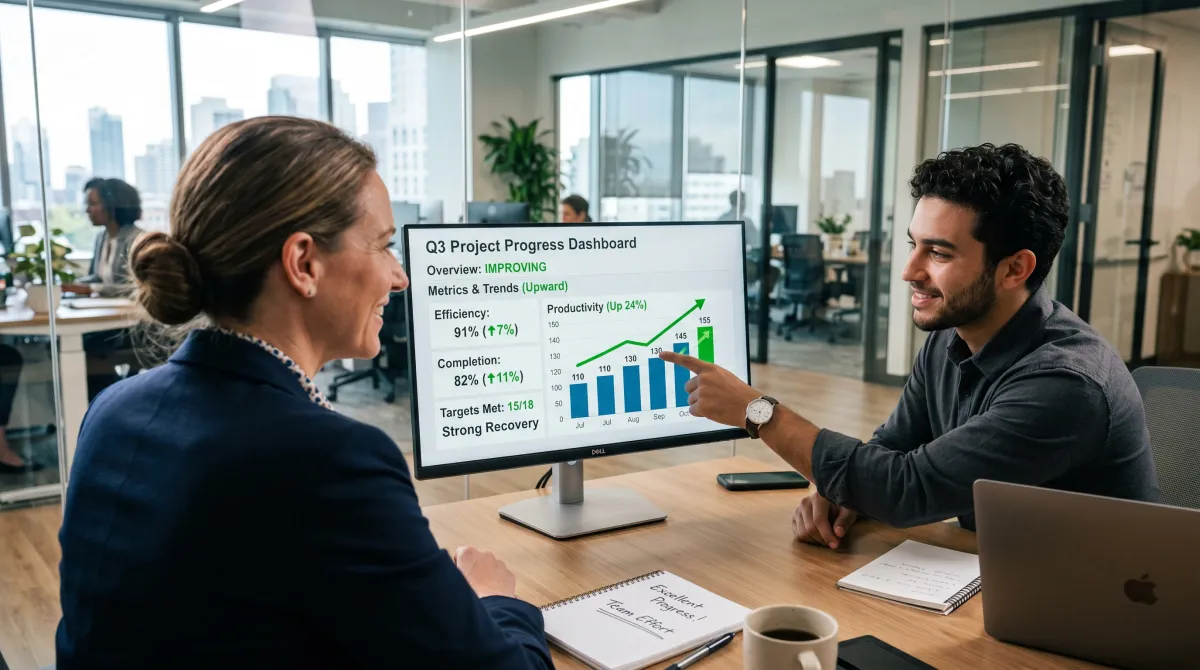
If you cannot measure a skill, you cannot manage it. Pick a signal before you start: a faster cycle time, fewer errors, a deliverable they could not produce last quarter, or a peer review score.
Avoid vanity metrics like courses completed or hours logged. Those measure activity, not capability. The honest test is simple: can they now do something valuable they could not do before? If the answer is fuzzy, your plan was fuzzy.
Tie the outcome back to the business. A clearer link to results makes the case for good decision making on where to invest your limited development budget next.
Where managers go wrong
The most common failure is scope. Managers try to enhance five skills at once and finish none. Pick one or two per person per quarter and protect them.
The second is set-and-forget. They write a plan in January and never mention it again. Skills need reinforcement, so put progress on the agenda of your regular one-on-ones until it sticks.
The third is forgetting the human side. Pushing growth without trust backfires. The teams that develop fastest are the ones where people feel safe to be bad at something on the way to being good. That climate is built, not assumed, and it starts with how you talk about people, including how you discuss employees with other employees.
The fourth is treating enhancement as a reward for top performers only. The biggest gains often come from a steady middle performer who finally gets a focused push. Spread the attention wider than your favorites.
Frequently asked questions
What is the difference between skill enhancement and upskilling?
They overlap heavily. Upskilling usually means adding new skills for a current or near-future role, while skill enhancement is the broader work of improving existing abilities and adding new ones. In practice, treat them as the same goal: a more capable person.
How long does it take to enhance a skill?
For a focused skill with real practice, expect meaningful progress in 8 to 12 weeks. Complex skills like leadership judgment take quarters, not weeks. The key is consistent reps, not intensity in one burst.
Whose job is skill enhancement, the manager or the employee?
Both. The employee owns the effort and the curiosity. The manager owns the opportunity, the feedback, and the time to practice. When either side opts out, growth stalls.
How do I enhance skills on a small budget?
Lean on stretch assignments, peer pairing, and your own coaching. These cost time, not money, and they outperform expensive courses for most behavior-based skills.