Business Concepts
Is Saturday a Business Day? The Real Answer (2026)
Is Saturday a business day? Usually no, banks, courts, and payroll exclude it, but shipping is the exception. See exactly how each system counts the weekend.

Ask five people whether is saturday a business day and you will get five answers, because they are all picturing different systems. Your bank, your shipping carrier, and the contract you signed each run on their own calendar, and the gap between them is where deadlines slip and payments arrive late.
Quick answer
For most purposes, Saturday is not a business day. Banks, courts, payroll systems, and standard contracts treat Monday through Friday as business days and exclude weekends and federal holidays. The exceptions are retail, some shipping services, and a handful of banks that keep limited Saturday hours.
Key takeaways
- A business day is a standard weekday, Monday to Friday, that excludes weekends and public holidays.
- Banks and the ACH network do not settle on Saturdays, so a Friday transfer often lands Monday or Tuesday.
- Shipping is the big exception: USPS, UPS, and FedEx all deliver some Saturday volume.
- Contracts and legal deadlines that fall on a Saturday usually roll to the next business day.
- Always read the exact wording, since "business day" and "calendar day" are not the same thing.
What counts as a business day
A business day is the period when most institutions are open for normal operations. In the United States and most of the West, that means Monday through Friday, roughly 9 a.m. to 5 p.m., excluding public holidays.
The point of the term is coordination. When a bank says "three business days," it is fencing off weekends so everyone counts the same way. That shared rule is one of the quieter business concepts that keeps payments, filings, and deliveries predictable across thousands of organizations.
Saturday sits outside that fence by default. It is part of the weekend, so unless a specific service says otherwise, you should assume it does not count toward a business-day deadline.

Saturday and banking: the rule that surprises people
This is where most confusion starts. In banking, Saturday is firmly not a business day, and that affects when your money actually moves.
The ACH network, which handles direct deposits, bill payments, and most transfers, processes on business days only. A payment you send Friday afternoon may not settle until Monday or even Tuesday after a holiday weekend.
Some banks keep Saturday branch hours for in-person service, deposits, and withdrawals. That counter being open does not make Saturday a processing day. Your deposit may post for cash access while the official transaction date still records as the next weekday.
Saturday hours at the branch are customer service, not settlement. Your money still moves on a weekday clock.
The practical lesson is simple. If you are timing a payment to avoid a late fee, count weekdays only and give yourself a buffer. Treating Saturday as live banking time is how good intentions still end up overdue.
Shipping is the loud exception
Shipping is the one place where Saturday genuinely works, and it trips people up in the other direction.
The United States Postal Service delivers regular mail and packages on Saturdays as standard. UPS and FedEx both offer Saturday delivery, though often as a paid add-on or limited to certain service levels rather than a default for every package.
So a carrier promising "two business days" and a carrier delivering on Saturday are using two different definitions inside the same shipment. Read the service description, not the brand name, before you promise a customer a date.
This split matters for anyone running operations. Misreading it creates the kind of avoidable friction that quietly erodes trust, the same way unclear expectations set people up to fail at work when nobody agreed on the rules up front.
Contracts, courts, and legal deadlines
In legal and contractual language, Saturday almost never counts as a business day, and the law usually protects you when a deadline lands there.
A common rule across courts and statutes: if a filing or payment deadline falls on a Saturday, Sunday, or holiday, it rolls forward to the next business day. So a 30-day window ending on Saturday effectively ends the following Monday.
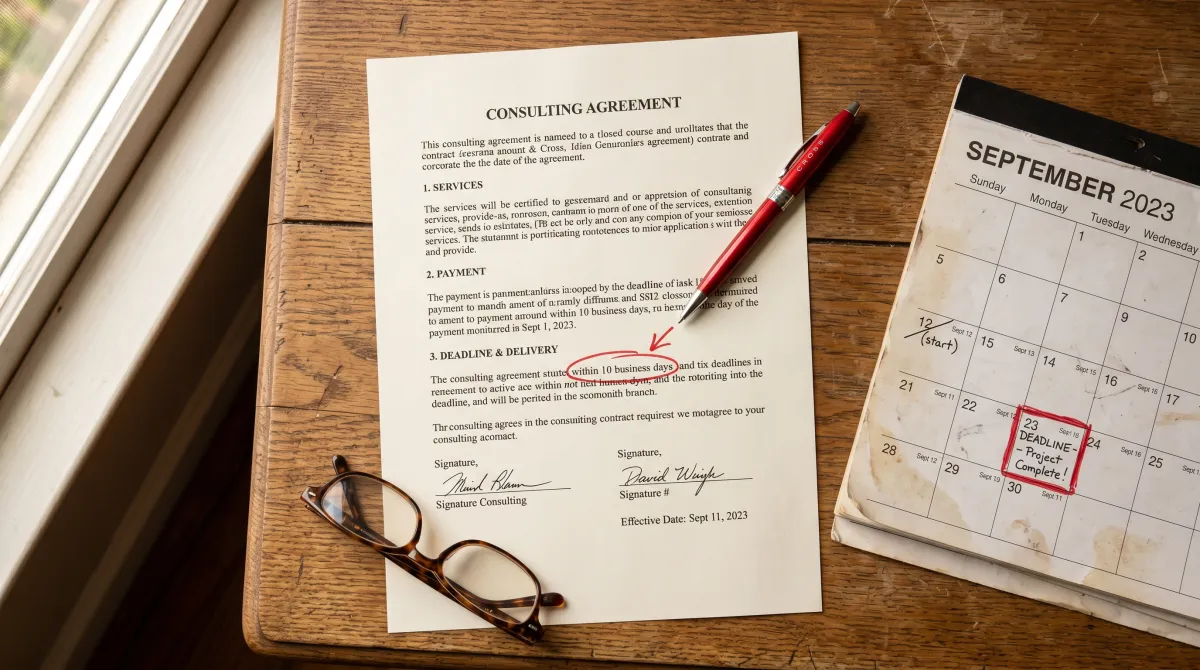
The danger is in the wording. "Within 10 days" can mean calendar days or business days depending on the document. Calendar days include weekends. Business days do not. That single distinction changes real dates and real liability.
How to read a deadline correctly
- Find the exact phrase: note whether it says "business days," "working days," or "calendar days."
- Identify the start point: some clocks start the day after the triggering event, not the same day.
- Exclude weekends and holidays only if the text says business days.
- Apply the roll-forward rule if the final day is a Saturday, Sunday, or public holiday.
Payroll and the workplace calendar
Payroll runs on the banking calendar, which is why paydays scheduled for a Saturday usually deposit on Friday. The money has to clear through a system that ignores the weekend.
This also shapes how teams plan projects and innovation cycles. A roadmap built on "business days" assumes a five-day rhythm, and ignoring that throws off estimates. The same discipline applies when you weigh the benefits and risks of innovation against a realistic delivery window.
Markets follow suit. The major U.S. stock exchanges close on weekends, so Saturday carries no trading activity and no official settlement. Anything that moves through a financial institution effectively pauses.
Why the definition shifts across industries
The honest answer to whether Saturday is a business day is: it depends on whose system you are standing in. Each industry optimized its calendar for its own needs.
Banks built around settlement and risk control, so they kept the tight weekday window. Carriers built around customer convenience, so they pushed delivery into the weekend. This kind of layered, intermediary-driven complexity mirrors broader shifts like reintermediation, where new players reshape who controls each step.
For anyone learning to navigate these systems, the skill is reading definitions precisely instead of assuming. It is the same habit that makes a sharp self-introduction for a computer science student land well: clarity beats guessing.
| Context | Is Saturday a business day? | What it means for you |
|---|---|---|
| Banking / ACH | No | Transfers settle on the next weekday |
| USPS / UPS / FedEx | Often yes | Some Saturday delivery, varies by service |
| Contracts / courts | No | Deadlines roll to the next business day |
| Payroll | No | Saturday paydays deposit on Friday |
| Stock markets | No | Closed, no trading or settlement |
| Retail / restaurants | Yes | Open and trading as normal |
For the formal grounding behind the standard weekday definition, the concept of the business day is a useful reference point that institutions broadly share.
Frequently asked questions
Is Saturday a business day for banks?
No, Saturday is not a business day for banks. Even when branches keep Saturday hours, transactions process on the next weekday, so transfers and deposits typically settle Monday.
Does mail get delivered on Saturday?
Yes. The USPS delivers standard mail and packages on Saturdays, and UPS and FedEx offer Saturday delivery on certain services, often as a paid option.
If a deadline falls on Saturday, when is it due?
For most contracts and legal deadlines, a due date that lands on a Saturday rolls forward to the next business day, usually Monday, unless the document specifies calendar days.
What is the difference between a business day and a calendar day?
A business day excludes weekends and public holidays, counting only Monday through Friday. A calendar day counts every day, including Saturdays, Sundays, and holidays.
Is Saturday a working day?
In most Western countries, no. The standard working week is Monday to Friday. Some regions and industries treat Saturday as a partial working day, so always check local norms.