Business Concepts
Departmentalization By Function: Pros, Cons & When to Use
Departmentalization by function groups staff by skill, like marketing or finance. See its real pros, cons, the silo trap, and when to switch structures.
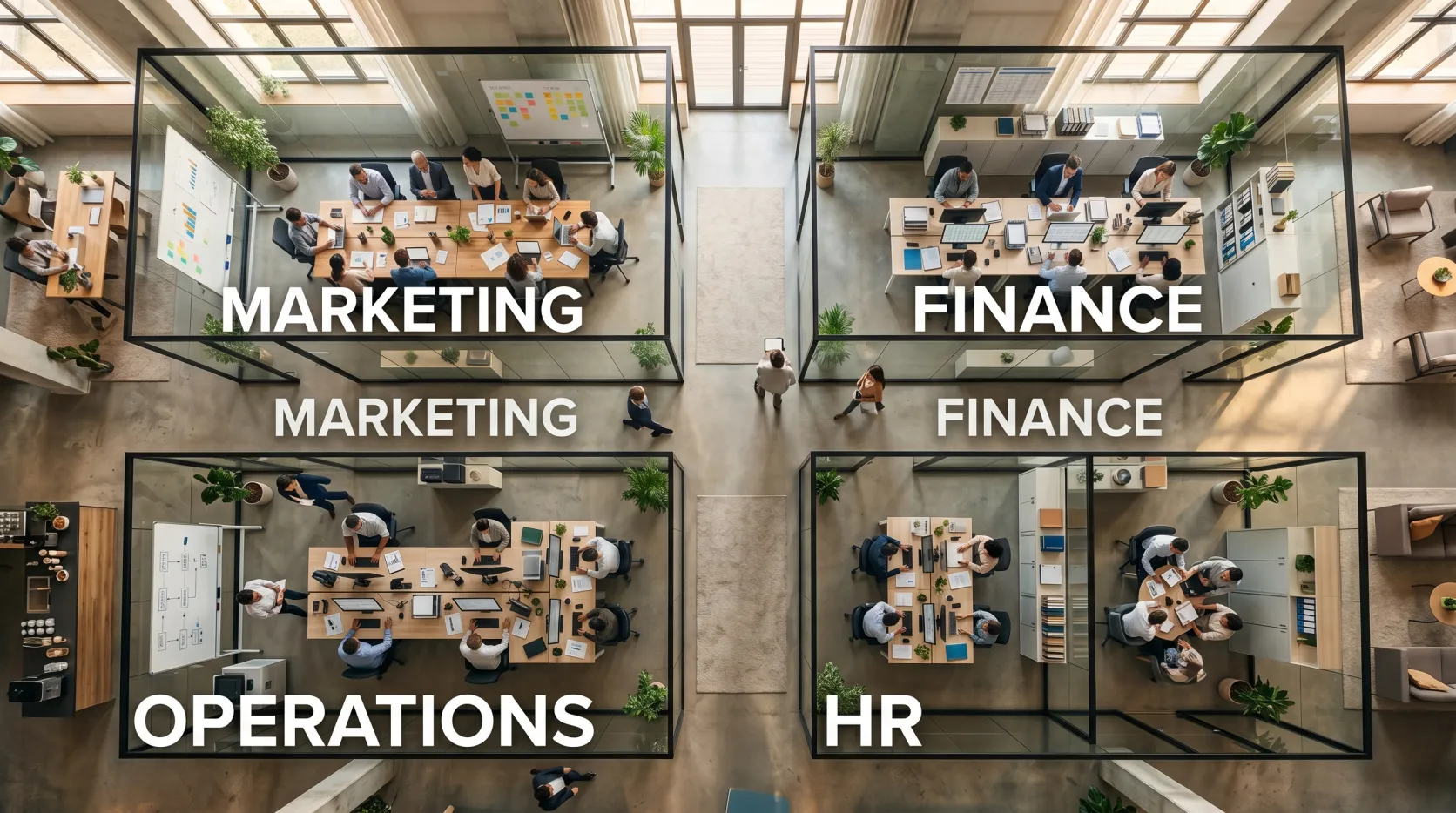
Departmentalization by function groups employees by the specialized work they do, so marketing reports to marketing, finance reports to finance, and operations stays with operations. It is the oldest, most common way to draw an organizational chart, and most companies start here for one simple reason: it matches how people actually build skill.
Quick answer
Departmentalization by function is an organizational structure that groups jobs by the activity they perform, such as marketing, finance, HR, production, and IT. Each department concentrates a single discipline under one manager, which deepens expertise and clarifies reporting lines. It works best for small to mid-size firms with a focused product line, and starts to strain when a company grows across many products, regions, or customer segments.
Key takeaways
- Functional departmentalization groups employees by skill or activity, not by product, region, or customer.
- Its biggest strengths are deep specialization, economies of scale, and clear chains of command.
- Its biggest weakness is the silo: departments optimize for their own goals over the company's.
- It fits focused, single-product organizations far better than sprawling, diversified ones.
- Most large firms eventually blend it with divisional or matrix structures rather than abandon it.
What departmentalization by function actually means
Departmentalization is the process of grouping individual jobs into departments, and the functional approach groups them by the type of work performed. A graphic designer, a copywriter, and a media buyer all land in marketing because their work is variations on one discipline.
This is the default org chart you picture in your head. A CEO at the top, then a row of vice presidents: VP of Sales, VP of Operations, VP of Finance, VP of Human Resources. Each function owns its lane and answers up a single line of authority.
It is one of several bases for grouping work inside an organization. Product structure groups by what you sell, geographic structure groups by where you operate, and customer structure groups by who you serve. Functional structure is organized purely around how the work gets done.

How a functional organizational structure works
In a functional structure, authority flows vertically. Each employee has one manager inside their specialty, and that manager rolls up to a department head who reports to the top executive. The chain of command is clean and unambiguous.
Decisions about a function stay inside that function. Hiring a new accountant, choosing accounting software, and setting payment terms all live with finance. Marketing does not weigh in on the general ledger, and finance does not pick the ad creative.
Coordination between departments happens at the top. When marketing needs a bigger budget, the conversation travels up to the executive who oversees both marketing and finance. That single point of integration is the structure's defining trait, and also its main bottleneck.
A simple example
Picture a mid-size software company with around 200 people. It runs five departments: Engineering, Product, Sales, Marketing, and Finance. Every engineer sits in Engineering regardless of which feature they build, and every salesperson sits in Sales regardless of which customer they close.
This works beautifully while the company sells one core product. The moment it launches a second, very different product line, those shared departments start fighting over priorities, and the cracks in functional structure begin to show.
Functional structure makes you excellent at your craft and clumsy at crossing the hallway.
Advantages of departmentalization by function
The functional model survives because it solves real problems that every organization faces early. Here is where it earns its keep.
- Deep specialization. Putting all the same specialists together builds expertise fast. Engineers learn from engineers, and that compounding skill is hard to replicate when talent is scattered.
- Economies of scale. One centralized department avoids duplication. You run a single payroll team, a single IT helpdesk, and a single procurement function instead of cloning them across the company.
- Clear chain of command. Everyone knows who their manager is and who owns each decision. Reporting lines and accountability are unambiguous.
- Efficient resource use. Shared tools, shared budgets, and shared knowledge inside a function reduce waste and make training easier.
- Career clarity. A junior analyst can see the exact path to senior analyst to manager inside their own discipline.
That clarity starts before anyone is even hired. It shapes how a candidate frames a self-introduction as a computer science student, pitching squarely toward one function rather than a vague generalist role. Specialization plus scale is exactly what you want when you are trying to do one thing extremely well.

Disadvantages and the silo problem
Every strength here has a matching cost. The same walls that concentrate expertise also block the flow of information across the organization.
The headline weakness is the silo effect. Each department optimizes for its own targets, and those targets quietly drift away from the company's overall goal. Sales chases volume, finance guards margin, and the two stop talking until something breaks.
Cross-functional coordination becomes slow because it has to climb the hierarchy. A problem that spans marketing and product cannot be solved between peers, it has to escalate to the one executive who sits above both. That single integration point overloads quickly as the firm grows.
- Slow response to change. Decisions that cross departments get stuck waiting for senior sign-off, which hurts in fast-moving markets.
- Tunnel vision. Specialists see their function, not the customer journey end to end, so accountability for the whole outcome blurs.
- Weak general managers. The structure trains deep specialists, not broad leaders who understand the full business, which creates a succession gap at the top.
- Internal competition. Departments fight over shared budgets and headcount instead of collaborating.
Functional vs. divisional structure
The clearest way to understand functional structure is to set it beside its main alternative. A divisional structure groups by product, region, or customer, with each division running its own mini set of functions.
| Dimension | Functional structure | Divisional structure |
|---|---|---|
| Grouping basis | Specialty (marketing, finance, ops) | Output (product, region, customer) |
| Best for | Single, focused product line | Diversified products or markets |
| Specialization | Very high, deep expertise | Lower, duplicated across divisions |
| Coordination | Slow across functions | Fast within a division |
| Cost efficiency | High, no duplication | Lower, functions are repeated |
| Accountability | By function | By product or market result |
Neither wins outright. The choice depends on how diverse your products and customers are. A focused firm pays a real penalty for divisional duplication, while a diversified one chokes on functional bottlenecks. Most companies do not pick one and stop, they layer approaches as they scale.
When to use departmentalization by function
Choose the functional model when the conditions favor depth over breadth. It is the right default in more cases than people assume.
- Small to mid-size companies where one executive can still coordinate across all functions without drowning.
- A single, dominant product or service where shared departments are not pulled in conflicting directions.
- A stable market where the slow cross-functional response is not a competitive liability.
- Skill-intensive work where deep specialization is the source of your advantage.
Outgrow these conditions and the structure starts working against you. Rapid growth, a second product line, or expansion into new regions are the classic signals to evolve toward a divisional or matrix model. Watch for chronic interdepartmental conflict and decisions that stall for weeks at the executive layer.
A toxic version of these silos can also surface at the individual level, where unclear cross-functional accountability becomes one of the quiet signs you are being set up to fail at work. Structure shapes culture more than most leaders admit.
The hybrid reality: matrix structures
Few large firms run a pure functional chart. The most common evolution is the matrix structure, which overlays project or product teams on top of the functional departments.
In a matrix, an engineer still belongs to Engineering for their craft and career, but also reports to a project lead for the duration of a build. You keep the deep specialization of functional grouping while adding the cross-functional speed of a divisional one.
The cost is dual reporting. Two managers, two sets of priorities, and the classic confusion over who has the final say. Matrix structures demand mature managers and clear rules of engagement, or they collapse into politics.
The same disruptive forces that reshape org charts also reshape entire value chains, the way that reintermediation redraws who sits between a company and its customers. Structure is never settled for long.
That instability is usually healthy. Reorganizing to match new products or markets is one of the everyday benefits and risks of innovation that push firms to keep redrawing their own charts.
Related guides
Frequently asked questions
What is departmentalization by function?
It is grouping employees by the type of work they do, such as marketing, finance, operations, and HR. Each department concentrates one discipline under a single manager, which builds deep expertise and creates a clear chain of command.
What is an example of functional departmentalization?
A manufacturing company split into Production, Sales, Finance, and Human Resources departments is a textbook example. Every employee sits in the department that matches their specialty, regardless of which product they touch.
What are the main advantages of functional structure?
Deep specialization, economies of scale from centralized departments, efficient use of shared resources, and an unambiguous reporting line. It is especially strong for focused companies built around a single product or service.
What is the biggest disadvantage of departmentalization by function?
The silo effect. Departments optimize for their own goals instead of the company's, cross-functional coordination slows down, and decisions that span functions get stuck waiting for senior leadership to resolve them.
When should a company switch away from functional structure?
When it adds a second major product line, expands into multiple regions, or grows too large for one executive to coordinate every function. These are the signals to move toward a divisional or matrix structure.
Further reading: Departmentalization (Wikipedia) and Organizational structure (Wikipedia).