Business Concepts
10 Year Treasury Yield Explained (2026): Why It Moves
The 10 year treasury yield prices mortgages, business loans, and stocks. Learn what drives it, why prices move inversely, and how to read it like an operator.

The 10 year treasury yield is the single number that quietly prices most of the economy. Mortgages, business loans, and stock valuations all take their cue from it. If you only watch one rate, watch this one.
Quick answer
The 10 year treasury yield is the annual return investors earn on a U.S. government bond that matures in ten years. It rises when investors expect stronger growth or higher inflation, and falls when they want safety. Because it is the benchmark for long-term borrowing, it shapes the cost of mortgages, corporate debt, and almost everything priced off "risk-free" money.
Key takeaways
- The yield moves inversely to bond prices: when prices rise, yields fall.
- It reflects the market's combined bet on growth, inflation, and Federal Reserve policy.
- It sets the floor for mortgage rates and corporate borrowing costs.
- A falling yield often signals fear; a rising one usually signals optimism or inflation worry.
- The gap between the 10 year and 2 year yield is a classic recession signal.
What the 10 year treasury yield actually measures
When the U.S. government needs money, it sells bonds. A 10 year Treasury note is a loan you make to the government that gets repaid in a decade, with interest paid along the way. The yield is your effective annual return on that loan.
The Treasury sets a fixed coupon, but the bond then trades on the open market. As investors buy and sell, the price moves. This benchmark sits among the foundational business concepts that anyone making capital decisions should understand cold.
This is why people say it is "risk-free" in nominal terms. The U.S. Treasury has never missed a payment, so the yield is treated as the baseline cost of money before any other risk gets stacked on top.
Why the yield and the price move in opposite directions
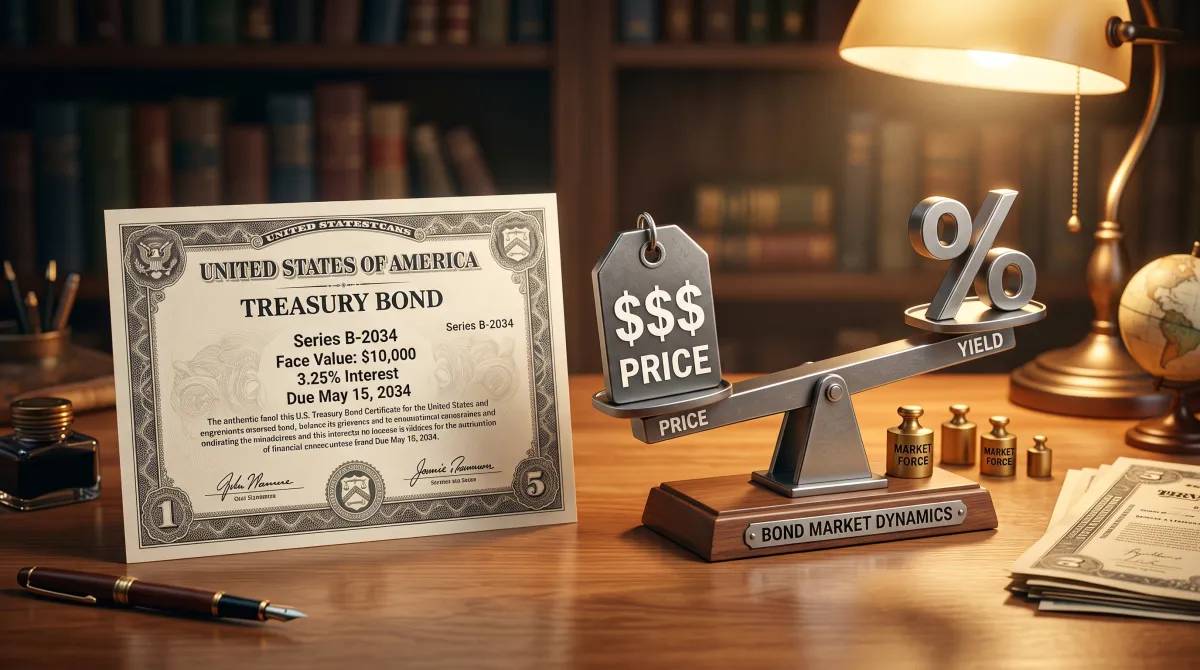
This trips up most beginners, so here is the plain version. The coupon payment is fixed in dollars. If demand for the bond pushes its price up, those same fixed dollars now represent a smaller percentage return. Yield falls.
Flip it around. If investors dump bonds and the price drops, the fixed payment becomes a bigger slice of a cheaper bond. Yield rises. Price up, yield down. Price down, yield up. That inverse relationship never breaks.
When everyone runs to safety, they bid up Treasuries and crush the yield. The yield is fear and greed expressed as a percentage.
So a falling 10 year yield often means money is hiding in safety. A rising yield usually means investors feel confident enough to chase higher returns elsewhere, or they are bracing for inflation.
What moves the 10 year treasury yield
No single lever controls it. The yield is a live vote on the future, and a handful of forces dominate that vote.
| Driver | Effect on yield | Why |
|---|---|---|
| Inflation expectations | Push it up | Investors demand more return to offset eroding purchasing power. |
| Federal Reserve policy | Both directions | Rate hikes and balance-sheet moves ripple into long-term yields. |
| Economic growth | Push it up | Strong growth pulls money out of bonds into riskier assets. |
| Flight to safety | Push it down | Crises send money into Treasuries, lifting prices. |
| Government supply | Push it up | More bond issuance can require higher yields to find buyers. |
The Federal Reserve sets short-term rates directly, but the 10 year yield is set by the market. The Fed influences it, yet never fully controls it. That tension is where most of the daily volatility lives.
This is also why the yield is treated as a real-time economic mood ring. The market reprices it every second of every trading day, folding fresh data into one clean number.
Why it matters for your mortgage and your business
Here is where it stops being abstract. Long-term loans get priced off the 10 year yield, not the Fed's overnight rate. When the yield climbs, the cost of borrowing for a decade climbs with it.
Fixed mortgage rates track the 10 year yield closely. A jump of half a percentage point in the yield can add real money to a monthly payment. Homebuyers feel the yield even if they have never heard of it.

Businesses feel it too. Corporate bonds price at a spread above the Treasury yield, so a rising benchmark makes expansion debt more expensive. That can quietly reshape hiring plans, and sometimes it is one of the early warning signs that a company is under financial strain.
Stock valuations lean on it as well. Higher yields raise the bar that risky investments must clear, which is why growth stocks often wobble when the yield spikes. The yield is the gravity that pulls on every other asset price.
The yield curve and the recession signal
Compare the 10 year yield to the 2 year yield and you get the yield curve. Normally the 10 year pays more, because lending money for longer carries more uncertainty. That upward slope is the healthy default.
When the curve inverts, the 2 year pays more than the 10 year, something is off. An inversion has preceded most U.S. recessions, making it one of the most watched signals in finance. It tells you the market expects rates, and growth, to fall ahead.
Watching how money flows between maturities is a kind of structural shift, similar to how market intermediaries can re-emerge and reshape an industry once conditions change. The plumbing matters more than the headline.
How to read the yield like an operator
Do not obsess over the daily number. Watch the trend and the speed. A slow drift is the market digesting news. A violent move in days is the market repricing risk, and that is when to pay attention.
Pair the yield with context. Is it rising because growth is strong, or because inflation fear is spiking? Same direction, very different meaning. The story behind the move beats the move itself.
Treat the yield as a stress test on your own assumptions. Cheap money makes bold bets look smart, so weigh the genuine trade-offs between ambitious investment and prudent risk when rates shift under you.
Frequently asked questions
Is a high 10 year treasury yield good or bad?
It depends on who you are. A higher yield is good for savers and bond buyers seeking income, but bad for borrowers, since it raises mortgage and loan costs. For the broader economy it usually signals confidence or inflation pressure.
What is the difference between the yield and the interest rate?
The coupon is the fixed interest rate set when the bond is issued. The yield is the actual return based on the bond's current market price, which changes constantly as the bond trades.
Why do mortgage rates follow the 10 year treasury yield?
Mortgages are long-term loans, and lenders price them against the safest long-term benchmark available. The 10 year yield is that benchmark, so mortgage rates move in step, plus a spread for risk and profit.
Who sets the 10 year treasury yield?
The open market sets it. The U.S. Treasury auctions the bonds, but investors buying and selling them every day determine the price, and therefore the yield. The Federal Reserve influences it but does not set it directly.
What does an inverted yield curve mean?
It means short-term yields are higher than long-term yields, which is unusual. Historically this has often preceded recessions, because it signals the market expects slower growth and lower rates ahead.