Business Concepts
1 Minute Self Introduction Sample: 4 Scripts That Land
A 1 minute self introduction sample for interviews, networking, meetings, and class. Four-beat scripts to copy, adapt, and rehearse. See which fits your room.

A strong 1 minute self introduction sample does one job: it tells people who you are, why you matter to them, and what you want, before their attention drifts. Sixty seconds is roughly 130 to 150 spoken words. That is enough for a sharp pitch and nothing more.
I have coached people through job interviews, networking rooms, and first-day team meetings. The ones who land it never wing it. They use a repeatable structure and rehearse it out loud.
Quick answer
A 1 minute self introduction follows four beats: name and role, one relevant strength with proof, what you are working toward, and a hook back to the listener. Keep it to 130 to 150 words and end with energy, not a trail-off.
Key takeaways
- Sixty seconds equals about 130 to 150 spoken words. Write to that ceiling.
- Use the four-beat formula: identity, strength with proof, goal, hook.
- Match the version to the room: interview, networking, meeting, or classroom.
- Lead with one concrete result, not a list of adjectives.
- Rehearse out loud and time it. Reading silently hides the lumps.
Why a 1 minute self introduction matters
First impressions form fast, and people decide whether to keep listening within the opening seconds. A rambling intro signals that you have not thought about your audience. A tight one signals competence before you have proven anything.
Psychologists call this snap judgment the first impression effect, and it sticks harder than most people expect. The minute also forces clarity. If you cannot explain who you are and why it matters in sixty seconds, the message is still half-baked.
The constraint is the feature, not the bug. Need a longer format for a presentation or class? Our 3 minute self introduction speech examples stretch the same beats without padding.
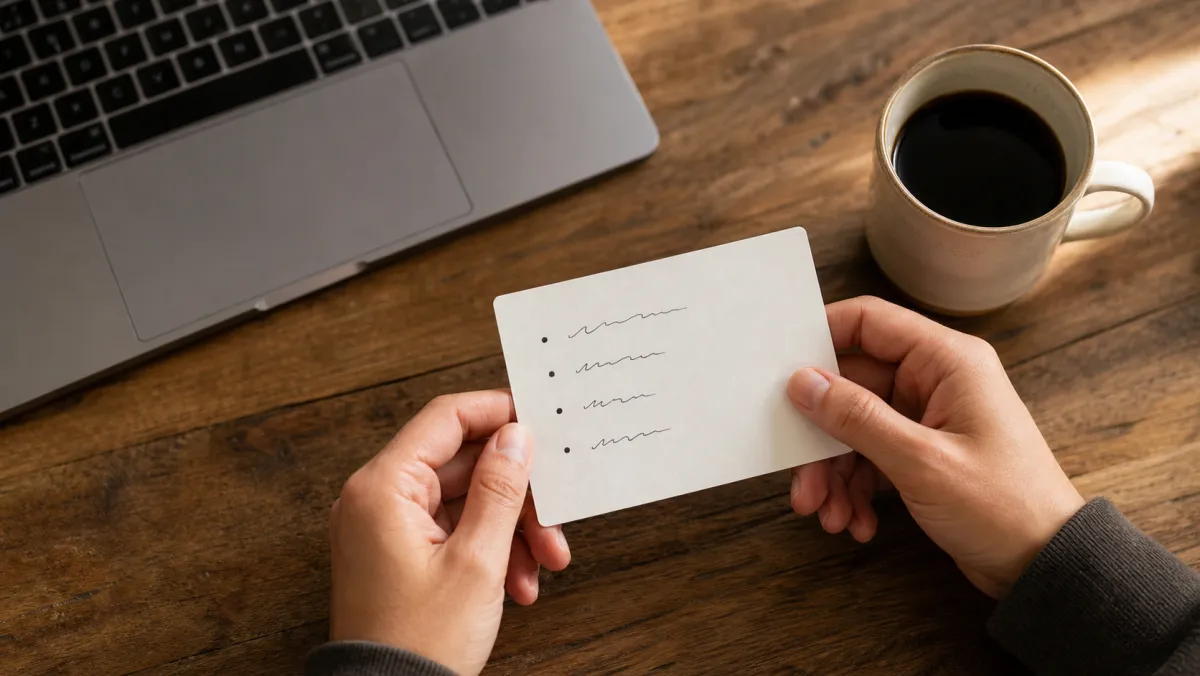
The four-beat formula for any 1 minute self introduction sample
Every script below uses the same skeleton. Learn the beats once and you can adapt on the spot without memorizing a wall of text.
Beat 1: Identity
State your name and current role or status in one line. No throat-clearing. Skip "Well, um, so basically" and open clean.
Beat 2: Strength with proof
Name one strength that fits this room, then back it with a number or a concrete result. "I am detail-oriented" is weak. "I cut our reporting errors by 30 percent in a quarter" lands.
Beat 3: Goal
Say what you are working toward right now. A goal makes you a person with direction, which is far more memorable than a résumé read aloud.
Beat 4: Hook back to the listener
Close with a question or a bridge to them. This turns a monologue into the start of a conversation and keeps the energy up at the finish line.
Sixty seconds is not a summary of your life. It is one clear reason for the listener to keep paying attention.
1 minute self introduction sample for a job interview
This is the most common version people ask for. Lead with the role you are targeting, then prove fit fast. It is the spoken cousin of an elevator pitch, just warmer and built for a conversation.
| Beat | What to say |
|---|---|
| Identity | Name plus your professional one-liner. |
| Strength + proof | One skill tied to the job, backed by a result. |
| Goal | Why this role, in one honest sentence. |
| Hook | Signal readiness for the next question. |
Word-for-word: "Hi, I'm Maya Chen, a marketing analyst with five years in B2B SaaS. In my last role, I rebuilt our lead-scoring model and lifted qualified pipeline by 22 percent in six months. I'm drawn to this position because it pairs analytics with strategy, which is exactly where I do my best work. I'd love to walk you through how I'd approach your first 90 days."
That runs about 60 seconds at a calm pace. Notice there is one number, one clear motive, and a forward hook. No filler.

1 minute self introduction sample for networking events
Here the goal is memorability, not a job offer. People meet many strangers in an hour, so give them one hook they will repeat later.
Word-for-word: "I'm Devon, and I help small e-commerce brands stop losing money on returns. Last year I helped a footwear shop cut returns by a third just by fixing their sizing guide. Right now I'm looking to connect with founders scaling past their first warehouse. What's the biggest operations headache on your plate?"
The closing question does the heavy lifting. It hands the conversation to the other person and makes you the one who started something useful.
1 minute self introduction sample for a team meeting
New on a team? Skip the full career history. People want to know how you fit and how to work with you.
Word-for-word: "Hi everyone, I'm Priya, joining as your new product designer. I spent the last three years on fintech apps, mostly untangling messy checkout flows. I'm here to make our onboarding feel obvious, and I learn fastest by shadowing, so expect me to ask a lot of questions this week. Where should I start to be most useful?"
This version trades polish for warmth. It tells the room you are a teammate, not a performer.
1 minute self introduction sample for students
In class, an internship interview, or an orientation, students often over-explain. Anchor on what you study, one project you are proud of, and where you are headed.
Word-for-word: "I'm Sam, a third-year computer science student. This semester I built a small app that helps classmates split shared expenses, and watching real people use it hooked me on building software. I'm aiming for a back-end internship this summer to get production experience. I'd love tips on how you broke into the field."
If you are headed into tech specifically, our guide on a self introduction for a computer science student goes deeper on framing technical projects for non-technical interviewers.
Common mistakes that waste your minute
- Listing adjectives. "Hardworking, passionate, dedicated" says nothing. Show one result instead.
- Reading your résumé aloud. The minute is a hook, not a transcript.
- No goal. Without direction you sound like a fact sheet, not a person.
- Trailing off. Mumbling "yeah, so, that's me" undoes a strong open. End with a clear hook.
- Speaking too fast. Cramming 220 words into the minute reads as nervous. Aim for 140 and breathe.
Reading the room matters too. Confident framing is not the same as overselling, and there is a real line between healthy self-promotion and the warning signs you are being set up to fail at work. Know your value, but also read whether the room is actually rooting for you.
How to rehearse so it sounds natural
Memorizing word-for-word makes you robotic. Memorize the four beats and one proof point, then let the wording flex. Practice out loud, record it once, and time it. The mouth catches lumps the eye skips.
Do three passes. First pass, get the beats in order. Second, trim every word that does not earn its place. Third, run it at conversational speed and confirm you land near 60 seconds.
Strong communication is a thread that runs through most career skills, the same way clear thinking shapes the benefits and risks of innovation on any team. The habit you build here pays off in pitches, reviews, and pretty much every meeting.
Curious how middlemen sometimes re-enter a supply chain after being cut out? See our breakdown of reintermediation for a related business concept worth knowing.
Related guides
Frequently asked questions
How many words is a 1 minute self introduction?
About 130 to 150 words. The average speaking pace is roughly 130 to 150 words per minute, so writing to that ceiling keeps you on time without rushing.
How do I start a 1 minute self introduction?
Start with your name and current role in one clean line, with no filler. For example, "I'm Maya Chen, a marketing analyst," then move straight into your strength and proof.
What should I avoid in a self introduction?
Avoid listing vague adjectives, reading your résumé aloud, speaking too fast, and trailing off at the end. Lead with one concrete result and finish with a clear hook back to the listener.
Can I use the same self introduction everywhere?
Keep the four-beat structure the same, but swap the strength and goal to match the room. A job interview, a networking event, and a team meeting each reward a slightly different emphasis.
How do I make my self introduction memorable?
Give the listener one specific hook, usually a result with a number, and close with a question. People remember a single sharp detail far better than a polished list.