Workplace & Career
Performance Improvement Plan: PIP Template & 5 Steps (2026)
A performance improvement plan (PIP) sets measurable goals on a timeline plus the support to help an employee improve. Get the 5 steps and a PIP template.

Performance Improvement Plan
A performance improvement plan is the document everyone misreads. Managers treat it as a paper trail to a firing. Employees read it as a death sentence. Both are wrong when the plan is built well, and both are right when it is built lazily. This guide shows you the version that actually moves performance.
Quick answer
A performance improvement plan (PIP) is a structured plan that names a specific performance issue, sets measurable goals with a timeline, and lists the support an employee gets to improve. Done right it is a roadmap for improvement, not a disciplinary action disguised as one. Most run 30, 60, or 90 days.
Key takeaways
- A PIP is a performance management tool, not an automatic step toward termination.
- Every PIP needs measurable, time-bound goals so the employee understands what success looks like.
- The 5 steps: diagnose the root cause, set SMART goals, list resources, run regular check-ins, then review the plan.
- Deliver a PIP in a calm pip meeting, not by email, and keep feedback clear and constructive.
- Use a PIP template so the structure stays consistent and defensible across your team.
What Is a Performance Improvement Plan?
The simplest performance improvement plan definition: a formal document that spells out specific performance issues, the expectations for improvement, and a deadline to meet them. It turns a vague feeling that someone is underperforming into an action plan with milestones. The whole point is to make employee performance measurable instead of a matter of opinion.
A PIP at work sits inside normal performance management, alongside performance reviews and one-on-ones. These workplace fundamentals matter, because a PIP is more formal than a quiet word and less final than termination. Reach for it when ongoing performance issues have not closed after regular feedback.
Used early, a PIP can lift an employee's performance before the situation hardens. The aim is to improve performance while there is still goodwill on both sides. Wait too long and even a fair plan reads as a formality. Timing is part of whether the employee can improve at all.
Is a PIP a disciplinary action? Not inherently. A good PIP is about employee growth and effective performance, not punishment. But in companies that only deploy them right before firing someone, the formal PIP becomes a ritual. That reputation is earned by bad practice, not by the tool itself.
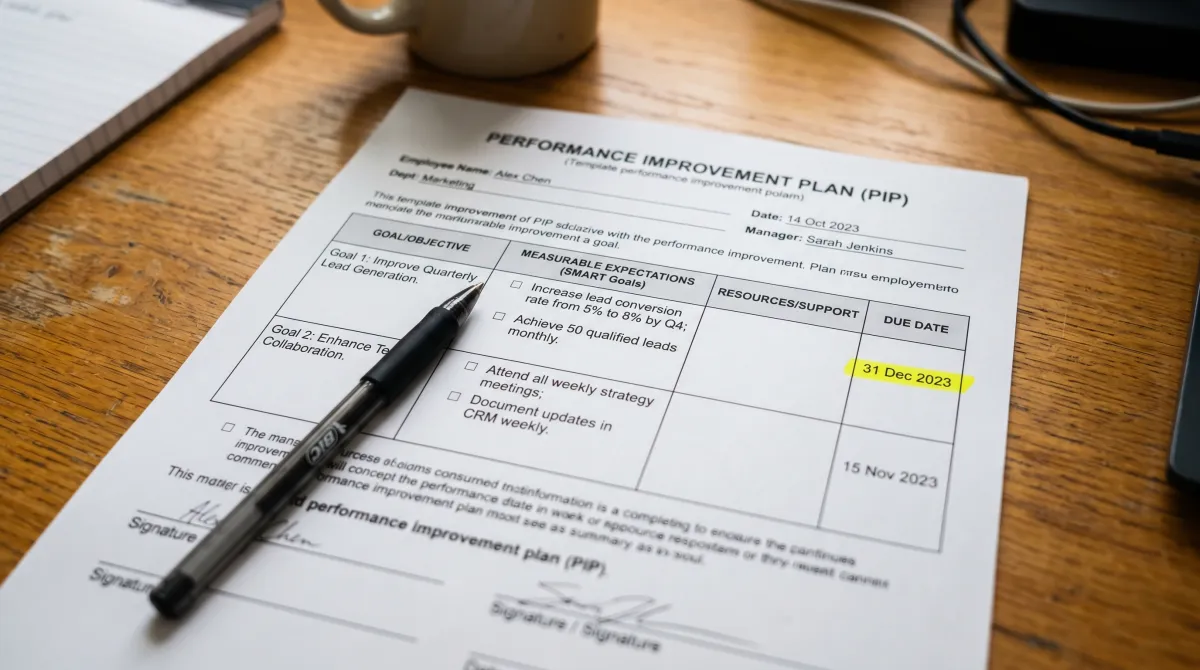
The honest distinction: a disciplinary action documents misconduct. A performance plan documents a capability or output gap and tries to close it. If you mix the two, you confuse the employee and weaken your own paperwork. Keep conduct issues in a separate process.
The trigger is usually clear. The employee is not meeting expectations, the gap is affecting performance on real work, and earlier feedback has not moved performance levels. At that point a structured plan gives both sides a fair, written shot at fixing it before harder decisions arrive.
A PIP that cannot describe what success looks like is not a plan. It is a countdown.
What to Include in a Performance Improvement Plan (PIP Template)
The fastest way to wreck a PIP is to write goals nobody can measure. "Improve communication" is not a goal. "Send a written project update every Friday by 3pm for the next 60 days" is. The second one tells the employee exactly when they have met expectations.
Here is what to include in a performance improvement plan, and what a usable performance improvement plan template covers field by field. These are the sections to include in a PIP every time.
| Section | What goes here | Why it matters |
|---|---|---|
| Specific performance issues | The concrete gap, with examples and dates | Vague issues cannot be fixed or measured |
| Measurable goals | SMART goals: specific, measurable, achievable, relevant, time-bound | The employee understands the target |
| Timeline and milestones | Start date, milestone dates, final deadline | Turns the plan into a roadmap for improvement |
| Resources and support | Additional training, mentorship, coaching, tools | Shows you want the employee to improve, not just to fail |
| Check-in schedule | Weekly or biweekly regular check-ins | No surprises at the final review |
| Action steps | The concrete moves the employee will make each week | Goals without action steps are just wishes |
| Next steps and outcomes | What happens if goals are met, partially met, or missed | Removes ambiguity about consequences |
Goals are the spine. They have to be achievable and attainable, not a stretch designed to fail. If the goals are realistic and tied to the real performance gaps you observed, the plan reads as fair. If the bar is set where a strong performer would struggle, any HR partner will tell you that is a problem.
Spell out what success looks like in numbers, not adjectives. The employee should understand what success looks like on day one and be able to track it themselves. That clarity is what lets the employee improve instead of guessing at a moving target.
A ready-made PIP template you can copy saves you from reinventing this every time and keeps documentation consistent across managers. Consistency is what makes the process defensible later.
The 5-Step Performance Improvement Plan Process
The PIP process is where most plans live or die. Five steps, in order. Skip the first and the rest collapse. Used well, these five steps help employees improve rather than just papering a file.
Step 1: Find the root cause. Before you write a single goal, work out why performance is slipping. Is it skill, clarity, workload, tooling, or motivation? A reassignment or a piece of additional training fixes some of these faster than any plan does. If the role itself is wrong, no PIP will save it.

Step 2: Set measurable, time-bound goals. Translate the performance concerns into SMART goals with clear deadlines. Two to four goals is the sweet spot. More than that and the employee cannot focus, and you cannot fairly track progress against the goals.
Step 3: List the resources available. Name the support the employee gets: performance coaching, mentorship, training or coaching sessions, shadowing, or a revised workload. This line separates a genuine plan from a paper trail. The point is to help the employee improve, not just to watch.
Step 4: Run regular check-ins throughout the process. Weekly or biweekly. The manager and employee review progress against milestones, adjust where the employee needs help, and document what happened. Regular performance conversations mean the final meeting holds no surprises for anyone.
Step 5: Review the plan at the deadline. At the end you review the PIP against the goals. Meeting the goals? Close it and keep coaching. Real but incomplete progress? You can extend the plan. No movement? Then next steps may include reassignment or termination, but only after a fair, documented effort.
Most plans run 30, 60, or 90 days. Ninety days is common for senior or complex roles because skill rebuilds take time. Thirty days fits a narrow, concrete fix where the change needed to improve is obvious. Match the length to the gap, not to a calendar habit.
How to Deliver a PIP: The PIP Meeting
You can write a flawless plan and still ruin it in the room. The pip meeting sets the tone for everything that follows, so treat it as a conversation, not a verdict. The goal is to help employees understand expectations, not to ambush them.
Meet with the employee in person, or on video for remote teams, never via a cold email attachment. Walk through each section. Confirm the employee understands the goals, the timeline, and the support on offer. The aim is that the employee understands what success looks like before they leave the room.
Keep your feedback clear and constructive. Address the issue, not the person. "These three deliverables missed deadline" lands better than "you are unreliable." Specific, behavioral, evidence-based language is what makes the plan fair and what makes the employee able to act on it.
Expect emotion. Being put on a PIP is stressful, and pretending otherwise helps no one. Give space for questions, agree on the first check-in date, and end with a genuine statement that you want them to succeed. Strong management practices show up most clearly in hard conversations like this one.
PIP vs Probation and Disciplinary Action
People confuse three things: a PIP, a probation period, and discipline. A probation period is the trial window for a new hire, before they are fully confirmed in the role. A PIP usually applies to an existing employee whose performance has dropped after they were already established.
Disciplinary action is for conduct: lateness, policy breaches, behavior. A PIP is for capability and output. The cleanest way to keep your HR policy defensible is to never blur them. If you fold poor performance and misconduct into one document, you give the employee a fair reason to challenge it.
This maps neatly onto standard performance appraisal and human resources frameworks, so most HR teams will recognise the structure. When you use a performance improvement plan inside that framework, you stay on solid ground.
When a PIP Works, and When It Does Not
A PIP can help when the gap is real, specific, and fixable, and when the employee is willing to engage. Plenty of people use a performance improvement plan as a genuine reset and come out stronger. That outcome is common enough that writing every PIP off as a firing is simply wrong.
Be honest about which parts of the employee's performance actually need improvement. A plan that flags everything dilutes focus and tells the employee nothing useful. Name the one or two areas that matter most, set the bar there, and let the smaller stuff go for now.
It fails predictably in three cases. When the goals are unrealistic. When no resources are offered. And when the manager has already decided and is just building a file. Employees can smell that last one, and it poisons trust across the whole team, not just with one person.
There is also a quieter use that gets ignored. Sometimes the right answer is not improvement but fit. A reassignment to a role that matches the person's strengths can solve a performance issue that no amount of coaching would. Good leadership treats the PIP as one option among several, not the only lever.
For the employee on the receiving end, the same logic applies in reverse. Engage seriously, document your own progress, and ask for what you need. We cover that playbook in how to respond to a PIP, including the conversations that decide the outcome.
The question everyone really wants answered is whether the plan is a quiet exit. The honest take lives in does a PIP mean you are getting fired, and the short version is: not if the goals are real and the effort is genuine on both sides.
Common Mistakes That Sink a PIP
The same errors show up again and again. Avoid these and you are ahead of most managers who deliver a PIP without a roadmap for improvement.
- Goals you cannot measure. If you cannot tell whether the goal was met from the data, it is not a goal. Make every target time-bound and countable.
- No support. Listing problems without listing resources signals you want the employee to fail. Name the training, mentorship, and coaching that will help employees improve.
- Surprise at the deadline. If the final review is the first time the employee hears how badly it is going, your check-ins failed. Regular performance feedback removes surprises.
- Mixing conduct and capability. Keep discipline and performance in separate processes, always.
- Deciding before you start. A PIP run as theatre wastes everyone's time and damages the team's trust in you.
Get those right and the plan does its real job: it tells the employee exactly what is needed to improve, gives them the means, and gives you a fair, documented basis for whatever comes next.
FAQ
What is a performance improvement plan?
A performance improvement plan is a formal document that names a specific performance issue, sets measurable and time-bound goals, lists the support an employee receives, and gives a deadline to meet expectations. It is a structured plan to help the employee improve, not an automatic disciplinary action.
What does a performance improvement plan mean for me?
It means your manager has documented specific performance concerns and is giving you a defined window, often 30, 60, or 90 days, plus resources to close the gap. It is serious, but it is also an opportunity for improvement with a clear target, not a guaranteed exit.
How long does a performance improvement plan last?
Most last 30, 60, or 90 days. The length should match the size of the performance gap. A narrow, concrete issue fits a 30-day plan, while a complex skill rebuild often needs 90 days. Managers can extend the plan if there is real but incomplete progress.
Is a PIP a disciplinary action?
Not by default. A well-built PIP is a performance management tool focused on helping the employee improve. It only resembles disciplinary action when companies use it purely as a paper trail before termination. Conduct issues should be handled in a separate disciplinary process.
Does a PIP lead to termination?
Sometimes, but not always. If the employee meets the goals, the plan closes and they continue. If there is no progress after a fair, documented effort with real support, next steps can include reassignment or termination. The outcome depends on the work, not the document.