Workplace & Career
Labeling 2 2 Reference Manual Answers (2026)
See what labeling 2 2 reference manual answers actually tests, the four worksheet fields, common mistakes, and a model example to check your work.

If you searched labeling 2 2 reference manual answers, you are looking at a worksheet that asks you to label the parts of a job reference document, and you want to check your work. This guide explains exactly what the exercise tests and gives you a framework that holds up no matter which textbook assigned it.
Different classrooms use different books, so no single published answer key covers every version of labeling 2-2: reference manual answers. What stays constant is the concept: labeling the parts of a reference section and understanding the field behind each label.
Quick answer
Labeling 2 2 reference manual answers refers to a career-readiness worksheet, numbered Unit 2 Lesson 2, that has students label the parts of a job reference section: reference type, capacity, contact details, and duration known. There is no universal answer key, but every version tests the same four ideas.
Key takeaways
- No single official answer key exists; curricula vary, but the underlying concepts do not.
- The worksheet tests four fields: reference type, capacity, contact info, and duration known.
- Capacity means your role relative to the applicant, not your opinion of them.
- References split into three groups: professional, academic, and personal.
- A correct label names a role, a setting, and a timeframe in one line.
What Is Labeling 2 2 Reference Manual Answers?
Labeling 2 2 reference manual answers means the correct responses to a Unit 2, Lesson 2 classroom activity that teaches students to read a job reference manual or reference section on an application. Most versions cover reference types, the capacity field, and the contact details a reference must provide.
The "2-2" numbering is a standard convention in career-readiness and Family and Consumer Sciences (FACS) curricula, where the first digit marks the unit and the second marks the lesson. These courses typically sit inside the National Career Clusters Framework, which groups career-readiness coursework into 16 nationally recognized clusters, according to Advance CTE. A worksheet labeled 2-2 usually sits early in a workplace-readiness unit on job applications, right after students cover what a resume includes.
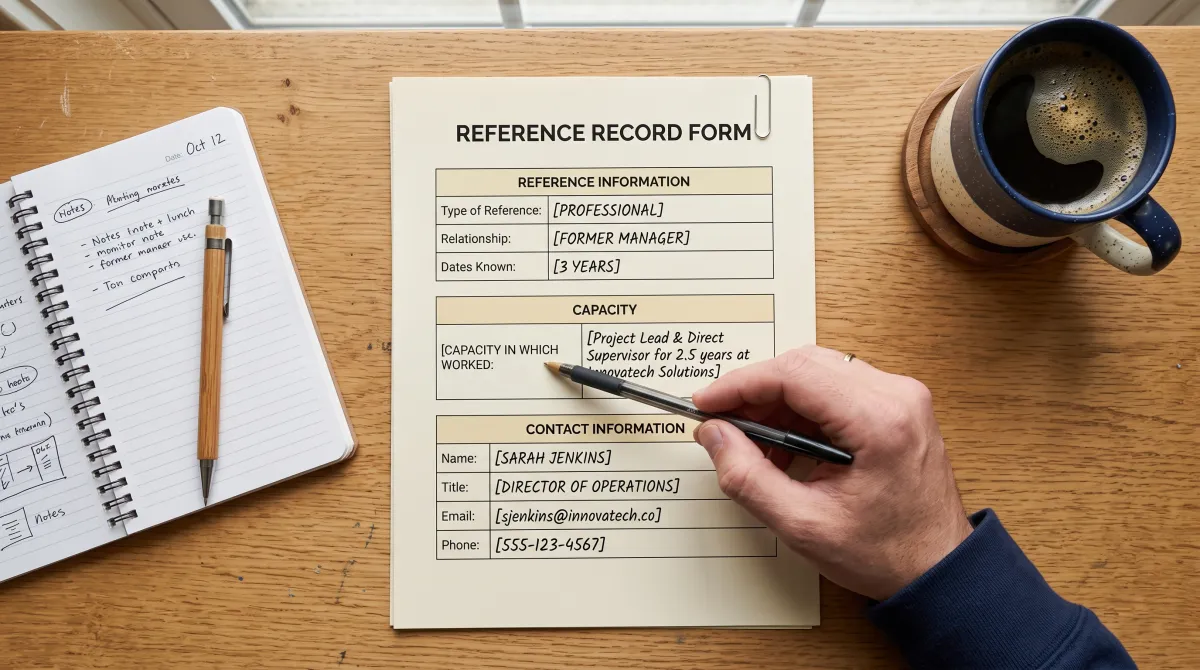
Labeling 2 2 Reference Manual Answers Explained
The core skill behind labeling 2-2 reference manual answers is reading a reference form the way an employer does. Every reference manual, whether a printed workbook page or an online application, breaks a reference entry into the same handful of parts.
Those parts are the reference's name, job title, employer, contact information, and the capacity in which they know the applicant. Capacity is the field students mislabel most, because it sounds abstract even though it asks something simple: what was your role when you knew this person?
The reference capacity meaning is not about character or friendship. It is asking which lens the reference is speaking from: manager, professor, coworker, or client. Each lens tells an employer how much weight to give the answer, the same logic our guide on answering in what capacity you know the candidate walks through for real applications.
The word itself has a plain origin. Capacity comes from the Latin capax, meaning "able to hold," according to Merriam-Webster. On a reference form, it asks what role you were able to hold relative to the applicant.
CareerOneStop, the career site funded by the U.S. Department of Labor, sorts job references into three categories: professional, academic, and personal, a framework most career-readiness curricula borrow directly.
A correctly labeled worksheet keeps those three groups separate. A professional reference is a supervisor, manager, or client. An academic reference is a teacher, professor, or advisor. A personal reference is a neighbor, coach, or family friend, used only when the other two are unavailable.
Paper workbooks and online application forms ask for the same information in a different order. A printed reference manual usually lists fields top to bottom; a digital form often splits them across tabs. Either format, the labeling logic does not change.
Common Mistakes on the Labeling 2-2 Worksheet
Students lose points on this exercise in the same few spots every time. Check your own labels against this list before you submit.
- Writing "friend" or "family" in the capacity field when a professional or academic reference was required.
- Leaving duration blank, when most reference manuals ask how long you have known the person.
- Mixing up "reference" (the person vouching for you) with "referral" (a recommendation toward an opportunity), a common labeling trap.
- Listing a title with no setting, such as "manager" with no company or team named.
Labeling 2 2 Reference Manual Answers Examples
Use this table as a model. It pairs a worksheet field with what it is actually testing and a correctly labeled example.
| Field on the worksheet | What it is testing | Correctly labeled example |
|---|---|---|
| Reference type | Professional, academic, or personal | Professional |
| Capacity | Your role when you knew the applicant | "Direct supervisor for two years" |
| Contact information | How the employer verifies the reference | Work phone and email, not a personal cell |
| Duration known | How long the relationship lasted | "2023 to 2025" |
| Consent line | Whether the reference agreed to be listed | "Permission confirmed before submission" |
Every correct answer names a role, a setting, and a timeframe, the same three-part structure recruiters expect when they actually call a reference.

A reference manual is not testing your memory. It is testing whether you can tell a real professional relationship from a favor.
How to Apply Labeling 2 2 Reference Manual Answers
Once you understand the categories, applying them to your own reference list is straightforward. CareerOneStop, the career site funded by the U.S. Department of Labor, recommends listing two to three references for most applications, a range that verifies recent experience without overloading a hiring manager's calls.
For each person, write their capacity the way the worksheet expects: role, setting, duration. "Store manager at Target, 2022 to 2024" tells an employer more than "boss."
If you are unsure who to put down as references for jobs, prioritize a direct supervisor, a professor who graded your work closely, or a client who saw your output firsthand. Confirm the role and timeframe with each person before you list them, so the capacity field matches what they will say if called.
Never list anyone before asking them. An unprepared reference who gets caught off guard can hurt an application more than a missing reference ever would.
Keep the list current. A supervisor from a job you left five years ago carries less weight than someone who saw your most recent work, so refresh the list before each application cycle.
The same capacity language shows up outside job applications too. Readers navigating tension with a jealous coworker will recognize how a stated role changes how a claim gets read.
The same is true for anyone watching for signs a boss is grooming them for promotion: capacity language shapes how those signals get interpreted too.
When you write a reference for someone else instead of listing your own, the structure repeats. Our Letter of Recommendation format and template guide walks through the same three parts, role, setting, and evidence, in paragraph form instead of a worksheet field.
Labeling 2 2 Reference Manual Answers: FAQ
What does capacity known mean on a reference?
"Capacity known" asks how you are connected to the applicant, such as manager, coworker, professor, or client. It is asking for your role in the relationship, not your opinion of the person.
Who to put down as references for jobs?
List two to three people who saw your work directly: a supervisor, a professor, or a client, in that order of preference. Add a personal reference only if you lack enough professional or academic contacts.
Is there an official answer key for Labeling 2-2?
No single answer key covers every textbook, since schools use different career-readiness curricula. The underlying concepts, reference types, capacity, and contact details, stay the same across every version.
What is the difference between a reference and a referral?
A reference is a person who vouches for you directly to an employer. A referral is a recommendation that points someone toward an opportunity, such as a job opening. Worksheets often test this distinction as a labeling trap.
How many references should a job application list?
Most applications ask for two to three references. Listing more rarely helps, since it spreads a hiring manager's attention across contacts who may remember you less clearly than your strongest two.