Workplace & Career
Letter of Recommendation: Format, Sample & Template
Write a letter of recommendation that wins: the 4-part format, a real sample, and templates that stay specific. See exactly what to keep and what to cut.

A strong letter of recommendation can move a candidate from the maybe pile to the shortlist in under a minute. A weak one quietly sinks them. The difference is rarely talent, it is what you choose to put on the page.
I have written and read hundreds of these over the years. The pattern is consistent: specific, credible letters win, and generic praise reads as a polite no. Teams with sharp workplace communication habits write them faster, because they already track what their people accomplish.
Quick answer
A letter of recommendation is a signed document where someone who knows a candidate vouches for their skills, character, and fit for a specific job, school, or opportunity. The best ones name a concrete role, give two or three measurable examples, and close with a clear, confident endorsement.
Key takeaways
- Lead with your relationship to the candidate and how long you have known them.
- Replace adjectives with evidence: numbers, outcomes, and one short story.
- Follow a four-part format so the reader can scan it in 30 seconds.
- Use a sample or template as scaffolding, never as a fill-in-the-blank shortcut.
- End with an explicit recommendation and an offer to talk.
What Is a Letter of Recommendation?
A letter of recommendation is a written endorsement. One person, usually a manager, professor, or mentor, tells a decision-maker why another person deserves a role or a place.
It is different from a reference list. A reference is a phone number; a recommendation letter of substance does the persuading for you, in your own words, before anyone picks up the phone.
These letters show up everywhere: job applications, graduate school, scholarships, promotions, and visa files. The audience is always busy, so they reward letters that respect their time.
Most readers skim. So the form of recommendation letter you choose matters as much as the words. A clean structure signals that a busy, credible person took the request seriously.
There is also a quiet legal and reputational weight here. Your name sits next to your claims. Inflate them and you spend credibility you will want later; understate them and you fail the person who trusted you.
Types of Recommendation Letters, and Who Should Write Yours
Not all letters do the same job. An academic letter for graduate school weighs research ability and intellectual curiosity. An employment letter weighs delivery, reliability, and how someone behaves under pressure.
A character reference, often used for a visa or court file, speaks to integrity rather than output. Knowing which type you are writing decides what evidence belongs in it.
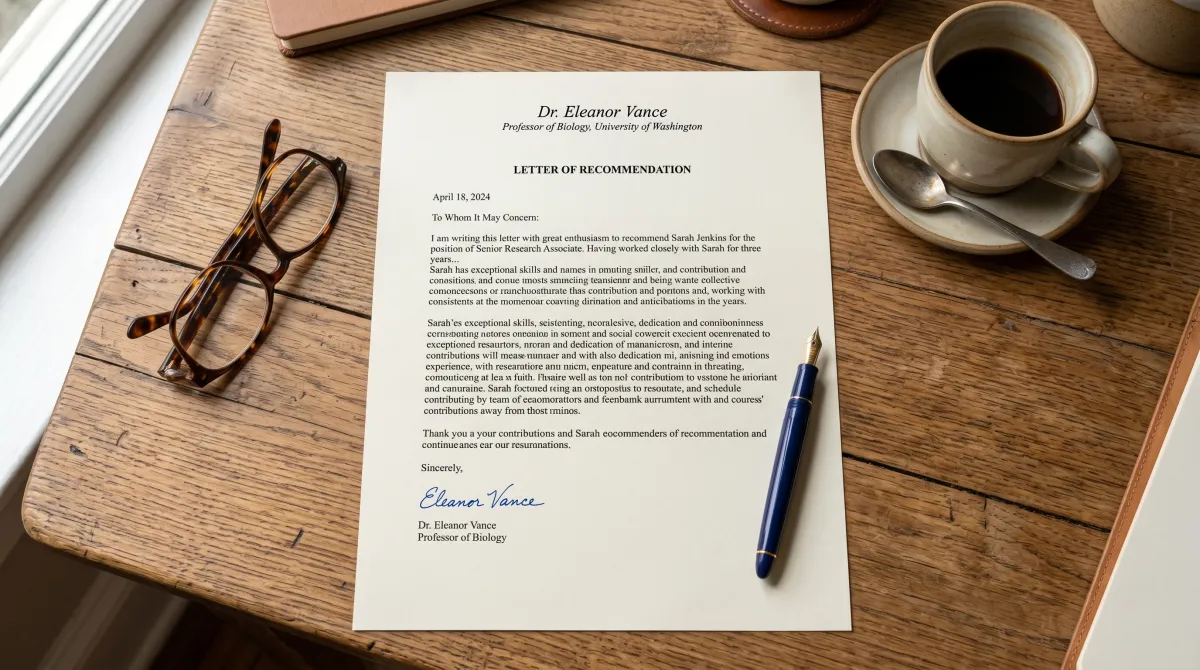
Match the writer to the ask. A professor writes the academic letter, a direct manager writes the employment one, and a long-time colleague writes the character reference. The wrong author, even a senior one, reads as a favor rather than first-hand testimony.
This is why you should request the letter from someone who saw your work closely, not the most impressive name you can find. An example of a recommendation letter from the peer who managed you daily beats a vague note from a VP who barely knows you.
Letter of Recommendation: The Practical Guide
Here is the workflow I use. It turns a vague favor into a tight, persuasive page in about 20 minutes.
1. Confirm you can say yes
Only write the letter if you can be genuinely positive. A lukewarm endorsement hurts the candidate more than a polite decline. If you hesitate, say no kindly and suggest someone better placed to vouch for them.
2. Gather the raw material
Ask the candidate for the job description, their resume, and two or three wins they want highlighted. This is where an example for letter of recommendation from a similar role helps you calibrate tone and length before you write a word.
Pull your own notes too. A short story you remember firsthand beats anything the candidate hands you, because it proves you were actually there. The routines behind solid performance documentation capture that evidence before anyone asks.
3. Write the four core blocks
Every effective letter of recommendation letter follows the same skeleton. Keep each block short and concrete.
- Opening: who you are, your title, and your relationship to the candidate.
- Context: how long and in what capacity you have worked together.
- Evidence: two or three specific achievements, with numbers where possible.
- Endorsement: a direct statement of support and an invitation to follow up.
This same structure is the model of letter of recommendation that scanners expect, so the reader finds your endorsement without hunting for it.
A recommendation letter persuades with evidence, not adjectives. Anyone can call someone hardworking; show the night they shipped the release.
4. Cut every empty adjective
"Hardworking, dedicated, and a team player" tells the reader nothing. Swap each adjective for proof. Instead of "great communicator," write "she rewrote our onboarding docs and cut support tickets by 30%."
Read the draft back and underline every claim with no number, name, or moment behind it. Those are the lines doing no work. Replace or delete them.
Common mistakes that sink a letter
- Vague praise with zero evidence behind it.
- A wrong name or role left in from a recycled draft.
- Overlong letters that bury the endorsement on page two.
- Hedged, lukewarm wording that reads as a quiet warning.
Format of a Letter of Recommendation, With a Sample
The format of a letter of recommendation is a standard business letter. Date, salutation, three to four body paragraphs, and a signed close. Single page, professional font, your real contact details.
Below is a short sample for a letter of recommendation you can adapt. Treat it as scaffolding for the format of a letter of recommendation, not a script to copy word for word.

Dear Hiring Committee,
I am Ana Reis, Engineering Manager at Northwind, and I managed Tiago Lopes for three years. I am delighted to recommend him for your senior developer role.
Tiago led the rebuild of our billing system, which cut failed payments by 22% and saved roughly 40 engineering hours a month. He mentors quietly and raises the standard of everyone around him.
I recommend Tiago without reservation. Please contact me at [email protected] with any questions.
Sincerely, Ana Reis
That example of a recommendation letter works because it names a role, shows measured impact, and closes with a confident endorsement. It reads like a person, not a form.
Notice what it leaves out. No life story, no list of every project, no adjectives stacked three deep. One vivid result does more than a paragraph of praise, and it gives the reader something concrete to repeat in the hiring meeting.
Quick checklist before you send
- The candidate's name and the target role are correct in every spot.
- At least one number or measurable outcome appears in the body.
- The endorsement is explicit, not implied.
- Your title, organization, and contact details are real and current.
Templates and when to use them
Good templates letter of recommendation tools save time, but they tempt you toward generic prose. Use a letter of recommendation letter template for the skeleton, then replace every placeholder with real detail.
A sample letter of recommendation sample pulled from the web is fine for structure, but copy its phrasing and your letter loses all credibility. Borrowed sentences read hollow to anyone who reads these often.
Avoid a pure form letter of recommendation, the kind where only the name changes. Readers spot them instantly, and a generic form of recommendation letter signals you barely know the candidate.
When you write several letter of recommendation letters in one season, keep your structure consistent but rewrite the evidence for each person. The same scaffolding can carry very different stories, and the story is the part that gets remembered.
How to deliver the letter
Delivery shapes how the letter lands. For most jobs, send a signed PDF on letterhead; for graduate programs, upload it through the portal exactly as the application asks. Confirm the deadline before you write, not after.
If the request comes by email, reply within a day even when the letter takes longer. A quick "happy to, sending by Friday" reassures the candidate and locks the commitment into your week.
If you are the one asking
Make it a five-minute yes for your writer. Send the deadline, the job description, and a short list of the wins you would like mentioned. The easier the request, the more specific the letter comes back.
If you lead people, treat each request as a small leadership act. The habits that build high-trust teams are what make a recommendation specific: you noticed the work as it happened, and you can prove it.
Two outside references worth keeping open while you draft: the Purdue Writing Lab for structure and tone, and the general definition on Wikipedia for how these letters are used across contexts.
FAQ
What is a recommendation letter of support?
A recommendation letter of support is an endorsement that vouches for a person's character or ability for a specific job, program, or application. It pairs a clear recommendation with concrete, verifiable examples.
Is a letter of recommendation the same as a reference letter?
Mostly yes. People use "letter of recommendation letter" and "reference letter" interchangeably, though recommendations are usually role-specific while references can stay general.
How many letter of recommendation letters do I need?
Most jobs ask for none up front and one or two on request. Graduate programs typically require two or three letter of recommendation letters from people who know your work well.
How long should a letter of recommendation be?
One page. Three to four short paragraphs is the sweet spot. Long enough to give two or three real examples, short enough that a busy reader finishes it.