Business Concepts
Cheap Business Cards (2026): Where to Order for Under $20
Cheap business cards cost $10 to $40 for 100-500 prints, dropping fast with volume. See real pricing, smart order sizes, and how to protect cash flow.

Cheap business cards remain one of the highest-leverage marketing buys a small business can make. A box of a hundred can cost less than a lunch order, yet it puts your phone number in a stranger's pocket long after the conversation ends.
The catch is that "cheap" only helps your business if the spending actually supports how the business runs day to day. That means understanding where a $20 box of cards fits next to bigger financial ideas like cash flow, working capital, and gross margin.
Quick answer
Cheap business cards typically run $10 to $40 for 100 to 500 cards from online printers, with per-unit cost dropping sharply at higher volumes. Order only what you can realistically hand out in 6 to 12 months, and treat the expense as a small, recurring marketing cost rather than a one-time bulk purchase.
Key takeaways
- Standard cheap business cards cost roughly $0.05 to $0.15 per card depending on paper stock and finish.
- Bulk pricing reflects economies of scale, but overproduction wastes cash on cards you'll never use.
- Card spending is expensed immediately, it never touches depreciation schedules like equipment does.
- Small, recurring print orders protect cash flow better than one large annual order.
- A card with a payment or scheduling link can nudge accounts receivable closer to zero.
What Is Cheap Business Cards?
Cheap business cards are standard-format cards, usually 3.5 by 2 inches, printed on basic cardstock through online or local print shops at the lowest reasonable price point. They skip premium finishes like foil stamping or letterpress in favor of clean design and fast turnaround.
For most small businesses, this category covers everything a founder actually needs: a name, a role, contact details, and a QR code or website. The goal is credibility at a low unit cost, not a design showpiece.
This kind of lean spending decision is part of the broader business concepts every founder eventually has to learn, since small recurring costs add up faster than most owners expect.
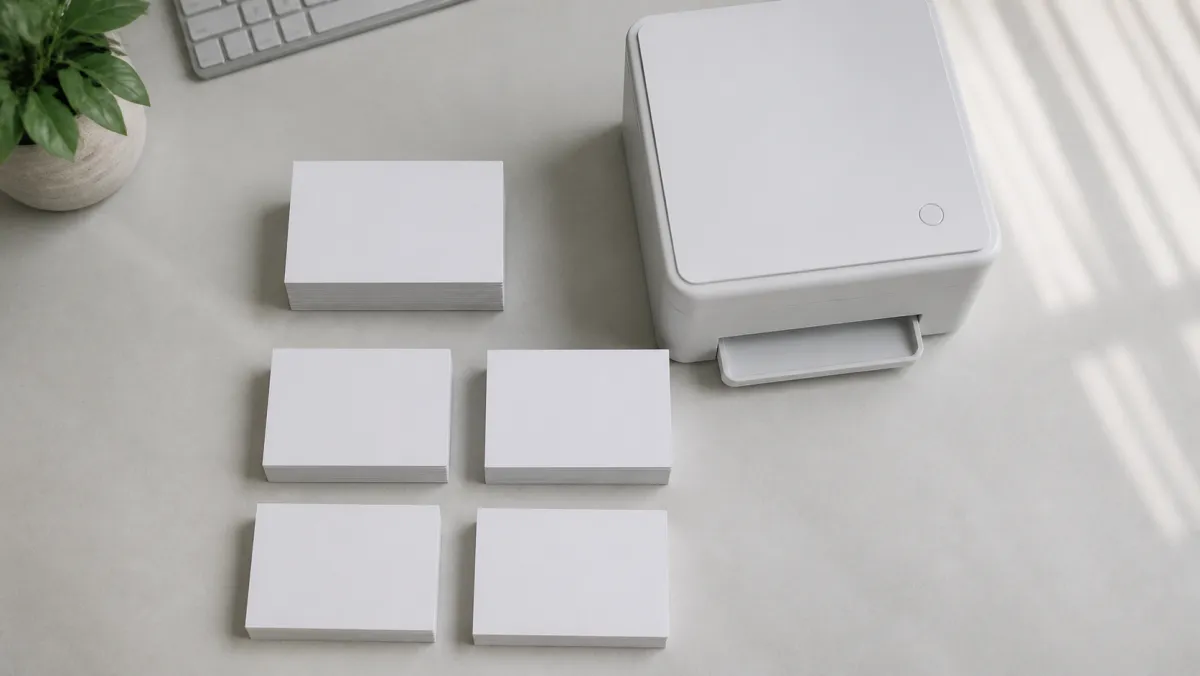
Cheap Business Cards Explained
Pricing for cheap business cards drops fast as order size grows. Printing 100 cards might cost $18, while 1,000 cards from the same printer might cost $45. That's a textbook economies of scale definition in action, the same principle that lets factories cut per-unit costs at higher volume: fixed setup costs get spread across more units, so the per-card price falls.
The trap is ordering far more than you need just to chase a lower unit price. Printing 5,000 cards for a two-person startup is a small-scale version of overproduction, tying up cash in a stack of cards that will sit in a drawer for years, possibly outdated before they're gone.
Business cards also sit in an unusual spot on the books. Because they're consumed quickly and cost little, they're expensed the moment you buy them. There's no depreciation meaning to track here the way there is for a printer, laptop, or company vehicle.
That's a useful contrast for new owners. The depreciation definition, as the IRS explains, covers the gradual loss of value in a capital asset over its useful life, while a $30 box of cards is simply a cost that hits your expenses in the month you paid for it.
Every dollar spent on cards is a dollar not sitting in the bank. Keeping that spend small protects your working capital definition, the cash and short-term assets available to cover payroll, rent, and inventory while invoices are still outstanding.
Cheap Business Cards Examples
A freelance consultant printing 250 matte cards for $22 through an online printer is a common baseline. A local contractor ordering 500 cards with a QR code linking to a booking page runs closer to $35, still well within the cheap tier.
Online print marketplaces have added a layer of aggregators between designer and printer, a small-scale version of reintermediation: middlemen reappearing after DIY design tools briefly cut them out. That layer usually adds convenience without adding much to the price.
Testing a new card format, like a QR-first design or a folded card with a mini menu, carries the usual benefits and risks of innovation. It might convert better, or it might just confuse people who expect a standard card.

How to Apply Cheap Business Cards
Start by ordering the smallest batch your printer offers, usually 100 to 250 cards. This limits how much cash sits idle and lets you catch typos or an outdated phone number before committing to a bigger run.
Match the order size to your actual networking pace. A founder attending one event a month doesn't need the same volume as a salesperson working a trade show floor every week.
Track the cost the same way you'd track any small marketing line item. Small, recurring print orders protect your cash flow definition basics, the pattern of money moving in and out of the business each month, better than one large annual order that drains a chunk of cash at once.
If your card includes a scannable invoice or payment link, it can quietly speed up collections. That's the practical side of the accounts receivable definition: money customers owe you that hasn't landed in the bank yet. A faster path from meeting to invoice shortens that gap.
It also helps to understand the accounts receivable meaning behind that number on your dashboard. It's not revenue you've banked, it's a promise of payment, and anything that speeds the handoff from card to invoice helps.
Founders who skip this kind of basic planning, ordering cards without a plan for cash flow or follow-up, often show the same warning patterns covered in signs you are being set up to fail at work: good intentions, no system behind them.
A business card is a five-cent asset. Treat the spending decision behind it with the same discipline you'd apply to a five-figure one.
Where Cards Fit on Your Numbers
Business cards rarely earn their own line on a balance sheet definition style report. They're consumed too quickly to count as an asset, so they flow straight through as a marketing or office supply expense.
Understanding the balance sheet meaning matters more for bigger purchases like equipment or inventory, where the item still has value at year end. Cards, by contrast, are gone the moment they're handed out.
The same logic applies to margin. Keeping marketing costs like card printing lean protects your gross margin definition: revenue minus the direct cost of delivering your product or service. Cheap cards barely move that number, which is exactly the point.
Put simply, the gross margin meaning for most service businesses has little to do with printing costs. It's driven by labor, materials, and pricing. Business cards just need to stay small enough that they never become a distraction from those bigger levers.
Related guides
Cheap Business Cards: FAQ
What is working capital?
Working capital is the cash and short-term assets a business has available to cover day-to-day costs like payroll, rent, and supplies after subtracting short-term liabilities.
What is accounts receivable?
Accounts receivable is money customers owe a business for goods or services already delivered but not yet paid for.
What is gross margin?
Gross margin is revenue minus the direct cost of producing a product or service, usually shown as a percentage of revenue.
What are balance sheet examples?
A balance sheet example lists assets like cash and equipment on one side, and liabilities plus owner's equity on the other, always balancing to the same total.
What do profit and loss statement examples look like?
A profit and loss statement example lists revenue at the top, subtracts costs and expenses line by line, and ends with net profit or loss for the period.