Software
Best SEO Tools for Ecommerce (2026): 7 We Trust
The best SEO tools for ecommerce fix crawl waste, thin product copy, and missing schema. See the 7-tool stack we run, with current 2026 pricing.

If you run an online store, the best seo tools for ecommerce are the ones that fix the problems product catalogs actually have: thousands of near-duplicate filter URLs, thin product copy, and missing schema. Generic "top 50 SEO tools" lists ignore that. This guide doesn't.
Quick answer
For most stores, the winning stack is Google Search Console (free) for real query data, Ahrefs or Semrush for keyword and competitor research, Screaming Frog for technical crawls of large catalogs, and Surfer SEO for category-page content. No single tool covers ecommerce SEO end to end.
Key takeaways
- Start with Google Search Console. It is free and shows you exactly which queries already convert.
- Pick one research platform (Ahrefs $129/mo or Semrush $139.95/mo), not both.
- Add Screaming Frog ($279/yr) once your catalog passes ~500 product pages.
- Faceted navigation, not keywords, is the #1 technical issue killing ecommerce crawl budget.
- Match the tools to your revenue, not to a competitor's shiny stack.
What Makes the Best SEO Tools for Ecommerce Different?
A blog needs keyword research and a content score. A store needs that plus crawl-budget control across a catalog that can balloon into millions of URLs.
One store with 10,000 products and 50 filter options can generate over 100 million URL combinations. Most are duplicate filter pages. On unmanaged sites, 40-60% of Google's crawl hits land on those junk URLs instead of pages that sell.
So the right ecommerce seo tools have to do three jobs: research demand, audit technical health at scale, and optimize the copy on category and product pages. You can see how the same logic applies across our wider software hub, where stacks beat single purchases.
The 7 Best SEO Tools for Ecommerce, Compared
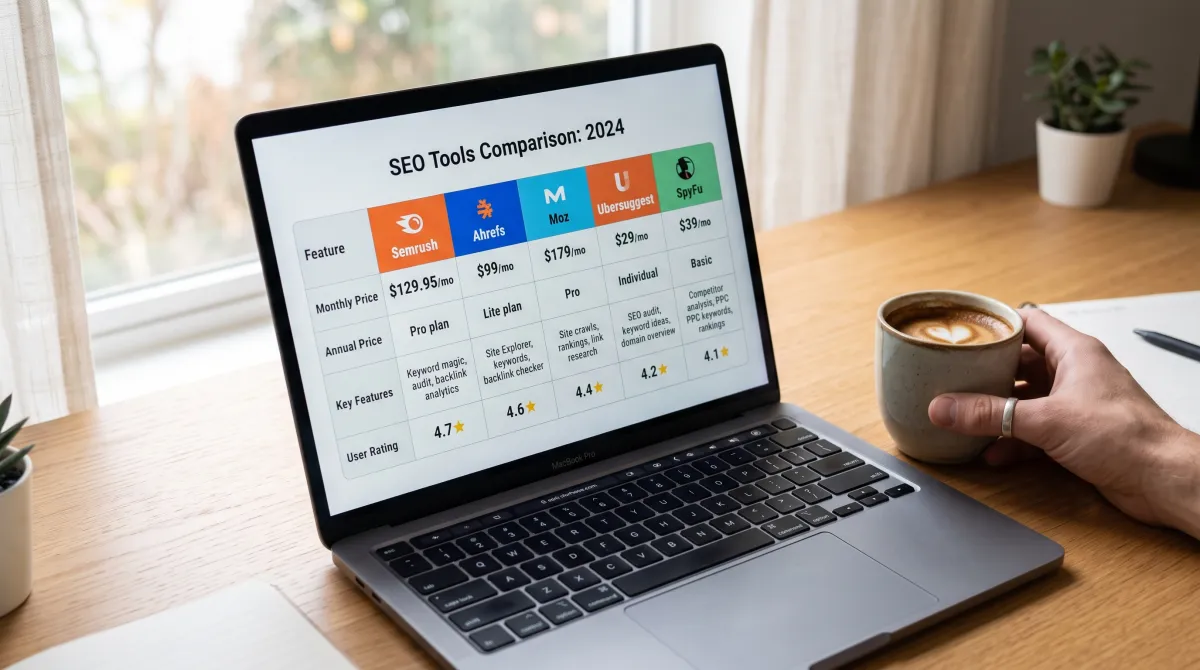
Here is the short list we keep coming back to, with current 2026 pricing verified on each vendor's site. The first column is the tool; pick based on what your store is missing, not on feature count.
| Tool | Best for | Starting price (2026) | Why it earns the slot |
|---|---|---|---|
| Google Search Console | Real query and indexing data | Free | Shows actual clicks, impressions, and crawl stats. Non-negotiable. |
| Ahrefs | Backlinks + competitor terms | $129/mo (Lite) | Largest referring-domain index; reads competitor Shopping ads. |
| Semrush | All-in-one marketing suite | $139.95/mo (Pro) | SEO plus PPC, social, and AI-visibility tracking in one login. |
| Screaming Frog | Technical crawls at scale | $279/yr (free under 500 URLs) | Finds faceted-nav duplication and broken links across big catalogs. |
| Surfer SEO | Category + buying-guide copy | $99/mo (Essential) | NLP scoring against pages ranking right now. |
| Plerdy | SEO + conversion data | Freemium | Pairs page audits with heatmaps, so you fix UX and SEO together. |
| Google Business Profile | Local + review signals | Free | One of the more useful free google review tools for store trust. |

Ahrefs vs Semrush: pick one, not both
This is the question every operator asks. Both overlap by roughly 80%, so paying for two is waste.
Choose Ahrefs if backlinks and competitor research drive your strategy. Its index covers hundreds of millions of referring domains, among the largest available. Choose Semrush if you want PPC, social, and content tools bundled so it can replace three subscriptions.
For a single store under $1M in revenue, either one plus Search Console is plenty. Don't let a comparison chart talk you into the $249.95/mo Semrush Guru tier you won't use.
The best SEO tools for ecommerce aren't the ones with the most features. They're the ones that stop Google from wasting its crawl on filter pages that never sell.
Best SEO Tools for Ecommerce Explained: Match Tools to Store Size
Buying by revenue band keeps you from overspending. Here is the framework we actually use with clients.
- Under $1M revenue: Google Search Console + Screaming Frog free version + Surfer if you publish content. Roughly $99/mo or less.
- $1M to $10M: Ahrefs Lite ($129/mo) + Screaming Frog ($279/yr) + Search Console. About $145/mo all in.
- $10M+: Ahrefs Standard ($249/mo) + Screaming Frog + Surfer + a dedicated crawler like Sitebulb for deep audits.
Notice the cheap tools do the heavy lifting at every level. Search Console and a crawler catch the technical issues that move rankings; the paid platform is mostly for research and reporting.
The technical wins that matter more than keywords
Most stores chase keywords and ignore the structural fixes that unlock far more traffic. Prioritize these.
First, control faceted navigation. Block price and sort parameters in robots.txt, and apply noindex, follow to most multi-filter combinations so link equity still flows. Screaming Frog and Search Console's Crawl Stats report show you the damage.
Second, ship Product schema on every SKU. Rich results with price, stars, and availability lift click-through noticeably. Schema is not a ranking signal, but the CTR gain is one of the highest-ROI moves in ecommerce SEO.
Third, treat category pages as primary. Well-optimized category pages often generate 3 to 5x more organic revenue than individual product pages because they rank for high-volume head terms.
How to Apply These SEO Tools Without Overspending
Tools are only half the job. The other half is the workflow that keeps your team shipping fixes instead of admiring dashboards.
We run SEO fixes through the same project tracking tools the rest of the company uses. A backlog of crawl errors, schema gaps, and content rewrites lives in kanban tools like Trello or a board in ClickUp, so every issue has an owner and a status.
For larger SEO sprints, agile project management tools such as Jira or Asana let you batch technical fixes into two-week cycles. That cadence matters: one advisory firm paired Ahrefs with Screaming Frog, worked through 150 on-page issues over nine months, and grew inbound inquiries 35%.
The point is simple. Pair your SEO stack with the team productivity tools you already have so insights become shipped changes, not screenshots in a Slack thread.
Where your ecommerce platform fits in
Your CMS shapes how easy these fixes are. Not all ecommerce platforms handle SEO equally, so a quick ecommerce platform comparison belongs in any tooling decision.
Among the leading ecommerce platforms, Shopify gives you clean URLs and fast hosting but limited control over faceted navigation. WooCommerce, effectively a free ecommerce platform built on WordPress, offers deep SEO control through plugins but needs more technical upkeep.
If budget is tight, the cheapest ecommerce platform route, open-source WooCommerce or Shopify's entry tier, still supports every fix above. Platform choice changes the effort, not the playbook.
For more on building a tooling stack that scales, see our guide on productivity tools for teams, which intersects directly with running a lean ecommerce operation.
Security matters too once you handle customer payment data, so our breakdown of security software for small business pairs well with the SEO stack above.
For the authoritative definition of how crawlers process your store, Google's own documentation on managing crawl budget for large sites is worth a read, as is the Wikipedia overview of SEO for the fundamentals.
Best SEO Tools for Ecommerce: FAQ
What are the best business credit cards for an ecommerce store?
The best business credit cards for most stores are the Chase Ink Business Cash for no-fee cash back on internet and phone services, and the Ink Business Preferred for ad and shipping spend. Verify current terms before applying, since rewards change often.
Which is the best business credit card for ad-heavy sellers?
The best business credit card for heavy ad spend is the Chase Ink Business Preferred, which earns 3 points per dollar on search and social ads plus shipping, on up to $150,000 in combined annual category spend. It carries a $95 annual fee.
Are the best credit cards for business worth it over personal cards?
Yes. The best credit cards for business separate store expenses from personal finances, earn bonus points on ecommerce categories like shipping and software, and simplify bookkeeping at tax time.
What is the best credit card for a brand-new business?
The best credit card for a new business is usually a no-annual-fee option like the Ink Business Unlimited, which gives flat-rate cash back without bonus categories to manage while you find your spending patterns.
Do the best company credit cards integrate with accounting tools?
Most of the best company credit cards from Chase and Amex sync directly with QuickBooks and Xero, which removes manual entry and keeps your ecommerce expense tracking clean.
Do I need paid SEO tools if I have Search Console?
Search Console is essential but reactive: it shows queries you already rank for. Paid tools like Ahrefs or Semrush reveal untapped keywords and competitor gaps, which is where most ecommerce growth comes from.