Business Concepts
Balance Sheet Examples (2026): 3 Real Templates You Can Use
See balance sheet examples for a freelancer, small business, and growth company, plus the equation, types, and tools to build your own today.

The fastest way to master this statement is to study real balance sheet examples, line by line, until the numbers click. Definitions help, but a sample balance sheet with actual figures shows how every dollar a company owns ties back to how it was funded.
📥 Free download: Balance Sheet Template
A ready-to-use balance sheet with realistic example numbers - open it in Excel or Google Sheets.
Quick answer
A balance sheet is a financial statement that shows what a company owns (assets), what it owes (liabilities), and what is left for owners (equity) at a specific point in time. In every example, total assets must always equal liabilities plus equity.
Disclaimer: This article is for general information only and isn’t financial, investment or tax advice. Rates, fees and rules change; check the provider’s or regulator’s official source or talk to a qualified professional about your situation.
Key takeaways
- The balance sheet equation is Assets = Liabilities + Equity, and it must always balance.
- Assets, liabilities, and equity each split into current and long-term line items.
- A balance sheet is a snapshot at one date, unlike the income statement or statement of cash flows, which cover a period.
- Reading three real examples teaches liquidity and financial health faster than any definition.
- Balance sheet skills and techniques matter beyond accounting, from job interviews to workplace budget decisions.
- A free balance sheet template or accounting software keeps the format consistent.
Balance Sheet Definition and Meaning
The balance sheet definition is straightforward. The balance sheet is one of the three core financial statements used in financial reporting, alongside the income statement and the statement of cash flows. The balance sheet is also called the statement of financial position.
The balance sheet meaning comes down to one idea. A balance sheet provides a snapshot of a company's financial position at a specific point in time. Where the income statement shows performance over months, the balance sheet shows what the business owns and owes on a single date.
Think of a company's balance sheet as a funding map. It lists the company's assets on one side and shows who has a claim on them: lenders through liabilities, and owners through shareholders' equity. Read together, those lines reveal the company's financial position on the reporting date.
Public companies prepare it under generally accepted accounting principles, so the format stays comparable across firms. The Financial Accounting Standards Board, a private nonprofit body established in 1973, sets the presentation rules U.S. public companies still follow when they prepare a balance sheet, according to the FASB. That consistency sits at the heart of the business concepts every operator should own, because it lets you read one company's balance sheet against another.
One quick note on terms. The phrase folio balance meaning usually refers to a guest's running hotel bill, not a corporate balance sheet. They share the word balance but measure different things, so do not confuse the two when researching.
The Balance Sheet Equation
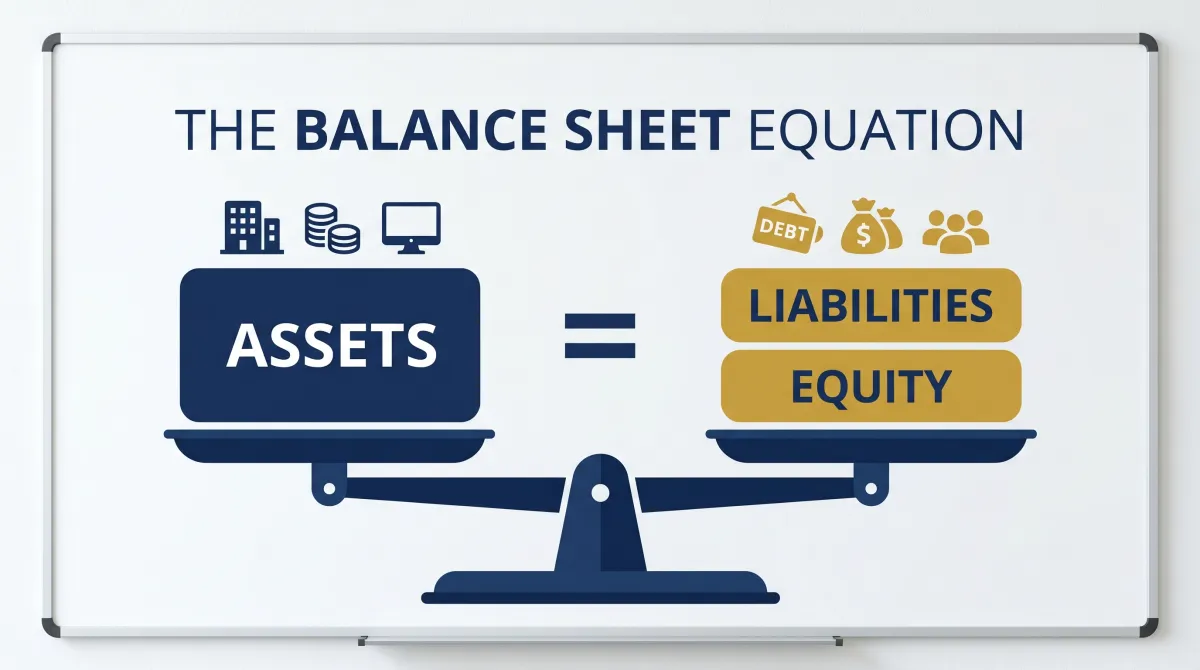
Every balance sheet follows a simple rule. The balance sheet equation is Assets = Liabilities + Equity. Total assets are always equal to the sum of liabilities and equity, which means that the balance sheet must always balance.
Assets are what the company owns. Liabilities are what the company owes. Shareholders' equity is what shareholders have invested plus retained earnings the business kept instead of paying out as a dividend.
If the two sides do not match, there is an error somewhere in the books. This is the first thing an accountant checks before trusting any other line item.
Balance Sheet Examples Compared
Here are three sample balance sheet examples at different scales. Each example of a balance sheet uses the same balance sheet format: assets at the top of the balance sheet, then liabilities, then equity. Notice how total assets equal total liabilities and equity in every column.
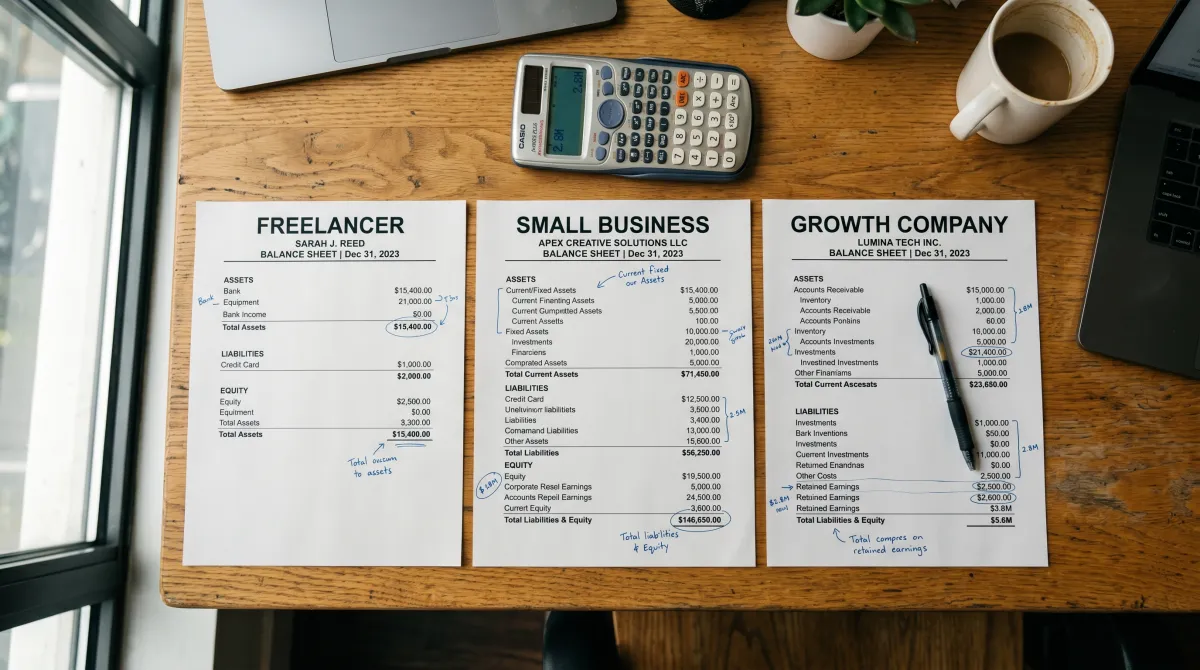
| Line item | Freelancer | Small business | Growth company |
|---|---|---|---|
| Cash | $12,000 | $60,000 | $500,000 |
| Accounts receivable | $8,000 | $40,000 | $300,000 |
| Total current assets | $20,000 | $100,000 | $800,000 |
| Long-term assets | $5,000 | $150,000 | $1,200,000 |
| Total assets | $25,000 | $250,000 | $2,000,000 |
| Accounts payable | $3,000 | $30,000 | $200,000 |
| Current portion of long-term debt | $1,000 | $20,000 | $100,000 |
| Total current liabilities | $4,000 | $50,000 | $300,000 |
| Long-term liabilities | $6,000 | $100,000 | $700,000 |
| Total liabilities | $10,000 | $150,000 | $1,000,000 |
| Shareholders' equity | $15,000 | $100,000 | $1,000,000 |
| Total liabilities and equity | $25,000 | $250,000 | $2,000,000 |
Current assets are items converted into cash within one year, such as the cash a company has on hand, accounts receivable, and inventory. Long-term assets, also called fixed assets, are not converted to cash within one year. Intangible assets include patents and trademarks, and these also appear on the balance sheet.
Current liabilities are amounts the company owes due within one year, like accounts payable and the current portion of long-term debt. Long-term liabilities, such as a multi-year loan, are due after one year. Subtract total liabilities from total assets and what remains is equity.
In the equity section of the balance sheet, retained earnings show profit the company kept rather than paying out as a dividend. As net income from the income statement builds over years, retained earnings and shareholders' equity grow with it.
Types of Balance Sheet
There are a few common types of balance sheet, and the format you choose depends on who reads it. The grouping you pick changes how easily someone using the balance sheet can compare one period to the next.
- Classified balance sheet: groups assets and liabilities into current and long-term sections. This is the standard example most companies use.
- Comparative balance sheet: places two or more dates side by side so you can see how the financial position changed.
- Common-size balance sheet: shows every line item as a percentage of total assets, which makes companies of different sizes comparable.
- Unclassified balance sheet: a plain list without current and long-term grouping, common for very small businesses.
More than 140 jurisdictions worldwide, including the European Union, Canada, and Australia, require or permit companies to format their balance sheet under IFRS instead of U.S. GAAP, according to the IFRS Foundation.
A comparative balance sheet is the most useful for spotting trends, the same way watching margins reveals structural shifts like reintermediation in a distribution chain. If accounts receivable doubled while the cash balance fell, the balance sheet shows a collection problem worth investigating before it drains the business.
What a Balance Sheet Includes
A complete balance sheet includes three blocks: assets, liabilities, and equity. Each balance sheet line sits in the section that matches how soon it turns into cash or comes due. This part of the balance sheet structure is what makes one company comparable to another.
Read each balance sheet line from the top down. The order tells you what the balance sheet gives a reader first: the most liquid assets, then longer-term ones, then the claims against them. A well-built balance sheet might also add subtotals so totals are easy to check.
Creating a Balance Sheet Step by Step
Creating a balance sheet is a short, repeatable process. Work in order and the totals fall into place, which is why a balance sheet is an essential habit for any operator who wants to read a balance sheet with confidence.
- List assets: record every item the company owns, from the cash balance to fixed assets, and total them.
- List liabilities: record what the company owes, splitting current liabilities due within one year from long-term liabilities.
- Solve for equity: set shareholders' equity equal to total assets minus total liabilities.
- Check it balances: confirm total assets equal total liabilities and equity before using the numbers.
Use a comparative balance sheet to see how each line moved against last year. Studying the statement this way is also a quiet workplace skill: being handed figures you cannot question is one of the signs you are being set up to fail at work.
How to Read a Balance Sheet

Learning to read a balance sheet is mostly about ratios between line items. Start at the top of the balance sheet with current assets, then compare them to current liabilities to gauge liquidity.
If current assets comfortably exceed current liabilities, the company can cover its short-term bills. The balance sheet helps you judge whether the company is over-borrowed by comparing total liabilities to equity. A business funded mostly by debt carries more risk than one funded by owners.
Strong financials also give a company room to absorb the benefits and risks of innovation, because there is a cushion of equity to fall back on if a bet does not pay off.
The balance sheet also pairs with the statement of cash flows and the income statement. Net income flows into retained earnings, and cash flows explain why the cash balance moved. Used together, the three statements give a full picture of the financial health of a business at one point in time.
A balance sheet never lies about funding: every asset on it was paid for by either a creditor or an owner.
Balance Sheet Skills, Strategies, and Interview Questions
The benefits of a balance sheet extend past accounting class. Anyone who forecasts budgets, negotiates a raise, or pitches a project needs to read one, because it shows whether a company can actually fund the plan.
Strong balance sheet skills separate finance hires who explain numbers from those who only report them. Employers look for people who can walk through a company's balance sheet and say what it means for hiring, spending, or risk.
Common balance sheet techniques include ratio analysis, such as the current ratio and debt-to-equity ratio, trend analysis across a comparative balance sheet, and common-size analysis that turns every line into a percentage of total assets.
Balance sheet strategies build on those techniques. A finance team might use the debt-to-equity ratio to decide whether to fund a new hire with cash on hand or a loan, then track the change on the next balance sheet.
Balance sheet best practices include reconciling every account before closing the books, keeping a comparative balance sheet on hand, and confirming total assets equal total liabilities and equity before sharing numbers with anyone.
Balance sheet in the workplace usually means non-accountants using it too. Sales leaders check accounts receivable, operations managers watch inventory, and HR teams reference it before approving new headcount.
Accountants who prepare a public company's balance sheet also work against a clock. The U.S. Securities and Exchange Commission requires large accelerated filers to submit a balance sheet inside Form 10-K within 60 days of fiscal year-end, versus 90 days for smaller non-accelerated filers, according to SEC filing rules.
Balance sheet interview questions test exactly these skills. Expect prompts like "walk me through the balance sheet equation," "how would a $10,000 loan affect the balance sheet," or "what does a rising accounts receivable balance signal." Practicing with the examples above prepares you to answer any of them with a real number, not just a definition.
Free Balance Sheet Template and Tools
You can build one in a spreadsheet using a free balance sheet template, or let software generate it. A template works for a freelancer, but once you have inventory, payroll, and investment activity, a balance sheet template inside accounting software keeps the format accurate automatically.
Best for most small businesses
QuickBooks Online From $35/mo
Generates a balance sheet, income statement, and statement of cash flows on demand, with a live balance sheet template built in. The default pick if you want one tool your accountant already knows.
Pros
- One-click financial statements
- Tracks accounts receivable and accounts payable automatically
- Accountant-friendly and widely supported
Cons
- Pricier than basic tools
- More features than a solo freelancer needs
Best for growing teams
Xero From $20/mo
Clean balance sheet format with unlimited users, so your whole team and your accountant read the same financial position from one company's balance sheet.
Pros
- Unlimited users on every plan
- Strong comparative balance sheet reporting
- Great bank reconciliation
Cons
- Payroll is an add-on in some regions
- Smaller app ecosystem than QuickBooks
Disclosure: the links above are affiliate links.
Balance Sheet Examples: FAQ
These frequently asked questions cover the gaps people hit when they first use the balance sheet.
What is a balance sheet and examples?
A balance sheet is a financial statement that lists a company's assets, liabilities, and equity at a single date. The examples above show a freelancer with $25,000 in assets and a growth company with $2,000,000, and in each one total assets equal total liabilities plus equity.
What is the golden rule of the balance sheet?
The golden rule is that the balance sheet must always balance: Assets = Liabilities + Equity. Total assets are equal to the sum of liabilities and equity, so if the two sides differ, there is an error in the books.
What are the 4 types of balance sheets?
The four common types are the classified balance sheet, the comparative balance sheet, the common-size balance sheet, and the unclassified balance sheet. Most companies publish a classified version that splits items into current and long-term.
How to make a balance sheet for beginners?
List your assets and add them up, list your liabilities and add them up, then set equity equal to assets minus liabilities. Use a free balance sheet template or accounting software so the format and totals stay correct.
How is a balance sheet different from profit and loss statement examples?
A balance sheet is a snapshot at one date, while profit and loss statement examples cover a period and show revenue minus expenses to reach net income. That net income then flows into retained earnings on the balance sheet.
What are accounts receivable examples on a balance sheet?
Accounts receivable examples include unpaid customer invoices and amounts billed but not yet collected. They appear under current assets because the company expects the cash within one year.
How does the balance sheet connect to cash flow examples?
Cash flow examples, drawn from the statement of cash flows, explain why the cash balance on the balance sheet rose or fell. The opening and closing cash on the cash flow statement match the cash line on two comparative balance sheets.
How do economies of scale examples show up on a balance sheet?
Economies of scale examples appear indirectly: as a company grows, fixed assets like equipment spread across more output, so long-term assets rise while cost per unit falls. The balance sheet shows the investment, and the income statement shows the margin gain.
Where do supply chain management examples appear on a balance sheet?
Supply chain management examples appear as inventory under current assets and accounts payable under current liabilities. Tighter supply chain management lowers inventory and frees up cash, which you can see on a comparative balance sheet over two periods.
What balance sheet interview questions come up most often?
Recruiters commonly ask candidates to explain the balance sheet equation, describe how a specific transaction like a loan or a purchase changes it, and interpret a rising or falling accounts receivable balance.
This content is for general informational purposes only and is not financial or investment advice. Consult a licensed financial professional before making financial decisions.