Software
What Is CRM Software and Why Your Business Needs It
CRM software centralizes leads, deals, and customer history in one dashboard. See what CRM does, 2026 pricing options, and whether your business needs one.

CRM stands for customer relationship management, and it is the software that keeps every lead, deal, and customer conversation in one place instead of scattered across email threads and sticky notes. If your team still tracks deals in a spreadsheet, this guide explains what a CRM actually does, what it costs in 2026, and how to tell if your business is ready for one.
Quick answer
A CRM is software that stores customer and prospect data, tracks every interaction, and automates follow-ups so sales, marketing, and support teams work from one shared record. Most businesses with more than a handful of customers already need one: 91% of companies with 10 or more employees run a CRM system, and free or low-cost plans make the switch cheap enough for a solo operator to justify.
Key takeaways
- The global CRM market hit $112.91 billion in 2025 and is projected to reach $126.17 billion in 2026.
- 91% of companies with 10 or more employees now use a CRM system, making it a mainstream tool, not a luxury.
- 65% of CRM users run generative AI inside the platform, and those users are 83% more likely to hit their sales goals.
- Cloud CRM is the default deployment now, with about 87% of companies running a cloud-based platform.
- Free plans from HubSpot and budget tiers like Zoho Bigin, from $9 per user per month, remove the old excuse that CRM is too expensive for a small team.
What Is CRM Software?
CRM software, short for customer relationship management, is a platform that stores every contact, deal, and interaction your business has with a customer or prospect. Instead of hunting through inboxes and spreadsheets, your team opens one record and sees the full history: emails, calls, purchases, and support tickets.
The category dates back decades, but the modern version has moved far past a digital rolodex. A customer relationship management system now handles pipeline tracking, marketing automation, and reporting inside one login, the same way other categories in our business software hub consolidate scattered tools into a single subscription.
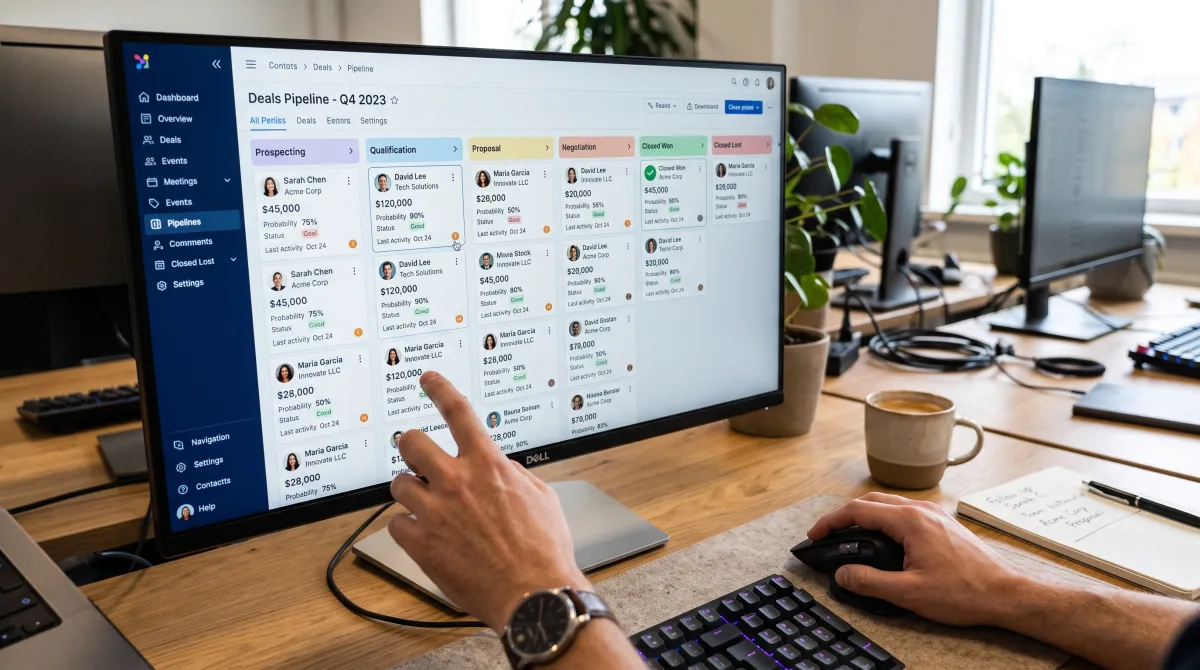
At its core, every CRM does three jobs: it stores contact and company data, it tracks where each deal sits in your sales pipeline, and it logs the emails, calls, and meetings tied to each relationship. Everything else, automation, forecasting, and AI, builds on top of that foundation.
Why Your Business Needs a CRM in 2026
Whether you need a CRM used to be a real debate for small teams. That question is largely settled now. 91% of companies with 10 or more employees already run a CRM system, and the global market is projected to reach $126.17 billion in 2026.
The real cost shows up when you skip one. Leads sit in someone's inbox until they go cold, two reps email the same prospect without knowing it, and a manager has no way to see which deals are actually moving. A CRM does not create more work, it removes the guesswork that already exists.
This matters even more for businesses selling directly to consumers, where every visit, cart, and support ticket is a data point worth tracking. Retailers running a b2c ecommerce operation lean on CRM data to spot repeat buyers and re-engage anyone who abandoned a purchase.
What a CRM Actually Does
Every CRM platform, from a free plan to an enterprise suite, is built around the same core functions. The table below breaks down what each one covers day to day.
| Function | What It Does |
|---|---|
| Contact database | Stores every lead and customer record, with full interaction history in one place |
| Pipeline tracking | Shows exactly which stage a deal sits in, from first contact to closed won |
| Automation | Sends follow-up emails, reminders, and task assignments without manual work |
| Reporting | Forecasts revenue and shows which reps or campaigns are actually converting |
| Integrations | Connects to email, calendars, and marketing tools so data does not live in two places |
AI Is Now a Standard CRM Feature
Generative and agentic AI moved from a premium add-on to a baseline feature inside most CRM platforms in 2026. About 65% of businesses now run a CRM with generative AI built in, and those users are 83% more likely to exceed their sales goals than teams working without it.
Salesforce's agentic AI product, Agentforce, is one clear signal of how fast this shifted: its annual recurring revenue grew 169% year over year in the fourth quarter of fiscal 2026. The AI does not just summarize notes anymore, it drafts follow-up emails, scores leads, and flags deals at risk of stalling.
Adopting AI inside a CRM is a practical example of what we cover in our guide to appex innovation: pushing a tool past the idea stage into something that measurably changes how a team closes deals.
What a CRM Costs in 2026
Price used to be the biggest excuse for skipping a CRM. That excuse is mostly gone. HubSpot's CRM is free forever with unlimited view-only seats, and its paid Starter tier for editing users runs $15 per seat, per month, billed annually.
Zoho Bigin is the budget pick for a small team that wants more structure than a spreadsheet without enterprise pricing. It starts at $9 per user per month and won PCMag's 2026 Editors' Choice award for small-business CRM.
Best for CRM plus marketing in one platform
GoHighLevel From $97/mo
Worth a look once you have outgrown a bare-bones CRM and want pipeline tracking, email and SMS automation, and funnels under one login instead of three separate subscriptions.
Pros
- CRM, funnels, and marketing automation bundled together
- Built-in SMS and a unified inbox for every channel
Cons
- Steeper learning curve than a single-purpose CRM
- Starter plan limits you to one business, no sub-accounts
If your budget covers more than just a CRM, our guide to affordable business management software compares bundled platforms that fold CRM, invoicing, and HR into one bill.
The question is not whether your business needs a CRM. It is which one earns a permanent seat in your stack.
Cloud CRM Is the Default Now
On-premise CRM is a shrinking niche. Roughly 87% of companies now run a cloud-based CRM platform, and cloud deployments accounted for 58.2% of total market revenue in 2024. That shift simplifies the buying decision: you are almost always choosing between cloud vendors, not between cloud and a server in a closet.
Weighing a CRM purchase deserves the same due diligence you would apply to a financial decision. The comparison in our active vs. passive investing guide is a useful mental model: pay for hands-on complexity only when you will actually use it, and default to the simpler, lower-maintenance option otherwise.
How to Choose the Right CRM for Your Business
There is no single best CRM. Salesforce holds the largest share of the market at 20.7% in 2026, ahead of Microsoft, Oracle, and SAP, but market share does not tell you which tool fits your sales motion.
- List your channels. Email, phone, SMS, live chat: pick a CRM that logs the channels your team actually uses.
- Test the free tier first. Run real deals through HubSpot's free plan or Zoho Bigin's trial before paying for anything.
- Check the AI features you will use. Lead scoring and email drafting save real hours; skip AI add-ons you will not touch.
- Price out the full team. Multiply the per-seat cost by every rep who needs edit access, not just the first user.
CRM FAQ
Do I need a CRM for my small business?
Yes, in most cases. 91% of companies with 10 or more employees already run a CRM system, and free plans from HubSpot make the cost argument mostly moot for smaller teams too.
What is new about CRM software in 2026?
Generative and agentic AI moved from an add-on to a standard feature. 65% of CRM users now run AI inside the platform, and Salesforce's Agentforce alone grew annual recurring revenue 169% year over year.
Is there a free CRM that is actually usable?
Yes. HubSpot's CRM is free forever with unlimited view-only seats, and Zoho Bigin starts at $9 per user per month if you need more structure. Both are current 2026 Editors' Choice picks for small business.
Should I choose a cloud or on-premise CRM?
Choose cloud. About 87% of companies already run a cloud-based CRM, and on-premise deployment is now a shrinking niche that adds server and maintenance costs most small teams do not need.
The best CRM is the one your team actually opens every morning without being told to. Start with a free plan, get your real pipeline into it, and upgrade only once you hit a feature you are missing.