Business Concepts
What Are the 4 Parts of a SWOT Analysis? (2026 Guide)
The 4 parts of a SWOT analysis are strengths, weaknesses, opportunities, and threats. See what each quadrant means and how to turn it into real decisions.

If you have ever stared at a blank strategy template, you already know the problem. You have opinions about your business, but no clean way to sort them. A SWOT analysis fixes that in four boxes.
Quick answer
The 4 parts of a SWOT analysis are strengths, weaknesses, opportunities, and threats. Strengths and weaknesses are internal factors you control. Opportunities and threats are external factors in your market. Together they map where you stand and where to act next.
Key takeaways
- SWOT splits into two internal quadrants (strengths, weaknesses) and two external ones (opportunities, threats).
- Strengths and weaknesses describe what is true inside your team today.
- Opportunities and threats describe forces outside your control that could shift the outcome.
- A SWOT is only useful if you convert each quadrant into a decision, not a list.
SWOT stands for strengths, weaknesses, opportunities, and threats. It is a simple framework, and that is exactly why it survives decades of strategy trends. The skill is not filling the boxes. The skill is being honest in them.
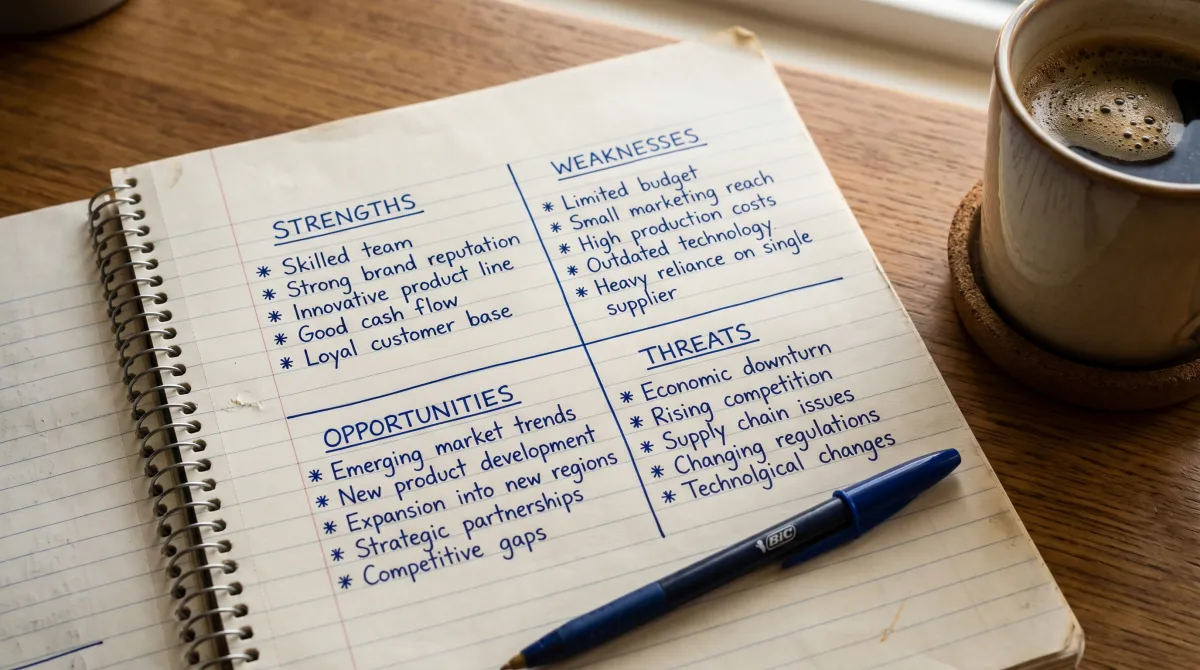
What Is A SWOT Analysis And Why It Has 4 Parts
A SWOT analysis is a planning tool that organizes what helps and what hurts your goal. According to the documented history of SWOT, it was built for corporate strategy, but teams now use it for products, careers, and projects.
The four parts exist because every situation has two axes. One axis is internal versus external. The other is helpful versus harmful. Cross them and you get exactly four quadrants. The wider business concepts hub covers why this two-by-two logic shows up across so many planning tools.
| Quadrant | Origin | Nature | You control it? |
|---|---|---|---|
| Strengths | Internal | Helpful | Yes |
| Weaknesses | Internal | Harmful | Yes |
| Opportunities | External | Helpful | No |
| Threats | External | Harmful | No |
Keep that grid in mind. Most weak SWOTs fail because people put an external factor in an internal box. A new competitor is a threat, not a weakness. Your slow onboarding is a weakness, not a threat.
Part 1: Strengths (Internal And Helpful)
Strengths are the internal advantages your team owns right now. They are the things you would point to if a customer asked why they should pick you over the next option.
Good strengths are specific and provable. "Great culture" is a slogan. "We ship customer fixes within 24 hours and have the support logs to show it" is a strength.
Ask these questions to surface real strengths:
- What do we do better than competitors, with evidence?
- What unique assets do we own (talent, data, brand, IP)?
- What do customers consistently praise in reviews or calls?
- Where do we win deals we probably should not?
A strength you cannot prove with a number or a customer quote is just a hope wearing a nicer label.
Part 2: Weaknesses (Internal And Harmful)
Weaknesses are internal limits that hold you back. This is the quadrant where ego kills the exercise, so it needs the most discipline.
The test for a weakness is simple. It is inside your walls, and you could fix it if you chose to invest. Thin documentation, a single point of failure on your engineering team, or weak cash reserves all qualify.

Run the honest version of these prompts with your team:
- Where do we lose deals, and what reason keeps repeating?
- What do we avoid talking about in front of leadership?
- Which processes break when one key person is out?
- What would a tough competitor attack first?
Naming a weakness is not admitting defeat. It is the only way to turn it into a project with an owner and a deadline.
Part 3: Opportunities (External And Helpful)
Opportunities are favorable conditions outside your business that you could ride. You did not create them, but you can position to capture them.
Common sources include a shifting market, a new technology, a competitor stumbling, a regulation change, or a customer segment nobody serves well yet. The signal that something is a real opportunity is that acting on it would move your numbers.
Strong opportunities usually connect to a strength. If you are great at fast support and a rival just gutted their support team, that is an opportunity you are uniquely built to take.
- What market or behavior shift is happening around us?
- Where are competitors weak or distracted?
- Which emerging tool or channel could lower our costs?
- What problem are customers asking about that nobody answers?
Part 4: Threats (External And Harmful)
Threats are external forces that could damage your position. Like opportunities, they live outside your control, which is why monitoring matters more than panicking.
A new entrant with funding, rising supplier costs, a platform changing its rules, or a recession are all threats. Even the U.S. Small Business Administration frames competitive analysis around scanning these outside forces before you commit.
Treat threats like a weather forecast, not a prophecy: you cannot stop the storm, but you can decide whether to sail today.
For each threat, write the early warning sign you would watch and the move you would make if it triggered. A threat with a contingency plan stops being a threat and becomes a managed risk.
A Worked Example: SWOT For A Small Coffee Shop
Theory sticks better with a concrete case. Imagine a single-location coffee shop deciding whether to open a second store.
Its strengths are a loyal regular base and a roaster relationship that keeps bean costs low. Its weaknesses are thin cash reserves and an owner who personally runs every shift.
On the outside, the opportunity is a new office tower opening two blocks away with no nearby cafe. The threat is a national chain rumored to be scouting the same district.
Read those four boxes together and the decision sharpens. The opportunity is real, but the weakness (owner-dependence, thin cash) means expanding now is risky if the chain moves first. The honest call is to fix the internal gaps before chasing the new tower.
How To Turn The 4 Parts Into Decisions
A SWOT grid is worthless if it ends as four lists. The value comes from pairing quadrants and asking what to do.
Use these four combinations to generate action:
- Strengths + Opportunities: where do we attack now while we have the edge?
- Strengths + Threats: how do we use what we have to defend?
- Weaknesses + Opportunities: what must we fix to even compete for this?
- Weaknesses + Threats: what is the worst-case combo we should de-risk first?
That last pairing is the one most teams skip and most regret skipping. A weakness colliding with a threat is how good companies get blindsided. Strong leaders treat this matrix as a priority filter, not a tidy artifact.
The same logic carries into day-to-day execution, where good management practice turns each quadrant pairing into owned action items with deadlines.
Common Mistakes With The 4 Quadrants
Most failed SWOTs share the same handful of errors. Avoiding them is half the battle.
- Confusing internal and external factors across the boxes.
- Listing vague adjectives instead of evidence.
- Filling all four quadrants evenly to look thorough.
- Never returning to it, so it ages into fiction.
Treat your SWOT as a living document. Revisit it each quarter, because strengths fade, threats arrive, and last year's opportunity is now table stakes. Sharing it openly also keeps the wider workplace aligned on which fights actually matter this quarter.
FAQ
What are the 4 parts of a SWOT analysis?
The 4 parts of a SWOT analysis are strengths, weaknesses, opportunities, and threats. Strengths and weaknesses are internal factors, while opportunities and threats are external ones.
Which 2 parts of SWOT are internal?
Strengths and weaknesses are the internal parts. They describe factors inside your organization that you can directly control or change.
Which 2 parts of SWOT are external?
Opportunities and threats are the external parts. They describe forces in your market or environment that you cannot control but must respond to.
What order should I fill out a SWOT analysis?
Most people start with strengths, then weaknesses, then opportunities, then threats. Starting internal builds momentum before you tackle the external factors you control less.
Is SWOT analysis still useful in 2026?
Yes. SWOT stays useful because it forces a clear split between what you control and what you do not. The framework only loses value when teams skip turning the quadrants into decisions.