Leadership
SWOT Analysis Graph (2026): How to Build One That Works
A SWOT analysis graph maps Strengths, Weaknesses, Opportunities, and Threats into one 2x2 grid you can read fast. See how to build, color, and read it.

Most teams write a SWOT as four bullet lists, then never look at it again. A swot analysis graph fixes that by forcing the four quadrants into one view you can actually read, compare, and act on in a meeting.
Quick answer
A SWOT analysis graph is a 2x2 grid that maps Strengths, Weaknesses, Opportunities, and Threats into four quadrants. Internal factors sit on top, external factors sit below, and the visual layout makes patterns and trade-offs obvious in a way plain lists never do.
Key takeaways
- The graph is a 2x2 matrix: internal factors up top, external factors below.
- Strengths and Opportunities are positive; Weaknesses and Threats are negative.
- The real value comes from reading across quadrants, not inside one box.
- Keep each quadrant to 3-5 specific, evidence-backed points.
- Pair it with a TOWS step to turn the graph into actual decisions.
What Is a SWOT Analysis Graph?
A SWOT analysis graph is the visual form of a SWOT analysis. Instead of four separate lists, you draw a square split into four equal quadrants, one per factor.
Each quadrant holds a short cluster of points. The position of each box carries meaning, so where a factor sits tells you whether it is internal or external, helpful or harmful.
SWOT itself is a strategic planning framework often credited to management consultant Albert Humphrey. The graph is simply the version your brain can scan in seconds, which is why it sits alongside the most-used business concepts and frameworks teams reach for in planning.
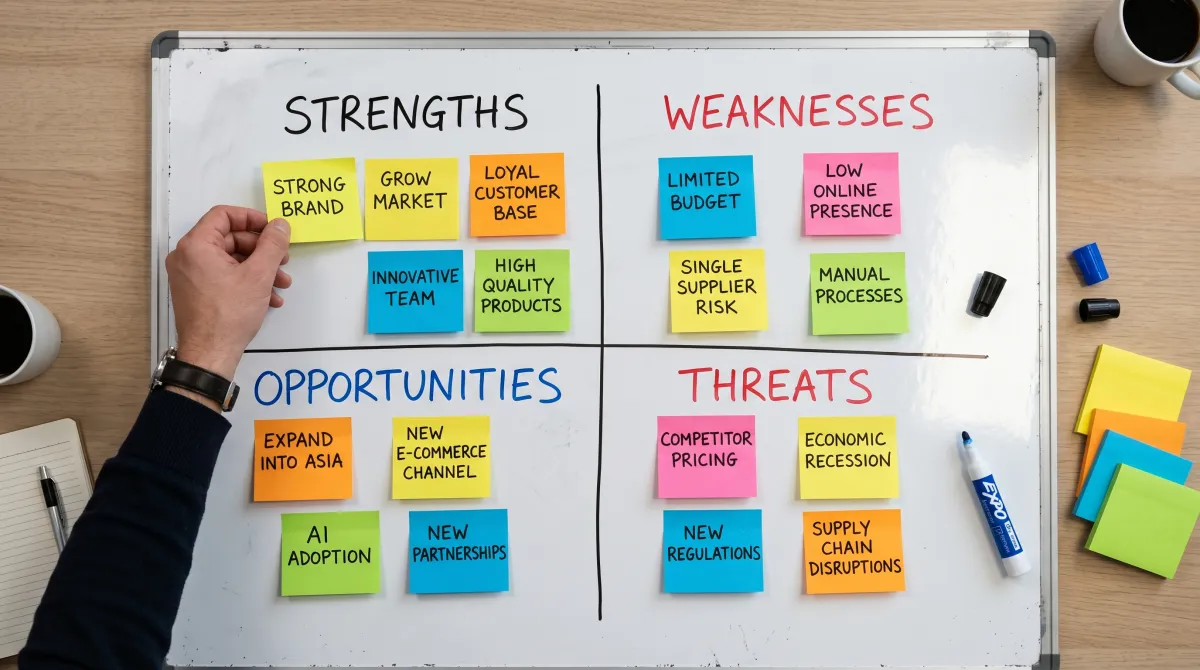
The 2x2 Layout: How the Quadrants Map
The power of the graph lives in its axes. The top row is internal to your business, things you control. The bottom row is external, things happening in your market regardless of you.
The left column is positive and the right column is negative. That gives you a consistent reading direction every single time.
| Quadrant | Position | Internal/External | Helpful/Harmful |
|---|---|---|---|
| Strengths | Top left | Internal | Helpful |
| Weaknesses | Top right | Internal | Harmful |
| Opportunities | Bottom left | External | Helpful |
| Threats | Bottom right | External | Harmful |
Some teams flip opportunities and weaknesses, and that is fine. What matters is keeping internal on one axis and external on the other so the chart stays honest.
That single rule separates a real strategy tool from a decorative slide. A graph that mixes the axes loses the one thing it was built to give you: a fast, unambiguous read of where each factor belongs.
Color helps the read even more. A light wash of green on the helpful column and red on the harmful one lets the eye sort the grid before it reads a single word. Keep that coding consistent across every chart your team makes.
SWOT Analysis Graph: The Practical Guide to Building One
You can build a clean SWOT graph in under an hour if you stay disciplined. The trick is specificity, not volume.
Step 1: Draw the grid
Start with a square divided into four equal boxes. Label them clearly and keep the colors consistent: green-ish for strengths and opportunities, red-ish for weaknesses and threats.
Step 2: Fill internal factors first
List strengths and weaknesses. These are things you own: your team, your cash position, your product, your processes. Be blunt. A weakness you hide is a weakness you keep.
Internal factors are also the ones you can act on this quarter. When a strong management team is one of your strengths, name the specific habit that makes it strong, not the title on the org chart.
Step 3: Add external factors
Now map opportunities and threats. These come from outside: market shifts, new competitors, regulation, technology, customer behavior. You react to these, you do not control them.
Step 4: Cap each box at 3-5 points
A graph with twelve bullets per quadrant is a wall, not a chart. Force ranking to the top few items. If everything is a priority, nothing is.
Step 5: Date it and add owners
A SWOT graph is a snapshot, so stamp it with the date and the question it was built to answer. Tag a name next to the boxes that need action, or the grid quietly becomes a wall poster nobody owns.

A SWOT graph that nobody argues over is a SWOT graph that wasn't honest enough.
Reading the Graph: Where the Real Value Is
Beginners read one box at a time. Operators read across the grid. The insight sits in the relationships between quadrants, not inside any single one.
Pair a strength with an opportunity and you find your fastest move. Pair a weakness with a threat and you find what could sink you. This cross-reading is sometimes formalized as a TOWS matrix.
- Strength + Opportunity: use what you do well to win an open market.
- Strength + Threat: use a strength to defend against a risk.
- Weakness + Opportunity: fix a gap so you can chase the upside.
- Weakness + Threat: the danger zone, plan to minimize or exit.
That last pairing is where most companies get caught off guard. Make it the first thing you stress-test.
A quick way to pressure-test the grid is to ask one question per pairing: what single action does this combination demand? If a pairing produces no action, either the points are too vague or they do not belong on the chart.
Rank the pairings, too. Most grids surface five or six viable moves, but you can only fund one or two. Sorting them by impact and effort turns a pretty diagram into a short, defensible priority list.
Common Mistakes That Wreck a SWOT Graph
The framework is simple, which is exactly why people misuse it. A few patterns ruin most grids.
The biggest is vagueness. "Good team" is not a strength, "senior engineers who ship weekly" is. Every box should survive the question "compared to what?"
The second is confusing internal and external. A competitor's price cut is a threat, not a weakness. Mislabeling factors breaks the whole chart's logic.
The third is treating the graph as the finish line. The graph is a diagnosis. The action plan that follows is the actual work, and it usually surfaces in how your team handles the daily workplace trade-offs the grid exposes.
The fourth is letting one loud voice fill every box. A SWOT graph built by one person is a list with extra steps. Pull factors from sales, support, and finance, then reconcile the overlaps on the grid itself.
The fifth is leaving boxes empty to look balanced. If your threats column is short, dig harder rather than padding it. An honest grid with two real threats beats a tidy one stuffed with filler nobody believes.
When a SWOT Graph Beats a Plain List
Use the graph when you need to align a group fast or present to stakeholders. The visual structure makes disagreement productive because everyone is pointing at the same grid.
It also works well early in strategy, before you commit to a direction. Seeing strengths and threats side by side keeps optimism and risk in the same frame.
For solo, fast notes, a list is fine. But the moment more than one person needs to weigh in, the graph earns its keep.
It also ages better than a list. Revisit the same grid a quarter later and the shifts are visible at a glance: a threat that grew, an opportunity you captured, a weakness you finally closed.
That makes the graph a tracking tool, not just a planning one. Keep last quarter's version beside the new one and the deltas become your status update, no separate report required.
Related guides
FAQ
What is a SWOT analysis graph?
It is a 2x2 grid that visualizes Strengths, Weaknesses, Opportunities, and Threats in four quadrants. Internal factors sit on top, external factors below, helping you read trade-offs at a glance.
What goes in each quadrant of a SWOT graph?
Strengths and weaknesses are internal factors you control, like your team and processes. Opportunities and threats are external factors from your market, like trends and competitors.
How many points should each box have?
Keep each quadrant to 3-5 specific, prioritized points. More than that turns the graph into an unreadable wall and dilutes the focus you are trying to create.
What is the difference between SWOT and TOWS?
SWOT lists the four factors. TOWS pairs them, like strength with opportunity or weakness with threat, to convert the diagnosis into concrete strategic moves.
What tool should I use to make one?
Anything from a whiteboard to a spreadsheet works. For shared documents, use a simple table or diagram tool so the 2x2 structure stays clear and editable.