Management
Management Performance Review Examples (2026)
Management performance review examples for leadership, communication, and accountability. Copy-ready phrases plus a quick-reference table to write fair reviews.

Most managers freeze at the same moment: the cursor blinks in the review box, and every honest thought suddenly sounds either too soft or too harsh. The fix is not more vocabulary. It is a set of management performance review examples you can adapt fast, so the feedback lands as specific, fair, and useful.
Quick answer
Strong management performance reviews pair a specific behavior with its measurable impact, then point to one clear next step. Use evidence ("reduced sprint slippage from 30% to 8%") instead of traits ("is a great leader"), and balance strengths with growth areas in every section.
Key takeaways
- Anchor every comment to an observable behavior and a result, not a personality label.
- Cover the five core areas managers are judged on: leadership, communication, decision-making, accountability, and people development.
- Write both positive and constructive phrases for each area so the review never feels one-sided.
- Close with a forward action the manager can start this quarter.
- Adapt the wording to your context; copied phrases without specifics read as generic.
What Is Management Performance Review Examples?
A management performance review example is a written sample that shows how to evaluate a leader's behavior, results, and impact on their team. It models the structure and language so you can replace the details with your own.
Good examples do one job well. They turn vague impressions into concrete sentences a manager can read, recognize, and act on. That is the gap most review forms fail to close.
Think of these examples as scaffolding. You keep the shape, swap in real numbers and moments from the review period, and the feedback immediately feels earned rather than borrowed.
If you want the full context first, our breakdown of the performance review process covers where leadership evaluations fit and how the cycle runs end to end.
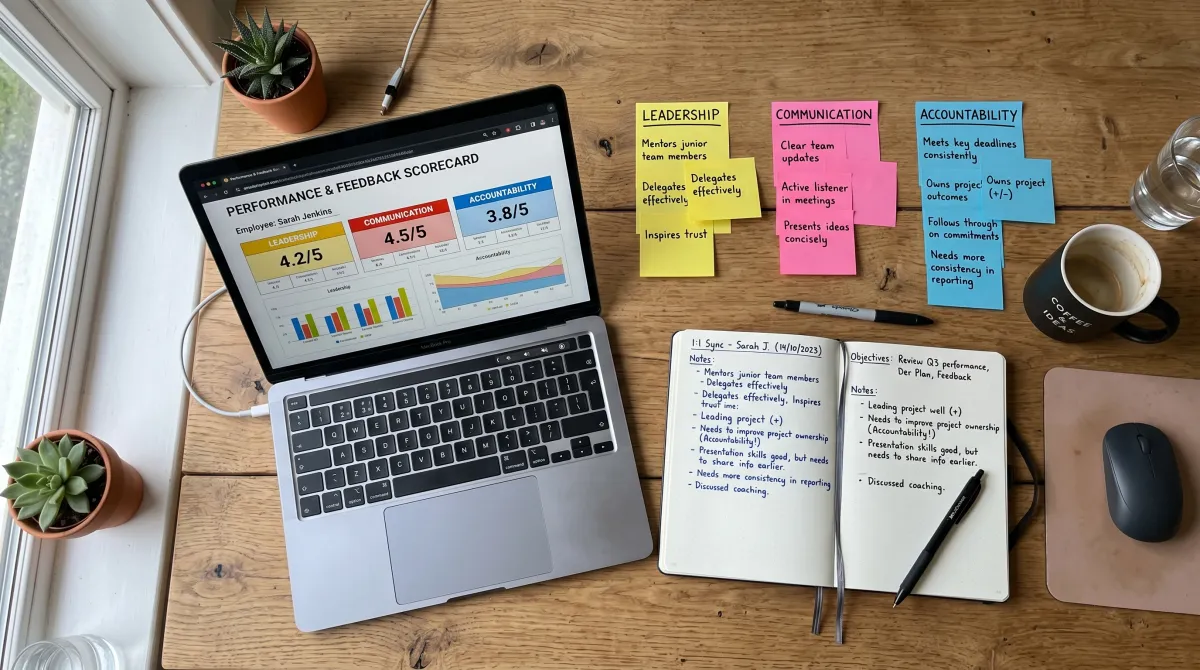
The Anatomy of a Strong Review Phrase
Every example below follows the same formula: behavior, impact, and direction. Skip any one part and the feedback gets weaker.
Behavior is what the manager actually did. Impact is what changed because of it. Direction is the next move. A line like "communicates well" has none of those. "Ran weekly 15-minute standups that cut duplicated work across two squads" has all three.
Feedback without evidence is just an opinion with a deadline.
This is the SBI model in plain terms: Situation, Behavior, Impact. Developed by the Center for Creative Leadership, it forces you off personality and onto facts the manager can verify.
Use numbers wherever you honestly can. Percentages, time saved, retention, project delivery dates. When numbers do not exist, name a specific situation instead.
Specificity separates a review people trust from one they quietly ignore. A manager who reads "you handled the Q3 outage by pulling two engineers off roadmap work and shipping a fix in four hours" knows exactly what to repeat.
A manager who reads "good under pressure" learns nothing actionable. Concrete examples beat labels because they tell the person precisely what to keep doing, which is the heart of any sound people management approach.
Leadership and Team Direction Examples
Leadership is the area most reviews fumble, because it is easy to praise vaguely and hard to critique kindly. These phrases keep both honest.
Positive: "Set a clear quarterly priority and repeated it in every team meeting, which reduced the 'what should I work on?' questions to near zero."
Positive: "Stepped back during the launch and let two engineers own decisions, growing their confidence without losing delivery quality."
Constructive: "Tends to set direction late in the cycle, leaving the team to guess priorities for the first week of each sprint. Aim to publish goals before the sprint starts."
Constructive: "Defaults to making calls solo. Inviting one peer into key decisions would build buy-in and surface blind spots earlier."
Each phrase names a moment, not a mood. That is what turns a rating into something the manager can actually repeat or fix next quarter.
Communication Performance Review Examples
Communication reviews go wrong when they grade volume instead of clarity. The goal is whether the message reached people and changed what they did.
Positive: "Translated a confusing executive mandate into three concrete team actions, so nobody left the meeting unsure of their part."
Positive: "Gives feedback in the moment rather than saving it for reviews, which keeps small issues from becoming big ones."
Constructive: "Updates are thorough but long. Leading with the decision, then the context, would help busy stakeholders act faster."
Constructive: "Avoids difficult conversations until they escalate. Practice raising concerns within 48 hours while they are still small."
Notice each constructive line ends with a behavior to try, not a verdict. A growth area without a next step is just a complaint in a nicer font.

Decision-Making and Accountability Examples
This pair separates managers who own outcomes from those who manage upward. Reviews should reward judgment, not just activity.
Positive: "Made a hard call to cut a feature mid-quarter, owned the trade-off publicly, and protected the launch date."
Positive: "Reports both wins and misses in monthly updates without spin, which has built strong trust with leadership."
Constructive: "Delays decisions while waiting for perfect data. Setting a 'decide by' date would keep projects moving."
Constructive: "When a target is missed, the explanation often points outward. Naming one thing within their control to change next time would model accountability for the team."
Accountability gaps also show up in how managers handle the everyday workplace dynamics between formal reviews, where small unowned misses tend to compound.
People Development and Coaching Examples
How a manager grows their people is the clearest signal of long-term value. These phrases focus on the team's trajectory, not the manager's likability.
Positive: "Built a development plan for each direct report and reviewed it quarterly, leading to two internal promotions this year."
Positive: "Gives stretch assignments matched to each person's goals, which has visibly raised engagement on the team."
Constructive: "Coaching tends to happen only with high performers. Spreading regular 1:1 time across the whole team would lift the middle."
Constructive: "Solves problems for the team rather than with them. Asking more questions before offering answers would build independence."
Management Performance Review Examples: The Practical Guide
Even with good examples, a few habits quietly drain the value out of a review. Watch for these before you submit.
The recency trap is the most common. Managers rate the last month heavily and forget the other eleven. Keep a running note across the period so the review reflects the whole year, not just the loudest recent event.
This bias is bigger than it looks. One large study of 5,000 managers found 62% of the variance in ratings traced to the rater's own tendencies, while only 21% reflected the employee's actual performance. A year-round record is the cheapest fix.
Trait language is the second trap. "Natural leader" or "poor communicator" labels the person instead of the action. Swap every label for a behavior, and the feedback becomes coachable rather than personal.
The third is the one-sided review. An all-positive review reads as avoidance, and an all-negative one reads as an ambush. Both lose credibility. Aim for honest balance in every section, even for your strongest managers.
There is a reason to lead with strengths. The Center for Creative Leadership recommends ongoing, balanced feedback, because critique only lands when there is enough trust in the relationship to receive it.
The practical takeaway: earn the right to critique. If trust is thin, your toughest line will bounce off, no matter how accurate it is.
Quick Reference: Phrases by Rating Level
Use this table to match tone to performance level without softening the truth. Keep the wording specific, then attach a real moment from the period before you paste any line in.
| Area | Exceeds expectations | Needs development |
|---|---|---|
| Leadership | "Sets direction early and empowers others to execute." | "Defines goals late, leaving the team to guess priorities." |
| Communication | "Makes complex updates clear and actionable." | "Delivers thorough but hard-to-scan updates." |
| Decision-making | "Decides quickly under uncertainty and owns trade-offs." | "Waits for perfect data before acting." |
| Accountability | "Reports misses honestly and adjusts." | "Explains shortfalls by pointing outward." |
| Development | "Grows direct reports into promotions." | "Coaches only top performers." |
Order matters as much as wording. Listing strengths first and growth areas second keeps the review readable under pressure and signals you noticed the wins before the gaps.
How to Turn Examples Into a Real Review
Start by collecting evidence before you write a single line. Pull metrics, notes from 1:1s, and specific moments from the period. The examples only work once you attach them to facts.
Then write strengths first, growth areas second, and one forward action last. Keep the ratio roughly balanced so the review reads as fair rather than as a verdict.
Consistency matters as much as wording. Assess every manager against the same five areas, not the reviewer's mood that week, so scores stay comparable across the team.
The best written form recaps an ongoing dialogue, not a once-a-year reveal. Weekly check-ins do most of the heavy lifting before the review is even due.
End with direction the manager controls. "Publish sprint goals before each sprint starts" beats "improve planning" because it is testable next quarter.
For evidence on what makes feedback effective, the research summarized by the Harvard Business Review is a useful starting point. It also helps to ground reviews in established frameworks like performance appraisal theory and the SMART criteria for goal setting.
Related guides
FAQ
What should a management performance review include?
It should cover leadership, communication, decision-making, accountability, and people development, with each point tied to a specific behavior and result. Always close with one clear next step the manager can act on.
How do you write constructive feedback for a manager?
Name the observable behavior, explain its impact on the team, and suggest a concrete change. For example: "Sets goals late, which leaves the team guessing; publish priorities before each sprint."
What are examples of strengths in a manager's review?
Strong examples include empowering direct reports to own decisions, translating unclear mandates into team actions, and building development plans that lead to promotions. Each strength should reference a real outcome.
How long should a management performance review be?
Long enough to cover each core area with specifics, usually one to two pages. Quality of evidence matters far more than length; a focused review with real examples beats a long, generic one.
How often should managers be reviewed?
A formal review once or twice a year works best when paired with ongoing feedback. Frequent check-ins also reduce recency bias, since the review draws on a running record rather than the last few weeks.