Business Concepts
Ledger Balance Meaning Explained (2026 Guide)
Ledger balance meaning explained simply: what it is, how it differs from available balance, and why the gap matters for your money and business.

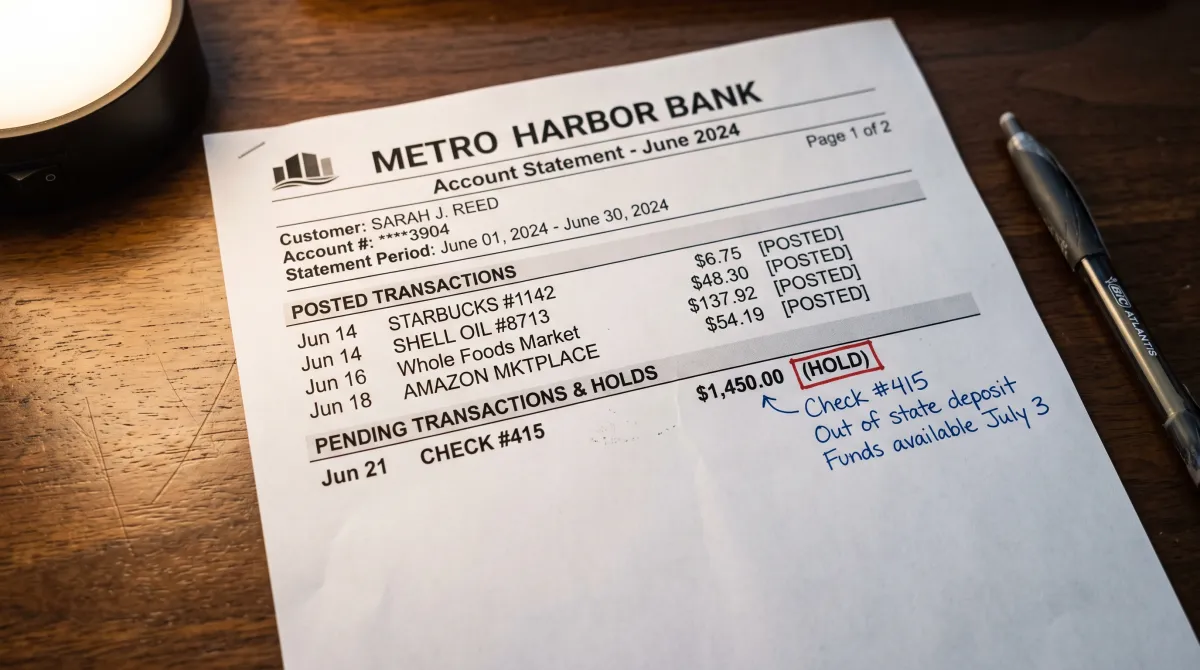
Your ledger balance is the total your bank has posted to your account, including deposits that have not cleared yet. Your available balance is the part you can spend right now. Start the day with $1,000, deposit a $500 check, and let the bank hold $300 of it: the ledger balance shows $1,500, the available balance shows $1,200, and spending past $1,200 risks a declined payment or an overdraft fee.
Disclaimer: This article is for general information only and isn’t financial, investment or tax advice. Rates, fees and rules change; check the provider’s or regulator’s official source or talk to a qualified professional about your situation.
This guide is part of our business concepts hub, where we break down finance and workplace terms in plain English, one at a time.
Quick answer
The ledger balance is the total amount in an account after all posted transactions as of the last processed business day, including deposits and checks that have not yet cleared. It differs from the available balance, which only counts funds you can spend or withdraw right now.
Key takeaways
- Ledger balance equals the total after every posted transaction, cleared or not.
- Available balance is what you can actually spend today.
- Holds, pending checks, and clearing balance timing explain the gap.
- Businesses reconcile ledger entries against fiscal year records for accounting.
- Related terms like depreciation, payroll, and invoices all hit the ledger differently.
What Is Ledger Balance Meaning?
The ledger balance is the running total a bank keeps in its books for an account, updated after each transaction is posted. It includes deposits, withdrawals, and checks written against the account, whether or not those items have fully cleared.
Banks calculate a clearing balance separately to track which deposits and payments have actually settled between institutions. Under Regulation CC, banks generally must make at least a portion of a deposit available for withdrawal by the next business day, which is exactly why the ledger balance can show money the available balance has not caught up to yet.
Some banking apps also flag a check balance target, a threshold your account must stay above to avoid overdraft fees or lost interest. That target is measured against the ledger balance, not the smaller available balance.
Ledger Balance Meaning Explained
In personal banking, the savings meaning of a ledger balance is straightforward: it is the number your bank statement shows at the top, before pending transactions are subtracted. For everyday budgeting, most people should watch the available balance instead.
In a business meaning, ledger balance carries more weight. Finance teams use it to reconcile the general ledger, the master record of every debit and credit across accounts payable, receivable, and cash.
The managerial meaning shifts again. Finance managers carry each account's ledger balance onto the balance sheet as cash, and our balance sheet examples show exactly where that line sits. Good managers use ledger data internally days before a bank statement catches up.
A related concept, invoice meaning, matters here too. When a business issues an invoice, nothing hits the ledger balance until the customer actually pays; the invoice itself is a receivable, not cash in the account.
Automated ledger tools have also changed how money moves between banks, which ties into ideas like reintermediation, where financial middlemen reinsert themselves into transactions that technology once promised to remove.
Ledger Balance Meaning Examples
The table below walks through common transactions and shows how each one moves through the ledger balance differently, which is often the fastest way to see the meaning behind the term.
| Transaction | Effect on ledger balance | Effect on available balance |
|---|---|---|
| Payroll deposit posts to an employee account | Increases immediately once the bank posts the batch | Usually available the same or next business day |
| Depreciation entry on a company vehicle | No effect; it is a non-cash bookkeeping entry | No effect |
| Customer pays an outstanding invoice | Increases once the payment posts | May lag by 1-2 business days if paid by check |
| Balance transfer between two of your own accounts | Updates on both accounts right away | Can lag on the receiving account until funds clear |
| Business remits a supplier payment | Decreases once the remittance posts | Decreases at the same time in most cases |
Payroll meaning ties directly into this table. Once a payroll batch posts, the ledger balance for each employee account rises immediately, even though the pay stub meaning behind that deposit, gross pay minus taxes and deductions, was calculated days earlier.
Under IRS Publication 946, computer equipment is typically depreciated over 5 years and office furniture over 7 years. The depreciation meaning behind that entry is simple: only a fraction of an asset's cost ever touches the ledger balance as a yearly expense.
How to Apply Ledger Balance Meaning
Reconcile the ledger balance against your available balance daily if your business runs tight on cash. A gap that keeps growing usually points to slow-clearing checks or holds you were not expecting.
Timing matters most at the fiscal year meaning cutoff, the close of the 12-month accounting period a business chooses for tax and reporting. Remit payment meaning becomes relevant here too: payments a company sends to settle its own bills should post before that cutoff to count in the current period.
Small business owners who check the ledger balance daily inside their accounting software catch problems early, before an overdraft fee or a bounced supplier payment forces a harder conversation. Automated alerts help, but a five-minute daily glance still beats surprises.
For personal accounts, treat the ledger balance as a ceiling, not a target. Spend against the available balance, and check the ledger only to confirm a deposit or check has been recorded correctly.
Automated ledger software is one of many examples in our piece on the benefits and risks of innovation for finance teams, where speed can outrun accuracy if nobody double-checks the numbers.

| Balance type | What it shows | Best used for |
|---|---|---|
| Ledger balance | Total after all posted transactions, cleared or not | Bookkeeping and reconciliation |
| Available balance | Funds you can spend or withdraw right now | Daily spending decisions |
| Clearing balance | Funds confirmed settled between banks | Confirming a deposit is truly final |
Your ledger balance tells you what happened. Your available balance tells you what you can actually do about it.
Every balance sheet traces back to the same principle: assets equal liabilities plus equity, a formula Italian mathematician Luca Pacioli formalized for double-entry bookkeeping in 1494. Ledger balances are the raw material that formula runs on.
Ledger Balance Meaning: FAQ
What is a balance sheet?
A balance sheet is a financial statement that lists what a business owns, owes, and the owner's equity at a single point in time. Every figure on it traces back to a ledger balance somewhere in the books.
What are balance sheet examples?
Common balance sheet examples include a small retailer listing cash, inventory, and accounts payable, or a startup listing equipment, loans, and founder equity. Both pull every number straight from the company's ledger balances.
Income statement vs balance sheet: what is the difference?
An income statement shows revenue and expenses over a period of time, while a balance sheet shows a ledger balance snapshot of assets, liabilities, and equity on one specific date. One measures a stretch of time, the other measures a single moment.
Why is a balance sheet important?
A balance sheet is important because it shows whether a business can cover its debts, using ledger balance totals to reveal financial health that a single bank statement cannot capture alone. Lenders and investors read it before anything else.
How does a balance sheet work?
A balance sheet works by following the accounting equation, assets equal liabilities plus equity, a formula every ledger balance ultimately has to satisfy once all entries are posted. If the two sides don't match, something in the books is wrong.