Business Concepts
Icelandair Business Class (2026): Saga Class Explained
Icelandair business class (Saga Class) trades a lie-flat bed for a cheaper fare and a free Iceland stopover. See how it stacks up against Emirates and BA.
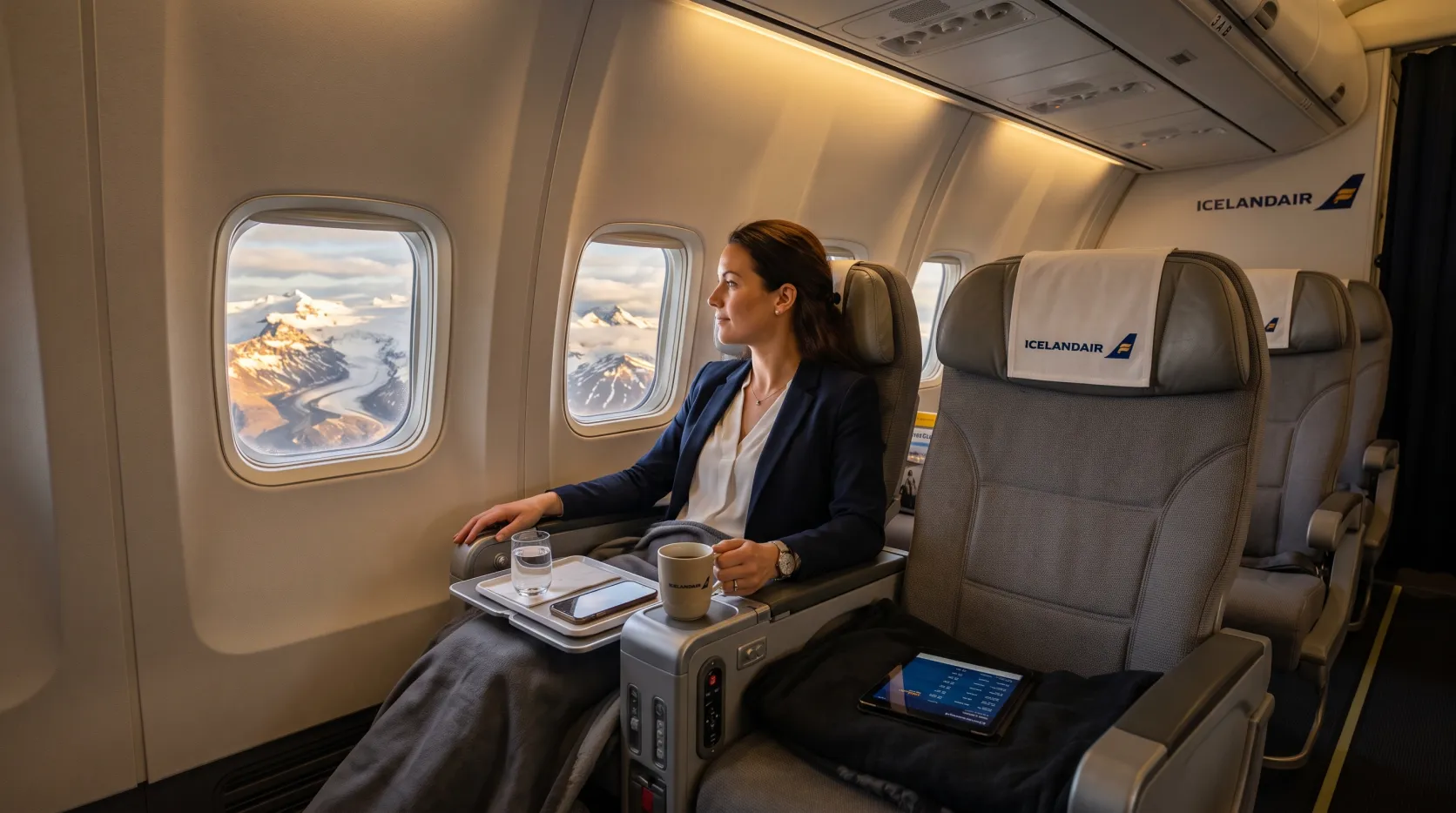
If you have priced a transatlantic ticket through Reykjavik, you already know Icelandair business class shows up cheaper than most full-service carriers. Icelandair calls its business cabin Saga Class, and the seat, the stopover, and the price all work differently than the lie-flat suites you get on Emirates or British Airways.
Quick answer
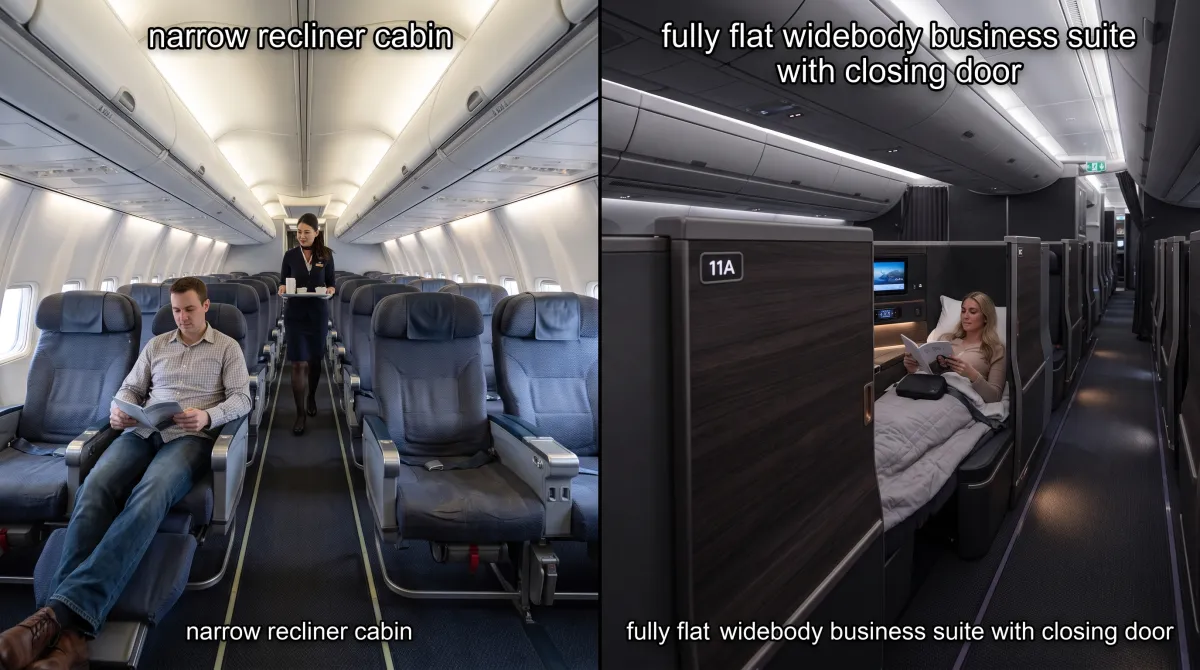
Icelandair business class is Saga Class, a wide 2-2 recliner seat flown on Boeing 757 and 737 MAX aircraft rather than a widebody jet. It does not lie fully flat like Emirates, American, British Airways, or United business class, but it comes with Icelandair's free multi-night stopover in Iceland, a perk none of those airlines match on the same route.
Key takeaways
- Icelandair business class (Saga Class) uses a 2-2 recliner seat on narrow-body aircraft, not a fully flat bed.
- The free Iceland stopover, up to several nights at no extra airfare, is Saga Class's real differentiator against Emirates, American, British Airways, and United business class.
- Qatar Airways, Air France, and Delta all fly fully flat suites on the same North Atlantic corridor Icelandair serves through Keflavík.
- You can book Saga Class directly, upgrade with Icelandair's Saga Club miles, or add it through a corporate travel policy.
What Is Icelandair Business Class?
Icelandair business class is Saga Class, the airline's premium cabin on its Boeing 757 and 737 MAX fleet connecting North America, Iceland, and Europe. Every seat sits in a 2-2 recliner layout instead of the fully flat pods long-haul widebody carriers fly.
The whole network runs through Keflavík International Airport (KEF), Iceland's main international gateway, according to Wikipedia. Icelandair built its stopover program around that hub, letting a New York to Amsterdam or Boston to Paris trip include a free multi-night break in Iceland.
For a wider vocabulary of the ideas behind corporate travel spending, see our business concepts hub, since Saga Class turns out to be a useful case study in a few of them.
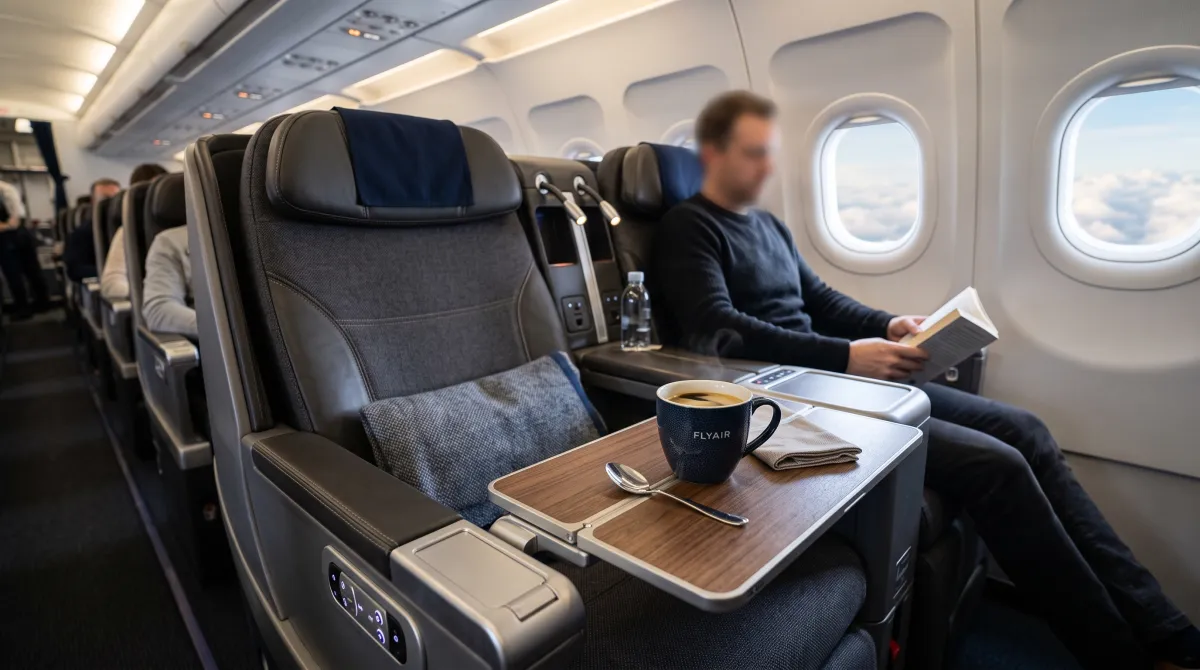
Icelandair Business Class Explained
The Saga Class seat reclines generously and adds width and legroom over economy, but it does not convert to a flat bed. Reviewers commonly cite roughly 40 inches of pitch, well short of the fully flat suites on longer widebody routes.
Because the seats sit two-and-two, a window passenger sometimes has to step past a neighbor to reach the aisle. That trade-off is the direct result of flying narrow-body Boeing jets on routes that widebody carriers usually cover with 777s or A350s.
What Saga Class buys instead is priority check-in, a dedicated bag allowance, lounge access at Keflavík, and better dining than economy. Icelandair layers its free stopover program on top, letting Saga Class travelers break their trip in Iceland for several nights at no added airfare.
Loyalty members can also earn and redeem through Icelandair's Saga Club program, which behaves like most airline mileage schemes: miles for paid fares, and award seats for Saga Class when inventory opens up.
Icelandair is not selling you a bed. It is selling you a cheaper seat and a free stop in Iceland, and that trade only makes sense if you actually use the stopover.
Icelandair Business Class vs Emirates, American, British Airways, and United
Every major competitor on this list flies a fully flat seat. Icelandair's recliner is the outlier, so the comparison really comes down to what you are willing to give up for the price and the stopover.
Emirates business class puts passengers in a fully flat seat, and on the Airbus A380 the cabin includes an onboard lounge and bar that Icelandair has no equivalent for. American Airlines business class, branded Flagship Business, runs fully flat seats with direct aisle access on its widebody fleet, a hardware jump Saga Class does not attempt to match.
British Airways business class introduced the Club Suite in 2019, its first seat with a closing privacy door, starting on the Airbus A350, according to British Airways. United business class, rebranded Polaris in 2016 according to United Airlines, also flies fully flat seats with saddle-style privacy dividers across its widebody long-haul jets, a product usually grouped with United business class Polaris reviews online.
Further out on the same North Atlantic corridor, Qatar Airways business class debuted the Qsuite in 2017 as the first business class seat with a fully closing door, according to Qatar Airways. Air France business class and Delta business class both fly fully flat seats with direct aisle access on their long-haul widebodies between the US and Europe, matching the same hardware gap every carrier on this list has over Saga Class.
| Airline | Seat type | Layout | Standout feature |
|---|---|---|---|
| Icelandair Saga Class | Recliner, not flat | 2-2, narrow-body | Free multi-night Iceland stopover |
| Emirates business class | Fully flat suite | Widebody (A380, 777) | Onboard bar and lounge on the A380 |
| American Airlines Flagship Business | Fully flat | Widebody, direct aisle access | Flagship Lounge access at hubs |
| British Airways Club Suite | Fully flat | 1-2-1, privacy door | First BA seat with a closing door |
| United Polaris | Fully flat | 1-2-1, privacy divider | Polaris Lounge access at hubs |
| Qatar Airways Qsuite | Fully flat, closing door | Convertible suites | First closing-door business class seat |
Read that table plainly and the pattern is obvious: Icelandair is the budget-priced outlier on hardware, and the stopover is the entire pitch for choosing it over a widebody competitor.
Icelandair Business Class Examples
A consultant flying New York to London for a two-day client meeting has little reason to route through Iceland. A widebody carrier's direct flight and a fully flat seat wins on time and rest.
A family planning a European vacation is a better fit. Booking Saga Class one-way through Reykjavik, adding a free four-night stopover, then continuing to Paris turns one flight into two trips for the price of one airfare.
A remote employee attending a conference in Amsterdam might also use Saga Class to break up jet lag deliberately, landing in Iceland first, adjusting for a few days, then flying onward rested. That use case rarely shows up in a straight price comparison against Emirates or United business class, but it is where Saga Class actually earns its seat.
The Business Story Behind the Recliner Seat
Icelandair's choice to fly Saga Class on narrow-body jets instead of widebodies is not an accident, it is a deliberate bet tied to a few concepts worth naming plainly.
Start with economies of scale. The economies of scale definition is simple: average cost per unit falls as volume rises. A widebody jet only pays for itself on a route with enough premium demand to fill dozens of flat-bed seats every day, something Icelandair's smaller North Atlantic markets often cannot support.
That connects directly to overproduction risk. Overproduction means building more capacity than the market will pay for at a profitable price. Airlines that install a large flat-bed cabin on a thin route can end up flying half-empty suites, a mismatch Icelandair avoids by keeping its business cabin small and its aircraft narrow-body.
Depreciation matters here too. The depreciation meaning most travelers never think about is spreading an aircraft's multimillion-dollar cost over its useful flying life instead of booking it as one lump expense. A narrow-body Boeing 757 or 737 MAX depreciates on a far smaller balance sheet line than a widebody jet, which keeps Icelandair's whole cost structure lighter.
The stopover program is really a cash flow decision dressed up as a marketing perk. Cash flow definition: the actual movement of money in and out of a business over a period, not the profit shown on paper. Every stopover traveler who eats, sleeps, and shops in Iceland for a few extra nights adds tourism revenue that never touches Icelandair's own books directly, but it keeps demand for its flights high enough to fill seats it would otherwise discount.
How to Apply Icelandair Business Class
Booking Saga Class works like most airline premium fares, with two extra levers worth using deliberately.
- Book directly when you can. Routing a corporate ticket through a third-party reseller instead of Icelandair.com is a small case of reintermediation, middlemen reinserting themselves into a booking process the internet was supposed to simplify.
- Plan the stopover on purpose. Icelandair's system lets you add a stopover of several nights at no extra airfare; skipping that step and just transiting through Keflavík wastes the one feature that justifies the recliner seat.
- Check Saga Club miles before paying cash. Award availability on Saga Class opens up on some routes well before the cash fare drops, so check both before booking.
- Clear it with your travel policy first. Who gets Saga Class approved on an expense report often mirrors the same quiet politics behind the signs you are being set up to fail at work, so confirm the policy before you book rather than after.
Airlines weighing whether to retrofit a fleet with new seats face the same benefits and risks of innovation that any company faces before a costly upgrade. Icelandair's answer, so far, has been to keep the recliner and compete on price and the stopover instead.
Related guides
Icelandair Business Class: FAQ
Is Icelandair business class worth it?
It is worth it if you plan to use the free Iceland stopover or want a cheaper premium seat on a short-to-medium transatlantic hop. It is a weaker choice than Emirates or British Airways business class if an overnight flat bed matters more to you than the stopover.
Does Icelandair business class have lie-flat seats?
No, Saga Class is a wide 2-2 recliner seat on Boeing 757 and 737 MAX aircraft, not a fully flat bed. Emirates, American, British Airways, and United all fly fully flat seats in business class on their widebody long-haul jets.
How much does Icelandair Saga Class typically cost?
Saga Class fares generally price below fully flat business class products from widebody carriers on similar North Atlantic routes, since the seat and aircraft cost less to operate. Exact fares change by season and route, so check Icelandair's own booking page for current pricing.
Can you use miles to upgrade to Icelandair Saga Class?
Yes, Icelandair's Saga Club loyalty program lets members redeem miles for Saga Class award seats when inventory is available. Checking award space alongside the cash fare before booking is the easiest way to see which option costs less.
What is included in Icelandair Saga Class?
Saga Class includes the wider recliner seat, priority check-in, a larger baggage allowance, lounge access at Keflavík, upgraded dining, and the option to add a free multi-night stopover in Iceland. It does not include a lie-flat bed.
How does Icelandair Saga Class compare to Qatar Airways or Air France business class?
Qatar Airways and Air France both fly fully flat seats with direct aisle access on their widebody jets, a hardware tier above the Saga Class recliner. Icelandair's trade-off is a lower fare and the free Iceland stopover, not a better seat.