Workplace & Career
Hostile Takeover: How It Works, Examples & Defenses (2026)
A hostile takeover means a bidder skips the board and goes straight to shareholders. See how tender offers, poison pills, and real deals play out.

A hostile takeover is what happens when a company tries to buy another company against the wishes of its board, going straight to shareholders instead of negotiating a friendly deal. It sounds dramatic because it is: boards get bypassed, lawyers get busy, and employees usually hear about it from the news before they hear it from management.
Quick answer
A hostile takeover is an acquisition attempt that a target company's board has rejected or never approved, where the acquirer appeals directly to shareholders through a tender offer or a proxy fight instead of a negotiated merger. It often triggers defenses like poison pills before ending in a sale, a sweetened deal, or a withdrawal.
Key takeaways
- A hostile takeover skips board approval and appeals straight to shareholders.
- The two main routes in are a tender offer (buy shares directly) and a proxy fight (replace the board).
- Poison pills and staggered boards are the most common defenses companies keep ready.
- Famous hostile bids include Oracle-PeopleSoft, Kraft-Cadbury, and the opening days of Musk's Twitter deal.
- For employees, a hostile takeover usually means months of uncertainty before layoffs or leadership changes are confirmed.
What Is a Hostile Takeover?
A hostile takeover is an acquisition attempt a company's board of directors has not approved. Instead of negotiating a merger agreement, the acquirer goes around the board and appeals directly to shareholders, usually through a public tender offer or a fight to replace board members with ones open to a deal.
This differs from a friendly merger, where both boards negotiate price and terms privately before anything becomes public. In a hostile deal, the target board says no first, sometimes more than once, and the bidder decides to press on anyway.
The word "hostile" describes the board's reaction, not the price. Bidders in hostile deals often pay a premium above market value to win shareholder support, exactly as in a friendly deal. What is missing is the board's blessing, not necessarily the money. For the human side of these deals, our workplace guides track what happens once the money story fades from the headlines.
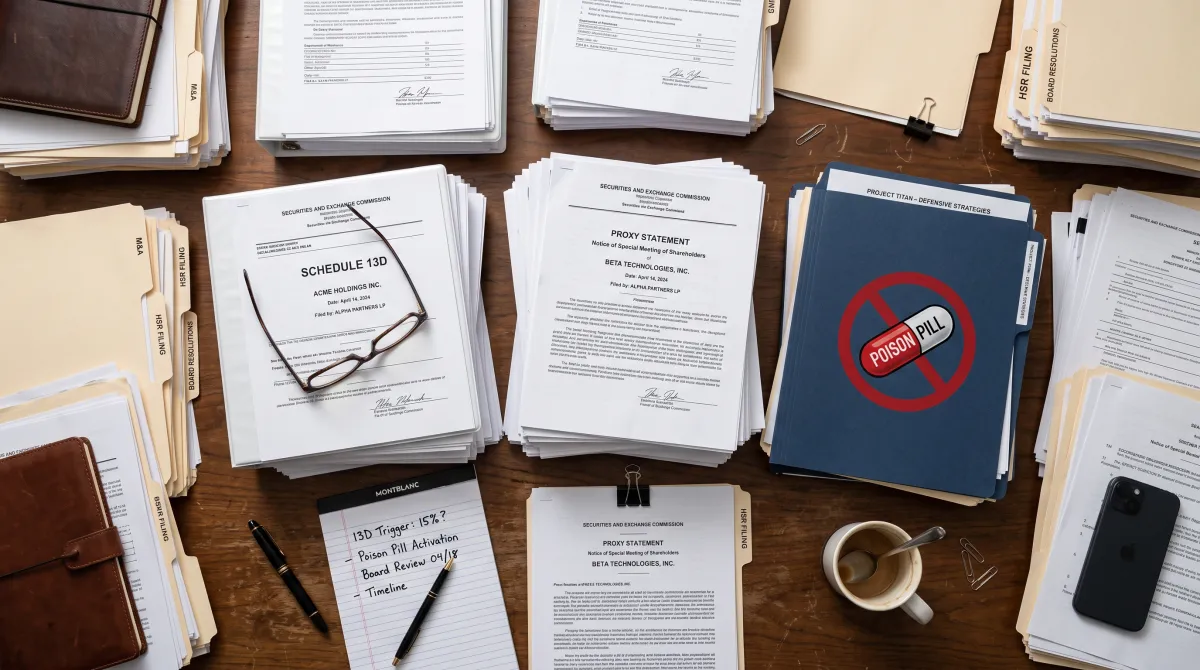
Hostile Takeover Explained: Tactics and Defenses
Once a board rejects an offer, an acquirer has two main paths forward, and most hostile campaigns use one or both before it is over.
A tender offer is a public invitation for shareholders to sell their shares directly to the acquirer, usually at a premium above the current market price. Shareholders decide individually, so the board's opinion no longer controls the outcome.
A proxy fight works differently. The acquirer nominates its own slate of directors and asks shareholders to vote them onto the board at the next annual meeting. Win enough seats, and the new board can approve the deal the old one refused.
Boards rarely sit still. The most common defense is a poison pill, technically a shareholder rights plan, which lets existing investors buy discounted shares the moment an acquirer's stake crosses a set threshold, usually 10% to 20%. That dilutes the bidder's position and makes the deal far more expensive.
A staggered board, where only a third of directors face election each year, buys time by stretching a full board takeover through a proxy fight across two or three annual meetings instead of one. A white knight, a friendlier bidder the target recruits to outbid the hostile one, is another common escape route.
A less common but historically important defense is greenmail, where the target buys back the acquirer's shares at a premium just to make the bidder go away. Congress imposed a 50% excise tax on greenmail profits under Internal Revenue Code Section 5881 in 1986, a change that made the tactic rare in the United States afterward, though it still surfaces in some cross-border deals.
Under SEC rules, any investor who acquires more than 5% of a public company's shares must disclose the stake within ten days by filing a Schedule 13D. That filing is often the first public sign that a hostile campaign is brewing.
| Move | Who uses it | What it does |
|---|---|---|
| Tender offer | Acquirer | Buys shares directly from shareholders at a premium, bypassing the board |
| Proxy fight | Acquirer | Nominates new directors and asks shareholders to vote them onto the board |
| Poison pill | Target board | Lets existing shareholders buy discounted shares once a bidder crosses an ownership threshold |
| Staggered board | Target board | Elects only part of the board each year, slowing a proxy takeover |
| White knight | Target board | Recruits a friendlier acquirer to outbid the hostile one |
Hostile Takeover Examples
Most hostile bids either fail, get sweetened into a friendly deal, or drag on for months before anyone knows the outcome. A few of the more instructive cases:
Oracle vs. PeopleSoft (2003-2005). Oracle launched an unsolicited tender offer for the software maker PeopleSoft in June 2003. PeopleSoft's board adopted a poison pill and fought back through the courts. A federal judge dismissed the Justice Department's antitrust challenge in September 2004, and Oracle completed the $10.3 billion acquisition in January 2005, after an 18-month battle, one of the longest hostile campaigns in tech history.
Kraft Foods vs. Cadbury (2009-2010). Cadbury's board rejected Kraft's initial approach as hostile and undervalued in 2009. Kraft went public with its offer, raised it repeatedly under pressure from Cadbury shareholders, and the two sides agreed on a deal worth about £11.9 billion in January 2010, according to filings with the UK Takeover Panel.
Sanofi vs. Genzyme (2010-2011). French drugmaker Sanofi made an unsolicited $69-per-share bid for the biotech Genzyme in August 2010 after months of private talks stalled. Genzyme's board resisted for months before agreeing to a sweetened offer worth roughly $20 billion in February 2011.
Elon Musk vs. Twitter (2022). Twitter's board adopted a poison pill within a day of Musk's unsolicited $54.20-per-share, $44 billion offer in April 2022, meant to stop any single holder from buying more than 15% of the company without approval. The board reversed course weeks later and accepted the deal, turning what began as a hostile bid into a signed agreement.
A hostile takeover is not really about hostility. It is what happens when a board says no and a buyer decides the shareholders should get the final word instead.

How a Hostile Takeover Unfolds, Step by Step
A hostile takeover usually moves through a predictable sequence: private approach, public pressure, formal offer, board defense, and finally a resolution, whether that is a sale, a proxy vote, or the bidder walking away.
- Private approach. The acquirer contacts the target's board privately, proposing a merger at a set price.
- Bear hug letter. If the board declines, the acquirer sends a public letter laying out the offer, pressuring the board through shareholders and the press.
- Tender offer or proxy fight. The acquirer goes around the board, offering to buy shares directly or nominating a rival slate of directors.
- Defense. The target deploys a poison pill, seeks a white knight, or challenges the bid in court.
- Resolution. The deal closes, the bidder raises its price until the board relents, shareholders vote out the current directors, or the acquirer walks away.
Deal mechanics get most of the coverage, but the people inside the target company live through a different version of the story. A hostile bid usually means weeks of speculation before anyone confirms whether jobs, teams, or entire departments will survive the new ownership.
Leadership reshuffles are common once a deal closes, and staff often start reading every meeting invite for signs their manager is being lined up for a bigger role, or a smaller one, under the new owner.
Office politics tend to sharpen under that kind of pressure too, the same dynamics covered in our guide to recognizing when a coworker's behavior has turned competitive rather than collegial.
Employees who end up job hunting after a takeover-related reorg often need references fast, which is exactly when knowing how to answer in what capacity you know the candidate on a reference form actually matters.
Hostile Takeover FAQ
What is the difference between a hostile takeover and a friendly merger?
In a friendly merger, both boards negotiate and agree to the deal before it becomes public. In a hostile takeover, the target board has rejected the offer, so the acquirer appeals directly to shareholders instead.
What is a bear hug letter in a hostile takeover?
A bear hug letter is a public letter the acquirer sends after a private approach is rejected, laying out the offer publicly and pressuring the board through shareholders and media coverage.
Can a hostile takeover be stopped?
Yes. Boards can deploy defenses like poison pills, staggered boards, and white knight bidders, or challenge the offer in court on antitrust or disclosure grounds. Many hostile bids end in a higher, friendlier price rather than an outright block.
Is a hostile takeover illegal?
No. Hostile takeovers are legal in most jurisdictions as long as the acquirer follows securities disclosure rules, such as reporting large stakes to regulators like the SEC. What makes a deal "hostile" is the board's rejection, not a violation of law.
What happens to employees after a hostile takeover?
Employees typically face a period of uncertainty while leadership and integration plans are finalized, and layoffs or restructuring are common once the deal closes, especially in roles that overlap between the two companies.