Business Concepts
Hospitality Management (2026): Roles, Skills, Software
Hospitality management runs hotels, restaurants, and resorts. See the core roles, software stack, and staffing playbook that keep operations running.

Hospitality management is the discipline of running guest-facing businesses, hotels, restaurants, resorts, and event venues, so that staffing, budgets, and service standards work together instead of against each other. It blends front-of-house guest care with back-of-house logistics: schedules, inventory, vendors, and technology. Anyone who leads a property relies on it daily, whether they use the term or not.
Quick answer
Hospitality management is the coordinated running of guest-facing businesses, covering operations, staffing, finance, and service quality. It applies core business management principles but adds 24/7 staffing, perishable inventory, and real-time service recovery that most other industries never have to handle at once.
Key takeaways
- Hospitality management centers on four pillars: front office, food and beverage, housekeeping, and revenue management.
- It differs from general business management mainly through 24/7 staffing demands and perishable inventory.
- Workforce management software and HR management software address the scheduling and turnover problems that hit hospitality hardest.
- Inventory and expense management software prevent the stock-outs and waste that erode already thin margins.
- Small operators can start with free project management and inventory tools before paying for a full property management system.
What Is Hospitality Management?
Hospitality management is the practice of planning, staffing, and overseeing businesses whose core product is a guest experience: hotels, restaurants, resorts, and event venues. It covers front-desk service and housekeeping, food and beverage, revenue management, and the vendor relationships that keep a property running smoothly.
Cornell University created the world's first four-year hotel management degree in 1922, turning hospitality from an apprenticed trade into a formal business discipline, according to Cornell's SC Johnson College of Business. That shift is why hospitality management today looks like a specialized branch of general management, not a separate craft.

Hospitality Management Explained
Every property, regardless of size, runs on the same four functions. Front office handles reservations, check-in, and guest requests. Food and beverage covers kitchens, bars, and banquet service. Housekeeping manages room turnover and cleanliness standards. Revenue management sets pricing and inventory to maximize occupancy and rate at once.
Hospitality management is a specialized branch of business management, applying the same planning, staffing, and financial-control principles to a product guests consume in real time. The difference is intensity: a hotel or restaurant cannot pause service to fix a staffing gap the way a back-office company can.
Travel and tourism, the sector hospitality management ultimately serves, generated close to 10% of global GDP before the pandemic disrupted travel, according to the World Travel and Tourism Council. That scale is why even small efficiency gains in staffing or inventory management move real money.
Workforce and HR Management in Hospitality
The National Restaurant Association counts roughly 12.5 million people working in U.S. restaurants, an industry where annual staff turnover regularly tops 70%, according to restaurant.org. Hotels see similarly volatile staffing, driven by seasonal demand and split shifts.
Workforce management software forecasts labor demand against bookings or reservations, then builds schedules that match. HR management software handles onboarding, certifications, and benefits across a workforce that often turns over faster than a manager can train it.
Understaffing is the single biggest driver of hospitality burnout. Managers who chronically run a property short-handed are effectively setting their own teams up to fail; if that pattern sounds familiar from the inside, the signs you are being set up to fail at work are worth checking before it costs you the team.
Hospitality Management Software Stack
Most operational pain in hospitality comes down to a handful of software categories, whether the property is a 12-room bed and breakfast or a 400-room resort.
| Category | What it solves in hospitality |
|---|---|
| Inventory management software (small business) | Tracks linens, amenities, and F&B stock so a shift never runs out mid-service. |
| Expense management software | Captures vendor invoices and per-department spend across housekeeping, kitchen, and maintenance. |
| Customer communication management software | Centralizes guest messages from booking sites, email, and text into one inbox. |
| Transportation management software | Schedules airport shuttles, valet, and group transfers without double-booking vehicles. |
| IT asset management software | Tracks the tablets, POS terminals, and door-lock hardware spread across a property. |
| Facilities management software | Logs maintenance tickets, preventive upkeep, and vendor contracts for the building itself. |
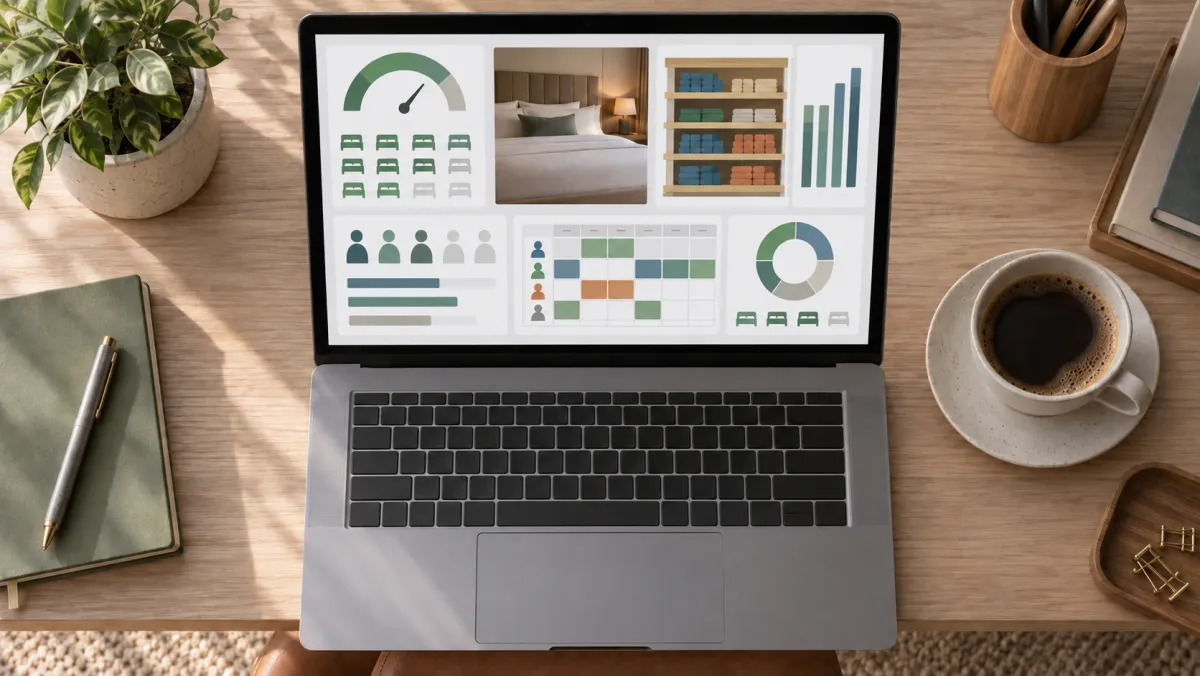
A small inn or independent restaurant rarely needs enterprise software on day one. Free project management software can run a renovation or a seasonal menu launch, and free inventory management software covers basic stock counts until order volume justifies a system built for hospitality.
Guest acquisition adds a layer most other industries skip: managing online travel agencies, metasearch, and direct bookings at once. Every commission paid to a large booking platform is a form of reintermediation, the return of a middleman that direct-booking campaigns exist to reduce.
Hospitality management is the only discipline where the product, the factory, and the sales floor are the same room, at the same time, with a guest watching.
Hospitality Management Examples
A boutique hotel's general manager reviews occupancy and rate data each morning, adjusts staffing for the day's check-ins, and reconciles the previous night's food and beverage revenue, all before the front desk opens.
A regional restaurant group applies the same discipline across dozens of locations, standardizing recipes, labor targets, and vendor pricing so one site's margin does not depend on one manager's instincts.
Resorts piloting AI chatbots for guest requests or dynamic pricing engines are testing the same trade-off every hospitality tech rollout faces: faster service weighed against the benefits and risks of innovation when a system fails during peak occupancy.
How to Apply Hospitality Management
- Map the guest journey end to end, from booking to checkout, and assign clear ownership for each stage.
- Staff to demand, not to habit, using booking or reservation data to build schedules ahead of peaks.
- Standardize SOPs across departments so service quality does not depend on who is on shift.
- Track cost per occupied room or cost per cover weekly, not just at month end.
- Build a supply chain plan for perishables and amenities before you need it, not after a stock-out.
- Add software by department, starting with the biggest bottleneck, instead of buying one system for everything at once.
Hospitality Management: FAQ
What is supply chain management in a hospitality context?
Supply chain management in hospitality is the process of sourcing, ordering, and moving food, linens, and amenities from vendors to the property on schedule. It matters more here than in most industries because F&B inventory is perishable and stock-outs are visible to guests immediately.
What is the best project management software for a hospitality business?
The best project management software depends on the task: board-based tools work well for renovations and event planning, while simpler checklist tools suit recurring tasks like pre-opening or seasonal changeovers. Match the tool to the project instead of picking one system for everything.
What should I look for in inventory management software for a small business hospitality operation?
Look for real-time stock counts, low-stock alerts, and integration with your point-of-sale or booking system. A small property does not need enterprise features, just accurate counts that prevent running out of amenities or ingredients mid-shift.
How does inventory management software change once a small business runs multiple properties?
Multi-property inventory management software adds centralized purchasing and cross-location transfers, so a resort chain can move surplus stock between sites instead of over-ordering at each one. Single-property tools rarely support that transfer function.
What does stock management software track that generic inventory software misses?
Stock management software built for food service tracks expiration dates, FIFO rotation, and waste by ingredient, not just unit counts. That level of detail is what keeps a kitchen's food cost percentage in line.