Workplace & Career
Exit Interview Question: 30 to Actually Ask (2026)
The best exit interview questions get honest answers. See 30 to ask, the ones to skip, and how to run the conversation so departing staff actually talk.

Most exit interviews fail before the first question lands. The person has one foot out the door, HR reads from a generic form, and both sides perform politeness. A sharp exit interview question cuts through that. It gets someone who is leaving to tell you what they would never say while still on payroll.
Quick answer
The best exit interview questions are open-ended, specific, and non-defensive. Ask why the person first started looking, what would have made them stay, and how the work actually felt day to day. Avoid yes/no prompts and anything that sounds like you are defending the company.
Key takeaways
- Open questions beat checkbox forms. "What made you start looking?" surfaces more than any rating scale.
- The single most valuable question is "What would have made you stay?"
- Run it after the resignation is final, ideally with a neutral interviewer, not the person's manager.
- Patterns across many interviews matter more than any single exit. Track themes, not anecdotes.
- Close the loop: tell the team what you changed, or the data goes to waste.
What Is an Exit Interview Question?
An exit interview question is any prompt you put to a departing employee to understand why they are leaving and what their experience was really like. The exit interview itself is a structured conversation, usually in the final week, and the questions are the engine that makes it useful.
Not all questions for an exit interview carry equal weight. A rating from one to five tells you little. A question that asks for a story, a moment, or a turning point tells you almost everything. The goal is candor, not a tidy form.
If you are still defining the format itself, start with our guide to running an exit interview before you pick your questions. The shape of the conversation changes which questions land.
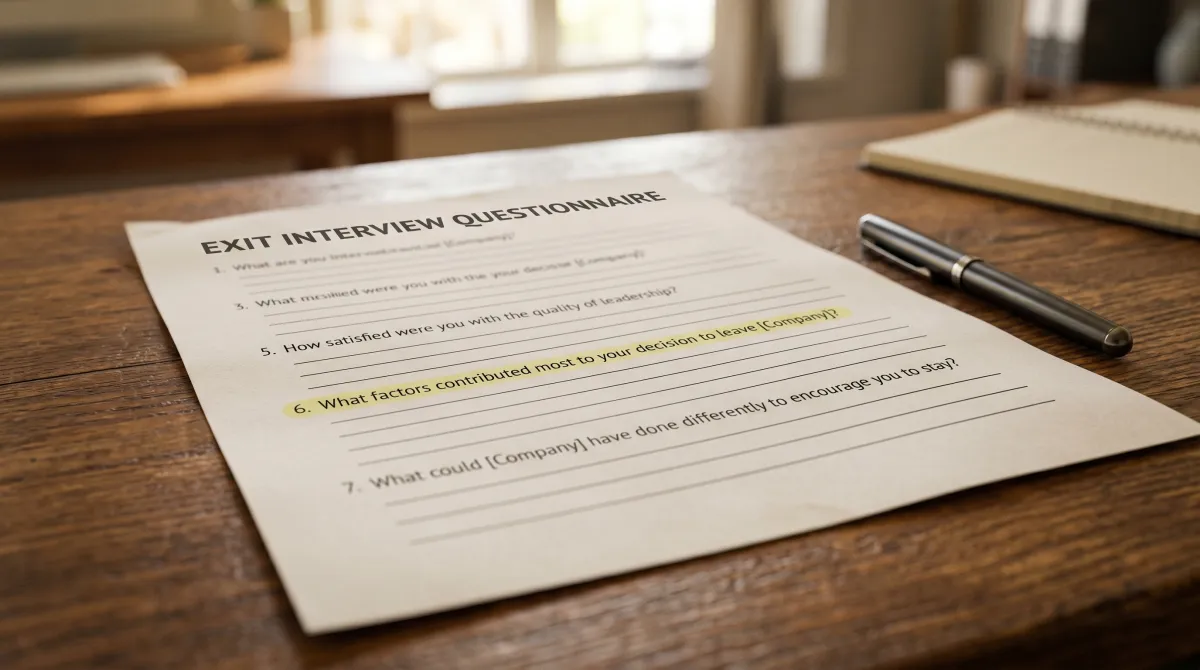
Why the Right Questions for an Exit Interview Matter
People rarely quit for the reason on the resignation letter. "New opportunity" usually masks something specific: a manager, a missed promotion, burnout, or a promise that never materialized. The right interview exit questions pull that real reason into the open.
The payoff is retention. Every theme you catch in an exit is a signal about the people still in their seats. When five leavers mention the same broken process, you are not hearing five complaints. You are hearing one problem that is quietly costing you more.
An exit interview is the cheapest market research you will ever run. The hard part is asking questions honest enough to deserve an honest answer.
Exit Interview Question: The Practical Guide
Below are 30 questions, grouped by what they uncover. There is no single perfect question for exit interview success; the right mix depends on the role and the exit.
Print these questions for exit interview rounds, pick eight to ten that fit the situation, and leave room to follow threads as they appear.
The departure itself
- What made you start looking for a new role?
- What was the deciding moment?
- What would have made you stay?
- Did you raise any of these concerns while you were here? What happened?
- Was there a single event that tipped you toward leaving?
The job and the work
- Did the role match what you were told during hiring?
- What part of the job did you enjoy most, and least?
- Did you have the tools, budget, and information to do your work well?
- Were your goals clear and reasonable?
- What slowed you down most often?
Management and the team
- How would you describe your relationship with your manager?
- Did you get useful, regular feedback?
- Did you feel recognized for good work?
- How would you describe the team's culture to a friend?
- What is one thing your manager could have done differently?
Growth and pay
- Did you see a path to grow here?
- Was your compensation fair for the work and the market?
- Did you get the development or training you expected?
- What skill did you want to build that you could not here?
The forward look
- What does your new role offer that this one did not?
- What should we change for the person who replaces you?
- Would you recommend this company to a friend? Why or why not?
- Would you ever consider coming back?
- Is there anything we have not asked that you want us to know?
Notice the pattern. Almost none of these are yes/no. The strongest questions in an exit interview ask for a comparison, a moment, or a recommendation, because those force a real answer instead of a polite one.
Open vs. closed: a quick contrast
| Type | Example | What you get |
|---|---|---|
| Closed (weak) | "Were you happy here?" | "Mostly, yeah." Dead end. |
| Rating (thin) | "Rate your manager 1-5." | A number with no context. |
| Open (strong) | "What would have made you stay?" | The real reason, in their words. |
| Forward (strategic) | "What should we change for your replacement?" | A concrete fix, no defensiveness. |

How to Run the Conversation
The questions are only half the job. Timing and tone decide whether anyone tells you the truth. Run the interview after the resignation is fully accepted, when there is nothing left to protect.
Use a neutral interviewer where you can. People will not critique a manager to that same manager's face. A peer from HR or a different team lead gets far more candor out of the same list of questions for an exit interview.
Keep the number of questions in exit interview sessions tight, eight to ten, so each one gets a real answer. Open with low-stakes prompts, then move into the harder ones once the person relaxes.
Listen more than you talk. When an answer is interesting, stay silent for a beat. The follow-up they volunteer is often the real headline.
Whatever they raise, do not defend the company in the room. The moment you argue back, the candor stops. This is one of the core habits of good people management, and it is the easiest one to forget under pressure.
Common Mistakes with Interview Exit Questions
The first mistake is treating the form as the goal. A checkbox survey collects data nobody reads. Build space for stories, and someone has to actually read them.
The second is collecting answers and changing nothing. Trust collapses fast when staff watch colleague after colleague flag the same issue while leadership stays still. Track themes across many exits, act on the loud ones, and tell the team what moved.
The third is asking leading questions. "You loved working here, right?" is not a question, it is a request for a compliment. Keep every prompt neutral so the answer can go either way.
For the wider context on retention and team health, the workplace hub connects the dots across hiring, culture, and offboarding.
You can also read the broader background on the practice via this overview of exit interviews.
Related guides
FAQ
What are the best questions for an exit interview?
The best questions for an exit interview are open-ended: "What made you start looking?", "What would have made you stay?", and "What should we change for your replacement?" These force specific, honest answers instead of yes/no replies, and they reveal the real reason behind the departure.
What is one essential question for an exit interview?
If you only ask one question for an exit interview, ask "What would have made you stay?" It surfaces the single fixable factor that pushed the person out, and it often exposes a problem affecting employees who are still on the team.
What interview exit questions should you avoid?
Avoid leading or defensive interview exit questions like "You enjoyed it here, right?" and thin rating scales with no follow-up. They produce flattering, useless answers. Replace them with neutral, open prompts that invite a real story.
How many questions in an exit interview is enough?
Eight to ten well-chosen questions in an exit interview is plenty for a 30 to 45 minute conversation. Fewer, deeper questions with room for follow-up beat a long checklist that nobody has time to answer properly.