Leadership
Communication Styles Quiz (2026): Score Yourself in 5 Min
Take this free communication styles quiz to find your default style under pressure, then learn exactly how to flex it. Score yourself and see which type fits.

A good communication styles quiz does one thing well: it shows you the default pattern you fall back on under pressure, before you say something you regret in a meeting. Most people have never named their style, so they keep colliding with colleagues for reasons they can't explain.
This guide gives you a practical, self-scored quiz and, more importantly, what to actually do with the result. If you lead a team, it doubles as a fast diagnostic for why two good people keep talking past each other.
Quick answer
A communication styles quiz is a short self-assessment that maps how you express needs, handle conflict, and process information. Most map you to four styles: assertive, passive, aggressive, and passive-aggressive, or to analytical, intuitive, functional, and personal. Score yourself, find your dominant style, then learn to flex it.
Key takeaways
- A quiz reveals your default style under stress, not a fixed personality label.
- Most frameworks use four styles; assertive is the healthiest target for nearly everyone.
- Your result is a starting line, not a verdict. The value is in flexing your style to the person in front of you.
- Re-take it every 6 to 12 months. Roles, teams, and pressure change your defaults.
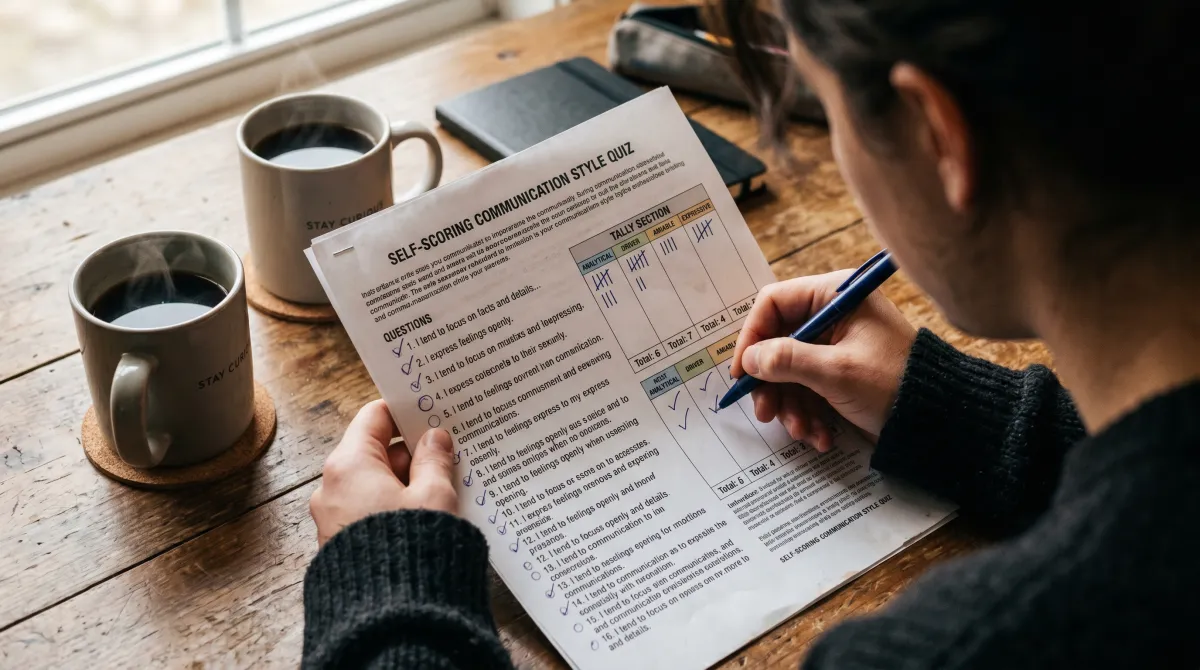
What Is a Communication Styles Quiz?
A communication styles quiz is a structured set of questions that surfaces how you naturally send and receive information. It looks at your tone, your comfort with conflict, how much detail you want, and whether you lead with facts or feelings.
It is not a personality test in the clinical sense. Think of it closer to a mirror you hold up during a tense Friday afternoon, when your real patterns show rather than your polished ones.
Good versions are rooted in established theory. Many borrow from assertiveness research and from broader models of interpersonal communication, which is why a solid quiz on communication styles tends to point you toward the same few archetypes.
If you want to see how this fits the bigger picture, our wider guide to communication at work shows where your style sits among the skills that move teams.
Why Knowing Your Style Beats Guessing
Most workplace friction is not about competence. It is two people running incompatible default settings and assuming bad intent. The analytical person reads the personal communicator as vague; the personal communicator reads the analyst as cold.
A quiz cuts that loop short. Once you can name your own pattern, you stop treating a clash of styles as a clash of character.
It also gives you a shared language. "I default to passive under pressure" is a sentence a team can work with. "You always shut down in meetings" is an accusation that goes nowhere.
The Communication Styles Quiz: Score Yourself
Answer honestly based on how you behave most of the time, not how you wish you behaved. For each statement, give yourself 1 (rarely), 2 (sometimes), or 3 (often).
| Statement | Style it scores |
|---|---|
| I say what I need directly, without apologising for it | Assertive |
| I go quiet to keep the peace, even when I disagree | Passive |
| I raise my voice or talk over people when I feel strongly | Aggressive |
| I agree out loud but show my frustration in other ways | Passive-aggressive |
| I want the data and the bottom line before the story | Analytical |
| I read the room and lead with how people feel | Personal |
Tally each style. Your highest score is your dominant style. Your second highest is your backup, the one you switch to when the first one fails you.
One caveat: score yourself twice if you can. Once for how you act with people you trust, once for how you act in a high-stakes room. The gap between those two columns is where most of your blind spots live.
Your quiz result is not who you are. It is the script you reach for when you stop thinking.

What Your Communication Style Result Means
Each style has a strength and a failure mode. Knowing both is the whole point. Here is the operator's read on each one.
Assertive
The target style. You state needs clearly and respect others doing the same. The risk: in low-trust rooms, directness can land as blunt, so pace it and check faces.
Passive
You prioritise harmony and rarely create friction. The cost is real, though. Unspoken needs pile up until they leak out sideways, usually at the worst possible moment.
Aggressive
You get heard and decisions move fast. But you win the argument and lose the relationship. People stop bringing you bad news, which is exactly when you need it most.
Passive-aggressive
This is the conflict-avoidant style with a sharp edge. The sarcasm and the quiet sabotage are signals that an honest conversation is long overdue.
Analytical and personal
These sit on a second axis: how you process. Analytical leads with data and wants the bottom line first. Personal leads with relationship and wants to know everyone is okay before the work starts. Neither is wrong; they just need translating for each other.
Communication Styles Quiz: The Practical Guide to Using Your Result
A result you don't act on is trivia. Here is how to turn one quiz into better conversations this week.
Flex, don't fix. You are not trying to delete your style. You are learning to borrow another one when the situation needs it. An analytical lead talking to a personal-style designer should open with the why, not the spreadsheet.
Name your default out loud. Telling a colleague "I process by asking lots of questions, it's not me doubting you" removes half the friction instantly. It reframes a quirk as a heads-up.
Watch your stress response. The quiz captures your calm-state answers. Notice which style you collapse into when a deadline slips. That gap is your real growth edge, not the label you scored highest on.
Build a one-line cheat sheet. For each key colleague, jot their likely style and the one move that works on them. Lead with data for the analyst, with context for the personal communicator. Small prep, large payoff.
If you manage people, this becomes leverage. Mapping your whole team's styles cuts the number of misfires in day-to-day management, because you stop assigning bad intent to a simple mismatch.
The same awareness lowers low-grade tension across the wider workplace, where most friction is two defaults grinding against each other rather than a real disagreement.
How Accurate Are These Quizzes?
Accurate enough to be useful, not precise enough to be gospel. A quiz captures a self-reported snapshot, and people consistently under-rate their own aggression and over-rate their assertiveness.
Treat it as a conversation starter, not a diagnosis. The most reliable signal comes from re-taking it after a hard quarter, then asking a trusted colleague whether the result matches what they actually see.
Pair your own answers with feedback from one person who will be honest with you. Self-report plus an outside read beats either one alone, and it catches the styles you are quietly defensive about.
FAQ
What is the best quiz on communication styles?
The best quiz on communication styles is the one tied to a clear model you can act on, usually the four-style framework of assertive, passive, aggressive, and passive-aggressive. Avoid quizzes that give you a fun label with no guidance on what to change.
How long does a communication styles quiz take?
A focused self-scored quiz takes about five minutes. The scoring above is intentionally short so you can do it before a meeting and use the result the same day.
Can my communication style change over time?
Yes. Your default shifts with role, team, and stress level. That is why re-taking the quiz every 6 to 12 months gives a more honest picture than a single result.
What are the four main communication styles?
The four main styles are assertive, passive, aggressive, and passive-aggressive. Assertive is the healthiest target because it balances stating your needs with respecting others.