Business Concepts
Business Owner's Policy (BOP): What It Covers (2026)
A business owner's policy (BOP) bundles general liability and property coverage into one plan. See what it covers, excludes, and costs before you buy in 2026.
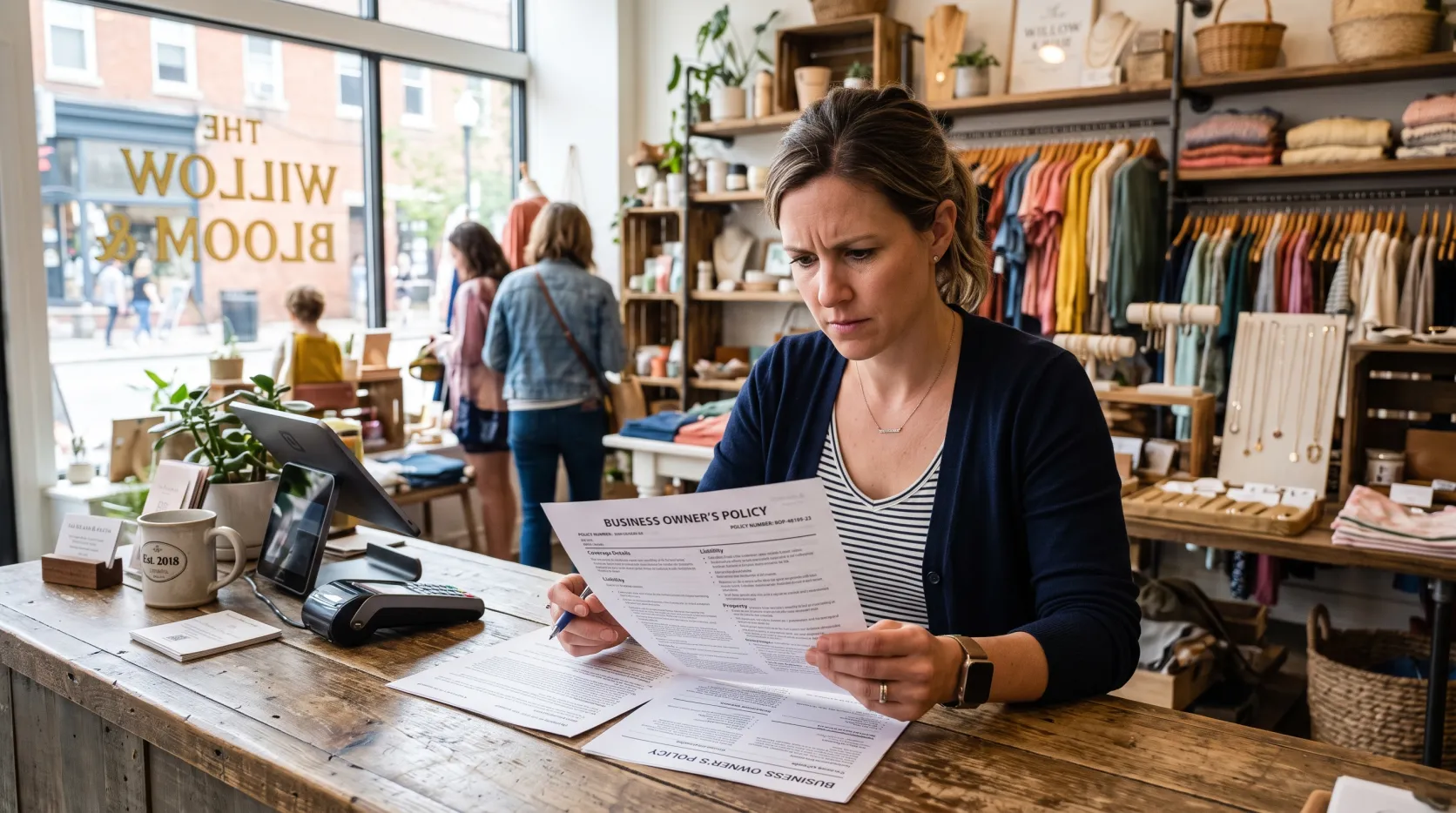
A business owner's policy (BOP) bundles two of the most common coverages, general liability and commercial property, into one contract with a single premium. Most owners choose one instead of shopping separately because it is faster to buy and usually cheaper, and it covers the claims that shut down a small operation fastest: a customer's fall, a kitchen fire, a burst pipe.
Quick answer
A business owner's policy (BOP) is a package policy that combines general liability and commercial property insurance, and usually business interruption coverage, into one plan built for small and mid-sized businesses. It typically costs less than buying each policy separately, but it excludes professional liability, workers' compensation, commercial auto, and cyber coverage.
Key takeaways
- A BOP combines general liability, commercial property, and usually business interruption coverage in one policy.
- Eligibility depends on industry risk, employee count, and location value, so high-risk trades often don't qualify.
- Professional liability, workers' compensation, commercial auto, and cyber liability are never included and must be added separately.
- Premiums vary by industry, square footage, revenue, and claims history, so quotes from more than one carrier matter.
- Confirming your legal business name through a state entity search speeds up the application.
What Is a Business Owner's Policy (BOP)?
A business owner's policy answers one of the first core business concepts every new owner runs into: how do you protect the company from the claims that happen most often? Instead of buying general liability and commercial property as two separate contracts, a BOP folds them into one policy with one renewal date.
Most BOPs also include business interruption coverage, sometimes called business income coverage. If a covered event forces you to close temporarily, it replaces lost income and covers ongoing expenses like rent and payroll while you rebuild.
Insurers built the BOP for small and mid-sized businesses with predictable, moderate risk: offices, retail stores, restaurants, and many service businesses. It is part of everyday business management, not a specialty product reserved for large manufacturers or high-hazard operations.

What a BOP Covers, and What It Excludes
General liability inside a BOP responds to third-party bodily injury, property damage, and advertising injury claims. Coverage typically starts at $1 million per occurrence and $2 million aggregate, the baseline the Insurance Information Institute cites as what most commercial leases and client contracts require.
Commercial property coverage protects the business building you own or lease, along with equipment, inventory, and signage, against fire, wind, theft, and vandalism. Limits should match the replacement cost of your space, not just its market value.
A BOP does not cover everything. Professional liability, also called errors and omissions, is excluded, so consultants and agencies still need a separate policy for mistakes in their advice or work.
Workers' compensation is required by law in 49 states, the lone exception being Texas, according to the U.S. Department of Labor, and it is never bundled into a standard BOP. As you hire your first employees, learning to spot signs you are being set up to fail at work from their side can help you head off the disputes that turn into liability claims.
Cyberattacks that compromise customer data, payment systems, or online accounts also fall outside a standard BOP. So does fraud involving forged checks or employee theft, both of which need a crime or cyber liability endorsement.
Commercial auto coverage is excluded too. If the business owns vehicles or employees drive for work, a separate commercial auto policy is required regardless of what the BOP includes.
| Included in a standard BOP | Requires a separate policy |
|---|---|
| General liability | Professional liability / errors and omissions |
| Commercial property | Workers' compensation |
| Business interruption | Commercial auto |
| Signage and equipment | Cyber liability |
Business Owner's Policy (BOP) Explained: How Pricing Works
Insurers price a BOP around five factors: industry classification, location and building value, square footage, annual revenue, and claims history. A quiet home-based consultancy pays far less than a restaurant running a full kitchen.
Carriers also weigh where the business sits. A storefront in a flood zone or a high-crime area raises the property portion of the premium even when the liability risk stays the same.
Bundling coverage into one BOP is usually cheaper than buying general liability and commercial property from two different carriers, since the insurer spreads its underwriting cost across a single policy instead of two.
Adding endorsements, such as equipment breakdown or higher liability limits, raises the premium but mirrors the benefits and risks of innovation found everywhere else in the business: spend a little more upfront to avoid a much larger loss later.
Business Owner's Policy (BOP) Examples
A boutique clothing store: commercial property covers inventory damaged in a burst pipe, while general liability covers a customer who slips on a wet floor and sues for medical bills.
A small marketing agency: the BOP's property coverage protects office equipment after a fire, but the agency still needs a separate professional liability policy if a client blames a campaign for financial harm.
A neighborhood cafe: business interruption coverage replaces lost income and covers rent while the cafe rebuilds after a kitchen fire closes it for two months, and general liability covers a delivery driver injured on-site.
An independent contractor doing light renovations: the BOP covers a client's damaged flooring from an accident, but the contractor still needs commercial auto coverage for the work truck and tools in transit.

Getting Business-Ready Before You Buy a BOP
Insurers ask for your exact legal business name before quoting a policy, so confirm it is on record first. Run a Wyoming business entity search, check the Oregon business registry through an Oregon business search, or pull a Missouri business search, depending on where you are registered.
Once the entity is confirmed, open a dedicated business bank account and order business checks so premium payments and any claims reimbursements stay separate from personal funds. If you bank with a major provider, chase business customer service can walk you through setting up autopay for recurring premiums.
Reliable business internet matters here too, since most carriers now handle applications, endorsements, and claims filing entirely online, and a dropped connection during a claim can delay repairs to the building.
You do not need one of the popular business degrees or business majors to understand a BOP. Marketplaces such as Simply Business let owners compare quotes from multiple carriers side by side, a modern form of reintermediation in an industry that spent years cutting out middlemen.
How to Apply for a Business Owner's Policy (BOP)
Follow these steps once the business is registered and ready to shop.
- Confirm entity registration through the state's business search, then gather the EIN, revenue estimate, and square footage.
- List the assets: building or leased space value, equipment, inventory, and signage, so property limits match replacement cost.
- Get quotes from at least three sources, including a marketplace, a direct carrier, and a local independent agent.
- Compare exclusions line by line, not just price, since two similarly priced BOPs can carry very different limits.
- Add the endorsements the business actually needs, such as cyber liability or higher limits, before binding the policy.
The cheapest BOP is worthless if it excludes the one claim that actually shuts your business down.
Business Owner's Policy (BOP): FAQ
What payroll services for small business work well alongside a BOP?
Providers such as Gusto, QuickBooks Payroll, and OnPay handle wage calculations and tax filings, and pairing one with a BOP and a separate workers' compensation policy covers both the financial and liability sides of having employees.
Can a virtual address for business be used when applying for a BOP?
Yes, but insurers still price the policy based on where operations actually happen, so a virtual address for mail does not replace disclosing the real work location on the application.
Where can I find business plan examples that include insurance costs?
The U.S. Small Business Administration and SCORE both publish business plan examples with sample budget line items, and a BOP premium typically belongs in the fixed operating expenses section.
Do I still need QuickBooks for small business if I already have a BOP?
Yes, insurance and accounting solve different problems. QuickBooks for small business tracks income and expenses, including the BOP premium, while the policy itself covers property damage and liability claims.
Is QuickBooks Online for small business enough to track BOP claims?
QuickBooks Online for small business can log claim payments and deductibles as transactions, but the insurer's claims portal or adjuster still handles the actual claims process and documentation.