Business Concepts
Business Continuity Plan (2026): What You Actually Need
A business continuity plan keeps your company running through outages, cyberattacks, or lost suppliers. Get the steps and free templates to build one.

A business continuity plan is the written playbook that keeps your company running, or gets it running again fast, when something breaks: a flood, a ransomware attack, a bank outage, or a key vendor disappearing overnight. Without one, a bad week can turn into a business you no longer own.
Quick answer
A business continuity plan is a documented set of procedures that lets an organization keep critical functions running, or resume them quickly, after a disruption such as a natural disaster, cyberattack, supplier failure, or extended outage. It covers risk assessment, recovery strategy, communication, and testing.
Key takeaways
- A business continuity plan identifies your critical functions and how fast each one must come back online.
- Risk assessment and a business impact analysis come before you write any recovery steps.
- Banking, insurance, and legal paperwork need their own backup plan, not just IT systems.
- ISO 22301 and NFPA 1600 are the standards most certified continuity programs follow.
- A plan nobody has tested is a plan that will fail on the day it matters.
What Is a Business Continuity Plan?
A business continuity plan, often shortened to BCP, is a documented strategy that tells your team exactly what to do when normal operations stop. It names the people in charge, the order in which functions get restored, and how long the business can survive without each one.
The concept is formally described on Wikipedia's business continuity planning entry as part of a wider discipline called business continuity management, which also covers crisis communication and disaster recovery for IT systems specifically.
It sits inside the wider field of core business concepts that every operator eventually has to learn, usually right after the first outage that costs real money.
Business Continuity Plan Explained
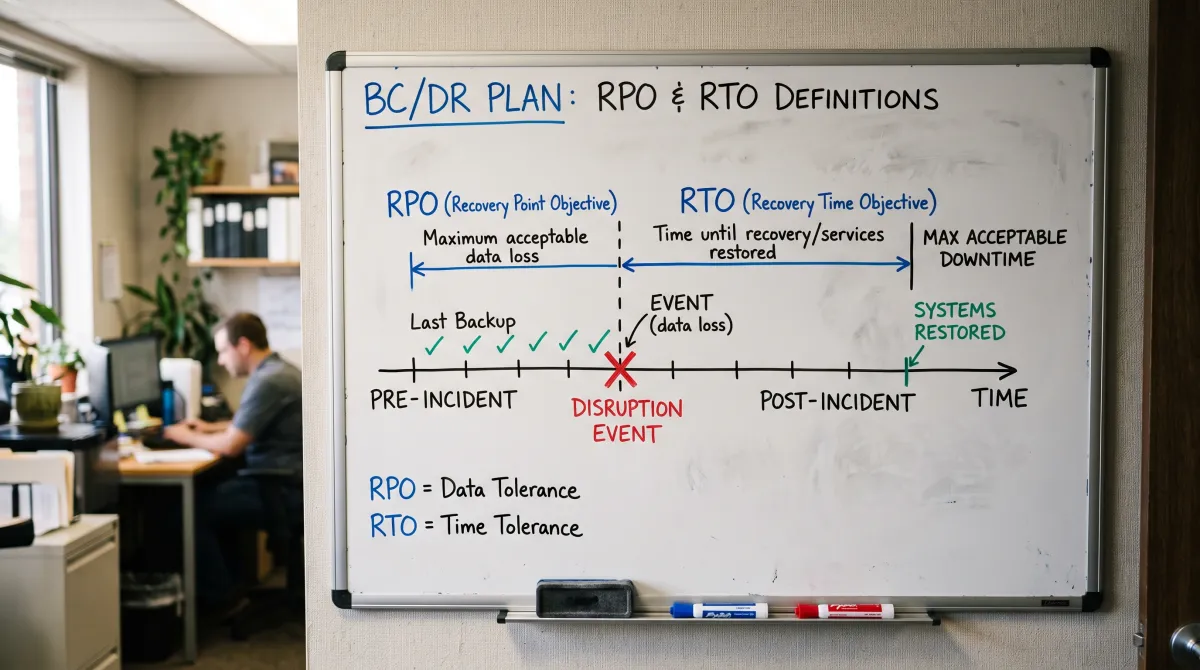
Every serious plan starts with a business impact analysis, or BIA. This step ranks each function, payroll, order fulfillment, customer support, by how much revenue or reputation you lose per hour it stays down.
From the BIA you get two numbers that drive everything else: recovery time objective (RTO), the maximum acceptable downtime, and recovery point objective (RPO), how much data loss you can tolerate. Both concepts were formalized under ISO 22301:2019, the international standard for business continuity management systems, which replaced the original 2012 edition.
In the United States, NFPA 1600, maintained by the National Fire Protection Association, is the benchmark standard auditors and insurers check against when they ask if your continuity program is credible.
Once you know your RTO and RPO, you build recovery strategies: backup sites, remote work protocols, alternate suppliers, and manual workarounds for systems that go down. The plan documents who executes each strategy and in what order.
A continuity plan you have never tested is just a comforting document, not a plan.
Testing closes the loop. Tabletop exercises, simulated outages, and full failover drills expose the gaps a plan looks fine on paper but that nobody could actually execute under pressure.
Business Continuity Plan Examples

A regional bakery chain loses its main kitchen to a fire. Its continuity plan already names a backup commercial kitchen twenty minutes away, a list of three suppliers who can deliver flour same day, and a script for the manager to text every location by 6 a.m.
A software company gets hit with ransomware. Its plan does not pay the ransom; it restores from an offline backup tested the prior quarter, switches customer support to a status page, and routes engineers through a pre-approved incident checklist instead of improvising.
A manufacturer loses its main overseas supplier overnight. Its plan already maps two backup vendors and treats the shakeup the same way it would evaluate reintermediation of a supply chain: who fills the gap, and at what cost.
A retailer's bank has a multi-day outage on its business banking platform. The plan lists a backup account at a second bank, printed copies of the last month's statements, and a manual process for issuing paper business checks until online access returns.
How to Apply a Business Continuity Plan
Assign an owner before you write a single page. Most companies hand this to whoever already owns operational risk: a COO, an office manager, or someone with a business management background. It is standard material in business degrees and business majors like operations management, so staff with that education are a natural fit to lead it.
Banking and admin continuity gets skipped more than anything else. Save your bank's emergency line separately from the app; Chase business customers should keep the Chase business customer service number written down, not just bookmarked, since a login outage can lock you out exactly when you need help. Get a backup business internet connection so your point of sale and email do not go dark during a local outage.
Confirm your commercial policy actually covers business interruption, not just property damage. Owners who shop coverage through brokers like Simply Business should ask that question directly, and every US carrier should be able to answer it in one call.
Part of continuity is proving your business still legally exists after chaos hits. If you incorporated in Wyoming, keep a saved Wyoming business entity search result on file. Businesses registered in Oregon or Missouri should do the same with the Oregon business registry, or an Oregon business search, and the Missouri business search tool, so you can show active status to a lender or landlord within minutes.
If your business building itself becomes unusable, from fire, flood, or a long power outage, your plan needs a pre-arranged backup location named in advance, not sourced in a panic while customers wait.
New tools change what recovery looks like every year, from cloud failover to AI-monitored alerts that flag a disruption before customers notice. Weigh each addition against the benefits and risks of innovation before you bolt it onto the plan, since more tools also means more things that can fail.
Communication failure sinks more recovery efforts than the disaster itself. If employees only learn their role during the emergency, you have created the same dynamic as being set up to fail at work, just at company scale. Put the calling tree, backup contacts, and decision authority in writing before you need them.
Review the plan at least once a year, and after every real incident. The U.S. Small Business Administration's emergency preparedness guide and FEMA's Ready.gov continuity program both offer free templates if you are starting from a blank page.
Business Continuity Plan: FAQ
Do I need payroll services for small business continuity?
Yes. If your payroll provider goes down or your office is inaccessible, a cloud-based payroll service lets you still pay employees on time, which keeps staff from walking away during a crisis.
Should I set up a virtual address for business continuity?
A virtual address gives you a mailing address and mail-scanning service that keeps working even if your physical office is closed, so legal notices and checks still reach you.
Where can I find business plan examples for continuity?
The SBA and Ready.gov both publish free business plan examples and continuity templates you can adapt, rather than starting your plan from a blank document.
Does QuickBooks for small business help with continuity planning?
QuickBooks keeps your financial records in the cloud, so if your office or computers are destroyed, you can still access invoices, payroll data, and cash flow history from any device.
Is QuickBooks Online enough for financial continuity?
QuickBooks Online covers financial record continuity, but it is not a full business continuity plan by itself; you still need separate plans for staffing, facilities, and communication.