Business Concepts
Business Coach (2026): Costs, Options, and How to Choose
A business coach costs $150-$500/hour or $500-$3,000/month depending on your stage. Compare formats, vet credentials, and see which fits your budget.

A business coach is the person you hire when you already know your numbers but keep making the same mistakes anyway. Good ones cut months off your learning curve. Bad ones burn a retainer on generic advice you could get from a podcast.
Quick answer
The best business coach for most owners is a credentialed one-on-one coach charging $150 to $500 per hour, or $500 to $3,000 per month on retainer, matched to your stage: startup, growth, or scale. Group coaching and free SCORE mentors work well for tighter budgets.
Key takeaways
- Business coaching runs $150 to $500 per hour for most owners, with $500 to $3,000 monthly retainers being typical.
- Executive and C-suite coaching costs considerably more, often $10,000 to $25,000 for a multi-month engagement.
- A business degree is not required to coach or to hire one, track record and references matter more.
- Before you hire a coach, confirm the operational basics: entity registration, business bank account, insurance, and internet are handled.
- Free options exist through SCORE, a nonprofit mentoring network backed by the U.S. Small Business Administration.
What Is the Best Business Coach for Your Stage of Business?
There is no single best business coach. The right fit depends on revenue stage, budget, and whether you need tactical help or a strategic sounding board. A founder pre-revenue needs different support than a $2M operator hiring their first VP.
Newer coaches typically charge $100 to $300 per hour, while experienced business coaches run $200 to $600 per hour. Small business specialists tend to sit at the accessible end, often $500 to $1,500 per month on retainer.

If your business is still finding its footing, that early stage is exactly where business building habits get set, for better or worse. Grounding those habits in solid business concepts from day one beats fixing them later.
Best Business Coach Options Compared
Here is how the main formats stack up on cost and fit before you commit a budget line to any of them.
| Option | Typical cost | Best for |
|---|---|---|
| Certified one-on-one coach (ICF) | $150-$500/hr or $500-$3,000/mo | Owners who want personalized accountability |
| SCORE mentor (SBA-backed nonprofit) | Free | Brand-new founders validating an idea |
| Group coaching or mastermind | $500-$1,500/mo | Owners who learn well from peer pressure |
| Executive or C-suite coach | $1,000-$2,500/hr or $10,000-$25,000/program | Leaders past $1M+ revenue or in transition |
The International Coaching Federation is the credentialing body most serious coaches reference, and it is worth asking any prospective coach whether they hold that certification.
Do You Need a Business Degree to Coach, or to Hire One?
No. Business degrees help with frameworks, but they do not replace operating experience. Some of the strongest coaches never finished a business major, they built companies instead and learned the hard way.
Plenty of people with finance or marketing business majors make excellent coaches too, because they pair theory with years of client work. Ask for client outcomes before you ask about diplomas.
If cost is the barrier, community college certificate programs and free SBA workshops cover similar fundamentals without the four-year price tag. What matters to future clients is what you can demonstrate, not the credential itself.
Business Coaching vs. Business Management Consulting
A business coach asks questions and holds you accountable to decisions you already have the answers to. Business management consulting is different: a consultant studies your operation and hands you a fix.
Many owners need both at different points. If you are stuck on execution and mindset, hire a coach. If you need someone to redesign your org chart or pricing model, hire a consultant.
Some clients come to coaching straight from a job where they were already noticing signs they were being set up to fail at work, and they want a coach precisely because they are done outsourcing their career to someone else's org chart.
Some coaches also help with structural shifts like reintermediation, reinserting your business into a value chain it got cut out of. That is a strategy question, not a mindset one, and it usually needs a consultant's playbook alongside a coach's accountability.
A good coach does not give you answers. They shorten the time it takes you to find your own.
How to Choose a Business Coach
Run every candidate through the same short checklist before you sign anything.
- Ask for three client references, not testimonials pulled from a sales page.
- Confirm pricing and cancellation terms in writing before the first paid session.
- Do one paid trial session before committing to a multi-month retainer.
- Check whether they have run a business themselves, or only coached others who did.
- Ask how they handle strategic pivots, including when a client is weighing the benefits and risks of innovation before a big bet.
Good coaches also push you toward systems, not just conversations. A shared task board keeps weekly commitments visible between sessions instead of living in a notebook.
Best for coaching accountability between sessions
ClickUp From $7/user/mo billed annually
Several coaches run their accountability system on ClickUp because it turns coaching action items into tracked tasks with due dates, instead of notes that get forgotten by Friday.
Pros
- Free plan works for a solo founder and one coach
- Unlimited plan adds dashboards to track weekly KPIs
Cons
- Business plan needed for advanced permissions at $12/user/mo
- Setup takes an afternoon to configure properly
The Operational Basics a Good Coach Will Audit First
Before a coach spends real time on strategy, most will check whether the boring foundation is actually in place. Clients are often surprised how many of these are still missing.
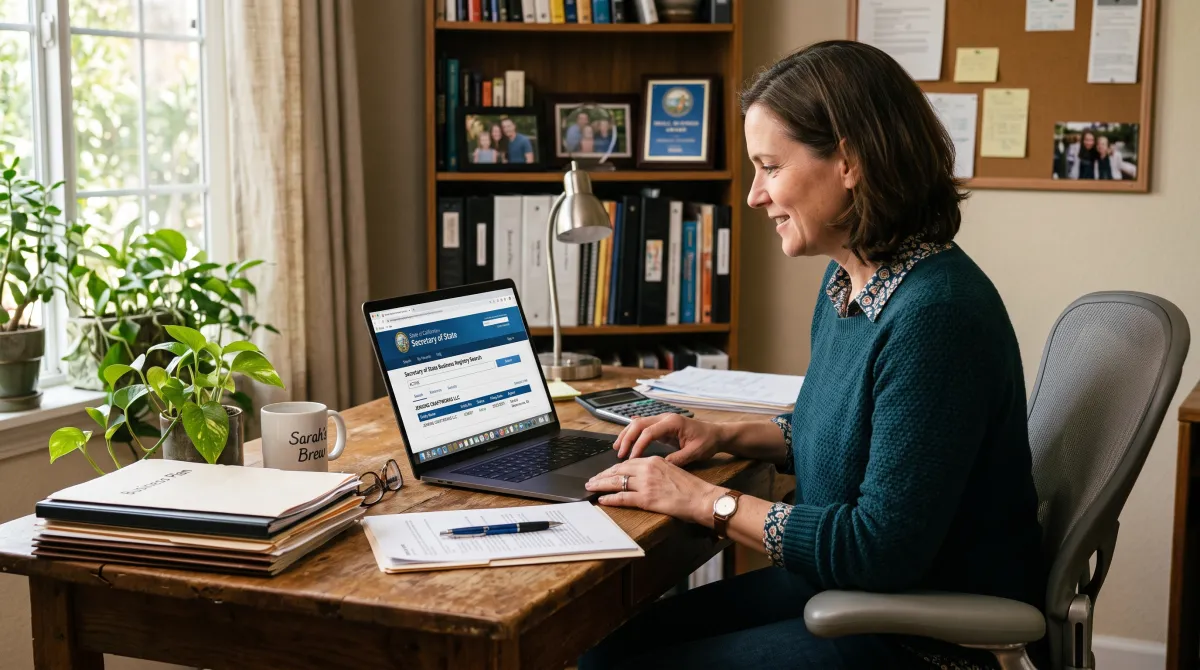
- Entity registration: a quick registry check covers this. Run a Wyoming business entity search, an Oregon business registry search (also called an Oregon business search), or a Missouri business search, each takes under two minutes on the relevant Secretary of State site.
- Business bank account: if you bank with a major institution, know your support line, for example Chase business customer service, before a payment problem becomes an emergency.
- Insurance: a broker like Simply Business can quote general liability or a business owner's policy in about ten minutes online.
- Business checks and paperwork: ordering business checks sounds minor until a vendor refuses a personal one.
- Business internet: a home router is not a business continuity plan once you have a team depending on uptime.
None of this is exciting. It is also exactly the kind of gap that turns a promising quarter into a scramble for a founder who assumed someone else had it covered.
Business Coach: FAQ
What payroll services work well for small business clients of a business coach?
Most small businesses run payroll through Gusto or ADP RUN, both of which handle tax filings automatically so a coach's client does not miss a deadline.
Do I need a virtual address for my business?
A virtual address makes sense if you work from home and do not want your residential address on public filings or a Google Business Profile listing.
Where can I find real business plan examples?
The U.S. Small Business Administration publishes free business plan templates and examples, the same resource many free SCORE mentors point clients to first.
Is QuickBooks good for small business owners working with a coach?
QuickBooks is the most common choice because most coaches and bookkeepers already know how to read its reports, which speeds up every coaching session.
What does QuickBooks Online cost in 2026?
As of September 2026, QuickBooks Online runs from $38 a month for Simple Start up to $340 a month for Advanced, with a Solopreneur tier around $20 a month for the smallest businesses.