Workplace & Career
Behavioral Interview Questions: STAR Method + Examples
Behavioral interview questions test real past actions using the STAR method. Get examples, prep tips, and a sample interview thank you email inside.

Behavioral interview questions is an interview method built around one idea: describe something you actually did, not something you might do. Hiring teams use them because past actions predict future performance far better than a hypothetical answer ever could.
I have sat on both sides of the table for over a decade, screening reference calls and running final round loops. The candidates who stand out are not the ones with the fanciest job titles. They are the ones who can walk through a real situation, calmly, with a clear result at the end.
Quick answer
Behavioral interview questions ask you to describe a specific past situation, using the STAR method (Situation, Task, Action, Result) to structure your answer. Prepare 6 to 8 stories that cover conflict, leadership, failure, and results, then adapt them to whatever the interviewer actually asks.
Key takeaways
- Behavioral interview questions ask for real past examples, not hypotheticals.
- The STAR method (Situation, Task, Action, Result) is the standard way to structure answers.
- Prep 6 to 8 flexible stories instead of memorizing answers to every possible question.
- A specific interview thank you email sent within 24 hours still influences hiring decisions.
- References get their own version, often opening with in what capacity do you know the applicant.
What Are Behavioral Interview Questions?
Behavioral interview questions ask candidates to describe a real situation from their past instead of a hypothetical one. The logic is simple: how you actually handled conflict last year predicts how you will handle it next year.
This interview technique, sometimes called past-behavior or competency-based interviewing, grew out of industrial and organizational psychology, the field that studies which interview formats actually predict job performance.
Frank Schmidt and John Hunter's 1998 meta-analysis in Psychological Bulletin remains one of the most cited pieces of evidence that structured interviews predict job performance more reliably than freeform conversation.
Employer expectations have shifted across the modern workplace, where structured hiring with a fixed scorecard is now standard even for entry level roles.
The STAR Method: Behavioral Interview Questions Explained
The STAR method turns a vague memory into a tight, evidence backed answer in under two minutes. It stands for Situation, Task, Action, Result, documented on Wikipedia as the STAR method, and it is the backbone of almost every strong response to star interview questions.
Skip the structure and answers tend to ramble, either drowning the interviewer in backstory or jumping straight to a vague outcome with no proof behind it.
| STAR step | What it covers | Typical length |
|---|---|---|
| Situation | The real context: team, project, or conflict | 1 to 2 sentences |
| Task | Your specific responsibility or goal | 1 sentence |
| Action | What you personally did, step by step | 3 to 4 sentences |
| Result | The measurable outcome and what you learned | 1 to 2 sentences |
Practice out loud, not just in your head. A story that sounds sharp in your notes often comes out tangled the first time you say it in front of another person.
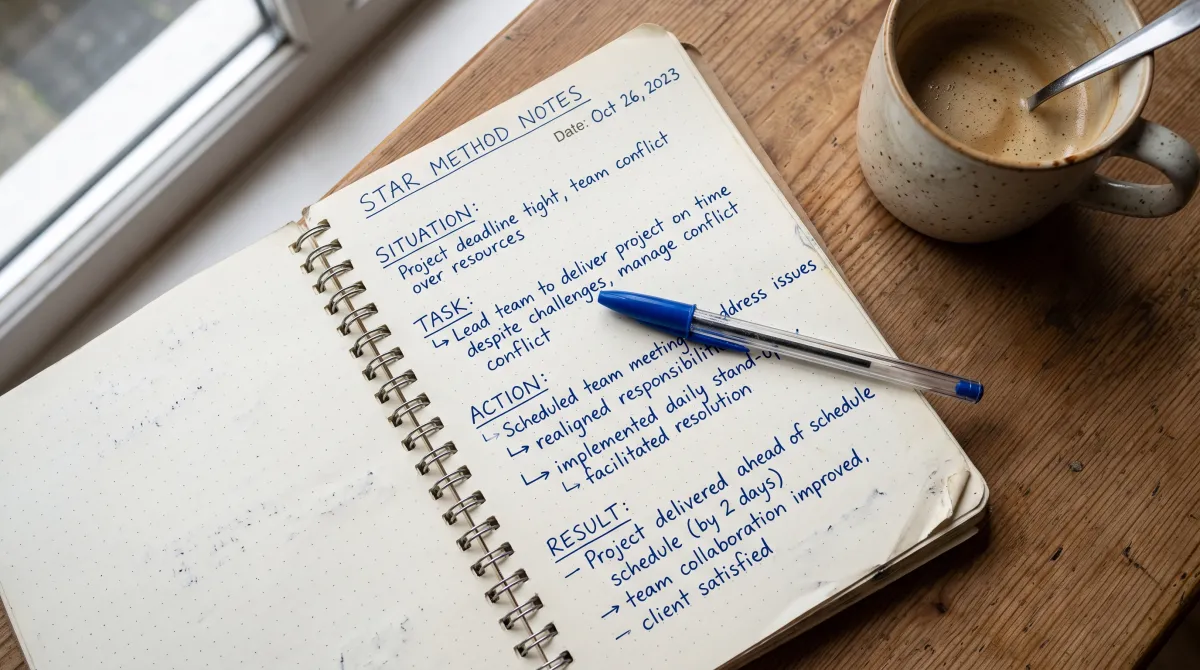
Behavioral Interview Questions Examples
Real prompts help more than theory. Below are behavioral interview questions examples grouped by the situation most interviewers are actually probing for.
Promotion Interview Questions
Promotion interview questions test whether you can operate at the next level, not just do more of your current job. If you are already noticing signs your boss wants to promote you, rehearse these early.
- Tell me about a time you influenced a decision without formal authority.
- Describe a project where you had to think beyond your current role.
- Give an example of when you mentored someone less experienced than you.
Employee Retention Interview Questions
Employee retention interview questions, used in both hiring and exit interviews, dig into why people stay or leave.
- Describe a time you almost left a job. What made you stay or go?
- Tell me about a manager who made you want to do your best work.
- What is one change that would have kept you longer at a previous employer?
Workplace Culture Interview Questions
Workplace culture interview questions reveal whether a candidate's working style actually fits the team, not just the job description. If your last role involved friction, maybe even jealous coworkers signs you had to navigate, be ready to discuss it honestly.
- Tell me about a workplace culture where you did your best work, and why.
- Describe a time you disagreed with a team norm. How did you handle it?
- Give an example of adjusting your style to fit a new team.
Work-Life Balance Interview Questions
Work life balance interview questions check for burnout risk and honesty about limits, not just ambition.
- Describe a time you had to protect your personal time during a busy stretch.
- Tell me about a period of high workload. How did you manage it?
- Give an example of setting a boundary at work without damaging a relationship.
How to Apply Behavioral Interview Questions Before and After the Interview
Preparation happens well before you sit down. Apply behavioral interview questions to your own history by writing out 6 to 8 stories that cover conflict, failure, leadership, and a clear win.
Reuse the same story for multiple prompts when it fits. One strong project story can answer questions about leadership, problem solving, and results with small changes in framing.
The work is not finished when the interview ends. A short, specific interview thank you email sent within 24 hours reinforces the same stories you told in the room.
A CareerBuilder survey found that 22% of hiring managers say they are less likely to hire a candidate who skips a thank you note, a real cost for a five minute email.
Glassdoor's research on hiring timelines puts the average US interview process at about 23 days from first interview to offer. That window gives a follow up email after interview real time to matter before a final decision.
Keep the follow up email after interview short: one specific detail from the conversation, one line on fit, and a clear next step. Generic thank you notes get skimmed and forgotten.

The best answer in the room is not the most impressive one. It is the one where the interviewer can actually picture you doing the work.
In What Capacity You Know the Candidate: Reference and Screening Questions
References get their own version of behavioral interview questions, usually opening with in what capacity you know the candidate. The answer sets the weight of everything that follows.
A reference who says "I managed her directly for three years" carries more weight than one who says "we worked in the same building." Recruiters listen for that distinction first.
Common phrasing varies: in what capacity do you know the applicant, in what capacity have you known the applicant, or a straightforward in what capacity you know the candidate answer written into a reference form. All ask the same thing.
Employer expectations for this step are specific. Most reference checks want a working relationship of at least six months, direct exposure to actual output, and permission to ask about both strengths and growth areas.
For a full breakdown, see our guide on how to answer in what capacity you know the candidate as a reference.
Common Mistakes That Sink Behavioral Interview Answers
Most weak answers fail for the same handful of reasons, not from a lack of good experience. The same self-awareness gaps show up across any workplace, not just in the interview room.
- No real result: ending on "and it worked out" instead of a specific, measurable outcome.
- Team story, not your story: describing what "we" did without saying what you personally did.
- Wrong story for the question: forcing a leadership story onto a conflict question.
- Rambling situation: spending three minutes on context and thirty seconds on action.
- Skipping the thank you step: treating the interview thank you email as optional.
Behavioral Interview Questions: FAQ
What are some good questions for an exit interview?
Strong questions for an exit interview ask why the person is leaving, what would have changed their mind, how they would rate their manager, and what one thing the company should fix first.
What is a good question for exit interview about culture?
A useful question for exit interview culture topics is describing a moment when you felt most and least supported. It surfaces specifics instead of generic complaints.
What are common interview exit questions employers ask?
Common interview exit questions cover the real reason for leaving, whether the role matched expectations, feedback on management, and whether the person would recommend the company to others.
How structured should an interview exit be?
An interview exit works best as a short, structured conversation with 6 to 8 fixed questions, run by HR rather than the departing employee's direct manager, so answers stay honest.
How many behavioral interview questions should I prepare for?
Prepare 6 to 8 flexible stories rather than memorizing dozens of answers. Most behavioral interview questions can be answered by adapting a small set of strong stories to fit the prompt.