Business Concepts
CoreWeave Stock: What Leaders Need to Know (2026)
CoreWeave stock jumped after blowout Q2 2026 earnings and a $104B backlog. Here's what CRWV's AI cloud business means for your tech strategy.

CoreWeave stock jumped again this week, and the move is a useful data point even if you never buy a share. CRWV beat Q2 2026 earnings estimates on August 11, then watched shares gain double digits in extended trading. For any leader weighing AI infrastructure spend, that reaction says something worth understanding.
Quick answer
CoreWeave (CRWV) is a specialized AI cloud provider, often called a neocloud, that rents GPU computing power to companies training and running AI models. Its stock jumped about 14% to 16% after Q2 2026 earnings beat expectations on August 11, with revenue up 112% year over year to $2.58 billion and a $104 billion contracted backlog. The business grows fast but burns cash, funded heavily by debt.
Key takeaways
- CoreWeave earnings for Q2 2026 beat estimates: $2.58 billion in revenue, up 112% year over year, versus a $2.56 billion consensus.
- CRWV stock rose roughly 14% in after-hours trading and traded near $105 by the next morning, breaking a streak of falling after every prior earnings report since its March 2025 IPO.
- Contracted backlog reached $104.2 billion, not counting more than $25 billion in new commitments signed after the quarter closed.
- 2026 revenue guidance rose to $12.4 billion to $13.2 billion, and planned capital spending rose to $35 billion to $39 billion.
- Growth is financed with heavy debt, including a new $2.6 billion loan, and free cash flow remains deeply negative.
What Is CoreWeave? The AI Neocloud, Explained
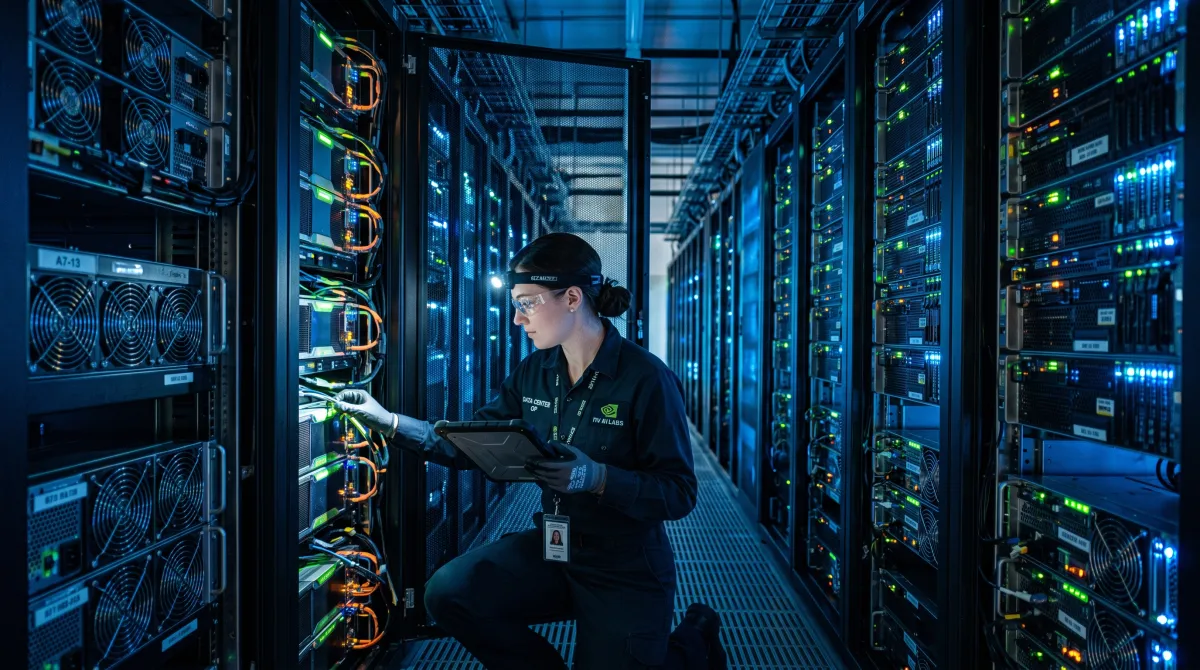
CoreWeave started in 2017 as a cryptocurrency mining operation in New Jersey, then pivoted hard into renting out Nvidia GPUs for AI training and inference. That shift turned it into what the industry calls a neocloud: a cloud provider built specifically for AI workloads, not general-purpose computing.
Amazon Web Services, Microsoft Azure, and Google Cloud sell everything from email hosting to databases. CoreWeave sells one thing at massive scale: dense clusters of graphics chips that AI labs need to train and run large models. It went public on Nasdaq in March 2025 under the ticker CRWV.
If you are building a mental model for reading a volatile stock like this one, our business concepts guides are a good place to establish the fundamentals before you dig into a single company's numbers.
Inside the Q2 2026 CoreWeave Earnings Beat
CoreWeave reported Q2 2026 results after the market closed on August 11. Revenue hit $2.58 billion, up 112% from a year earlier and ahead of the $2.56 billion analysts expected. That growth rate is rare for a company already generating billions in quarterly sales.
The company's adjusted per-share loss came in at $1.03, better than the $1.20 loss Wall Street had modeled. On a GAAP basis, net loss widened to $626 million from $290 million a year earlier, reflecting the cost of building data centers faster than revenue can offset. New business with Anthropic and Meta closed during the quarter.
Why CRWV Stock Jumped After Earnings
Shares had closed regular trading on August 11 at $90.32, up modestly ahead of the report. Once CRWV earnings landed, the stock jumped as much as 14% in after-hours trading, and by the next morning shares were changing hands near $105, roughly 16% above the prior close.
That reaction stood out because CoreWeave had fallen after every one of its previous earnings reports as a public company. Analysts responded quickly: JPMorgan raised its price target to $110 from $105, while Deutsche Bank had already lifted its target to $150 ahead of the print. The stock's 52-week range runs from $60.55 to $153.20.
CoreWeave's stock behaves like an options contract on AI capex. A shift in sentiment about AI demand can move the share price by double digits in a single session.
The Backlog and Guidance That Matter More Than the Headline Number
The more durable signal sits in the backlog. CoreWeave's contracted revenue backlog reached $104.2 billion, and that figure excludes more than $25 billion in new commitments signed after the quarter ended. Backlog this size gives investors visibility into revenue years out, not just the current quarter.
Management raised full-year 2026 revenue guidance to $12.4 billion to $13.2 billion, up from a prior range of $12 billion to $13 billion, and lifted its year-end active power target to more than 1.85 gigawatts. Capital expenditure guidance also climbed, to $35 billion to $39 billion, up from $31 billion to $35 billion in May.
The Debt-Funded Growth Model, and the Risk Behind It
None of that growth is free. CoreWeave closed a new $2.6 billion delayed-draw term loan on August 10 to help fund GPU capacity, adding to an already large debt load. Free cash flow stays deeply negative because the company spends on data centers well ahead of collecting revenue from them.
Before committing budget to a vendor with this kind of capital intensity, it is worth running your own numbers with a break-even point calculator to see how long you could absorb a similar cash burn if a project's timeline slips.
That debt also gets priced against the broader cost of capital, the same benchmark tracked by the 10 year treasury yield. When borrowing costs rise across the market, debt-heavy growth stories like this one feel it first.
There is also concentration risk. A large share of CoreWeave's backlog sits with a handful of AI labs and hyperscalers. Truist upgraded the stock to Buy in early August after a 42% drop from its highs, but the shares had already swung from near $99.54 in June to the high $70s by July 20 on broader AI bubble fears.

What CoreWeave Means for Leaders Evaluating AI Vendors
You do not need to own CRWV stock to learn from it. CoreWeave's swings are a live read on how the market is pricing AI infrastructure demand, and that sentiment eventually shows up in what your own AI vendors charge, and how reliable their capacity commitments turn out to be.
If a supplier's growth depends on debt-funded buildouts and a handful of anchor customers, treat that the same way you would treat any single-point-of-failure vendor. Ask about contract terms, capacity guarantees, and what happens if one large customer pulls back. CoreWeave's own Q2 2026 earnings release filed with the SEC is a useful template for the kind of disclosure worth requesting from any AI infrastructure partner.
The broader lesson holds beyond CoreWeave. AI capacity is being built faster than most companies can plan around, and the businesses financing that buildout are taking on real financial risk to do it. Understanding that trade-off helps you negotiate better terms and avoid overcommitting to a single supplier's roadmap.
Frequently asked questions
Is CoreWeave a normal cloud company like AWS or Azure?
No. CoreWeave is a neocloud, a provider built specifically around GPU infrastructure for AI training and inference, rather than the general-purpose computing, storage, and software services that AWS, Azure, and Google Cloud sell.
Why does CRWV stock move so much on earnings?
CRWV trades as a high-beta proxy for AI infrastructure sentiment. Its results react sharply to earnings, major contracts with clients like Meta, OpenAI, and Anthropic, and shifting fears about an AI spending bubble, which produces outsized swings in both directions.
How is CoreWeave paying for its data center buildout?
Mostly with debt. CoreWeave uses large credit facilities, including a new $2.6 billion delayed-draw term loan, to fund GPU purchases and data center construction ahead of the revenue that buildout is expected to generate, which keeps free cash flow deeply negative.
What does CoreWeave's backlog actually tell investors?
The $104.2 billion contracted backlog signals strong future revenue visibility, but it is concentrated among a small number of hyperscalers and AI labs. That combination of scale and concentration is the central bet, and the central risk, in the CoreWeave stock story.
Related guides
Sources: CNBC's coverage of CoreWeave's Q2 2026 earnings report and CoreWeave's Q2 2026 earnings release filed with the SEC.