Business Concepts
How to Read a Company Earnings Report (2026 Guide)
Learn how to read a company earnings report in 5 steps, using Nike stock's fresh Q4 2026 results as a live example. See why a beat can still sink a stock.

An earnings report looks like a wall of numbers built to confuse you. It is not. Once you know the five things that actually matter, you can read one in ten minutes and understand why a stock moves. We will use nike stock and its fresh Q4 fiscal 2026 results, released on June 30, 2026, as a live worked example.
Quick answer
To read a company earnings report, check five things in order: revenue growth, earnings per share versus expectations, the quality of those earnings, the segment breakdown, and forward guidance. Guidance about the future usually moves the stock more than the quarter that just closed.
Key takeaways
- Revenue tells you if the business is growing; always check reported versus currency-neutral numbers.
- EPS only matters against expectations, and headline EPS can be inflated by one-time items.
- Guidance about the future moves the stock more than the quarter that just closed.
- Segment data by region and channel reveals where the real strength or weakness sits.
- Nike beat estimates yet its shares still fell, a clean lesson in reading past the headline.
What an earnings report actually is
A public company must report results every three months. That filing, the quarterly earnings report, is a scorecard of how the business performed. In the United States it is filed with the Securities and Exchange Commission and released to the public.
The report bundles the income statement, balance sheet and cash flow statement with management commentary. You do not need to read all of it. You need to find five signals and know what each one means.
Reading numbers you understand is the foundation of real business and financial literacy. The Nike release is a clean teaching case because the headline and the reality point in opposite directions.
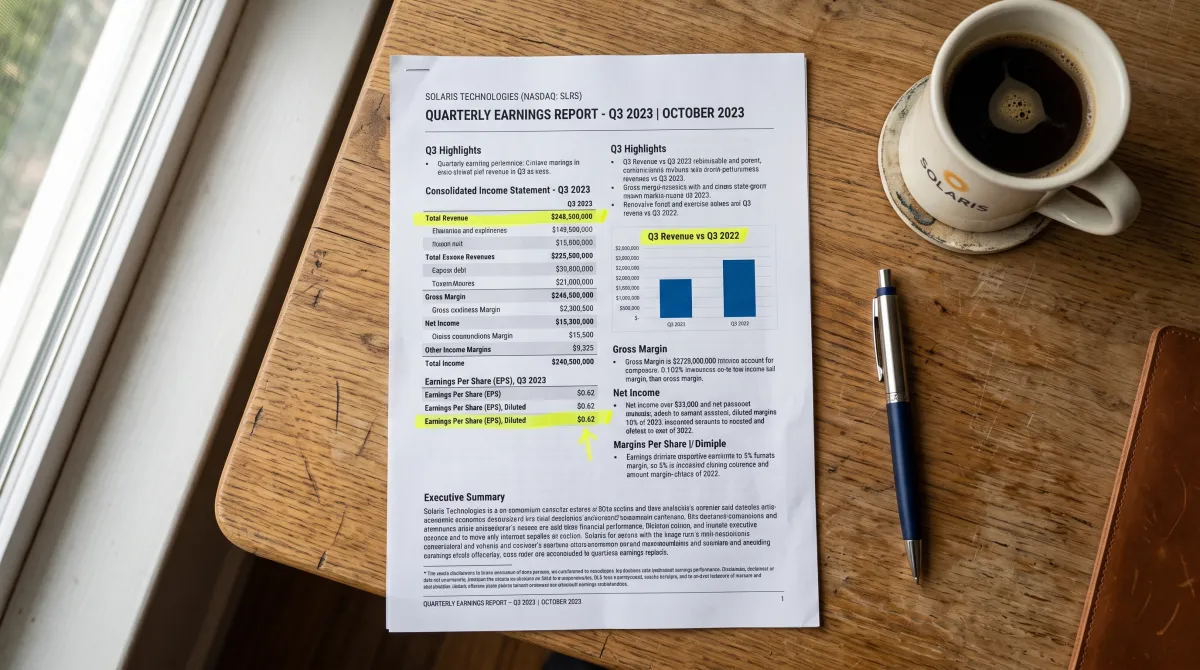
Step 1: Start with revenue, but read it twice
Revenue, the top line, is the total money the company brought in. It tells you whether demand for the product is growing or shrinking. Compare it to the same quarter a year earlier, not the previous quarter, because many businesses are seasonal.
Here is the trap. Nike reported Q4 revenue of $10.97 billion, down just 1% from a year earlier. That sounds stable. But on a currency-neutral basis, stripping out a weaker dollar, sales actually fell about 4%.
That gap matters. A favorable exchange rate flattered the reported number and hid real operating weakness. With any global company, check reported versus currency-neutral revenue before you call the business healthy.
Step 2: Check EPS against expectations, not zero
Earnings per share, or EPS, is net profit divided by the share count. It is the number headlines fixate on. But EPS in isolation is almost meaningless. What moves a stock is EPS versus what analysts expected.
Nike posted GAAP EPS of $0.72 against an expected $0.13. A huge beat, right? Not quite. That figure included a $0.52 benefit from an expected recovery of IEEPA tariffs, a one-time event, not repeatable business profit.
Strip that out and comparable adjusted EPS was around $0.20, still ahead of the $0.13 expected, but a very different story from $0.72. This is why professionals normalize earnings, removing one-time items before judging real performance.
A headline beat built on a one-time refund is not the same as a business that is winning. Read the footnotes.
Step 3: Judge the quality of earnings
Two companies can report the same profit yet be worth very different amounts. The difference is earnings quality: how much profit comes from the core business versus lucky, temporary or accounting-driven items.
Nike's gross margin jumped 890 basis points to 49.2% in the quarter. Impressive on the surface. But almost all of that came from a roughly $986 million tariff refund after the Supreme Court struck down the IEEPA tariffs.
That is a one-time cash event, not a structural change in how Nike makes shoes. Reading the notes to separate durable improvement from temporary boosts is essential. A margin gain you cannot repeat should not reshape your view of the long-term business.

Step 4: Break down the segments
A single company number hides the story. Good reports split results by region and by channel. That breakdown shows exactly where a business is winning and where it is bleeding.
Nike is a textbook example. Greater China fell 12% in the quarter, about 15% of total sales, a real pain point. Meanwhile North America grew 3% to $4.8 billion. On the channel side, wholesale grew while Nike Direct declined.
One healthy region can mask a sick one. Decomposing by geography and channel is how you catch the trend before it shows up in the total. The average always conceals what the pieces reveal.
Step 5: Guidance is what moves the stock
Here is the single most misunderstood point for new investors. The market prices the future, not the past. A great quarter can send a stock down if management's outlook disappoints.
Nike proved it. Despite beating on both revenue and EPS, the shares dropped as much as 8% after hours. Why? The fiscal 2027 guidance was cautious. CFO Matthew Friend signaled earnings would be roughly flat through the first two quarters, with revenue possibly falling low-to-mid single digits.
The beat was already priced in. The weak forward outlook was not. When you read any earnings report, jump to the guidance section, because that forward view often matters more than every backward-looking number combined.
How the five signals compare
This is the checklist in one view, mapped to what Nike's Q4 fiscal 2026 report actually showed. Use it on any company you study.
| Signal | Question to ask | Nike Q4 FY26 reading |
|---|---|---|
| Revenue | Growing or shrinking, reported vs currency-neutral? | -1% reported, -4% currency-neutral (weakness masked) |
| EPS vs expectations | Beat or miss the analyst number? | Beat: $0.20 adjusted vs $0.13 expected |
| Earnings quality | Core profit or one-time items? | $0.72 GAAP inflated by a $0.52 tariff benefit |
| Segments | Where is the growth and the pain? | China -12%, North America +3% |
| Guidance | What does management expect next? | Cautious: flattish FY27 earnings, stock fell |
Reading the narrative, not just the numbers
Earnings are a story told by management. Nike CEO Elliott Hill admitted plainly that "the results aren't there yet," and that Nike sportswear and Jordan streetwear sell-through remains challenged. That candor is a data point in itself.
For full-year fiscal 2026, Nike posted revenue of $46.4 billion, roughly flat, with net income of $3.11 billion, or $2.10 per share, down from $2.16 the year before. The company still returned billions to shareholders, mostly in dividends.
Context sharpens the read. Nike shares sit near $40, close to a 52-week low, roughly half their earlier high, and CFO Matthew Friend is departing with David Denton set to succeed him. A leadership change plus soft guidance is why the stock stayed pressured despite the beat.
Reading the commentary alongside the numbers turns a spreadsheet into a judgment. That is the skill: the report is a narrative, not just a table. The same preparation that makes a short spoken introduction land also makes an earnings call read cleanly, because both reward a clear structure over raw detail.
Related guides
Frequently asked questions
Why compare reported revenue with currency-neutral revenue?
Because exchange rates can hide the real trend. Nike's revenue fell only 1% as reported but about 4% on a currency-neutral basis, meaning a favorable dollar masked genuine operating weakness. The currency-neutral figure shows the true underlying demand for the product.
What is the difference between GAAP and adjusted EPS?
GAAP EPS follows standard accounting rules and includes every item; adjusted EPS strips out one-time events. Nike's GAAP EPS of $0.72 was inflated by a $0.52 non-recurring tariff benefit. The comparable adjusted EPS was about $0.20, so a professional normalizes one-time items before judging real performance.
Why did Nike stock fall even though it beat estimates?
Because the market prices the future, not the past. Despite beating on revenue and EPS, Nike's shares fell because its fiscal 2027 guidance was cautious and flattish. Investors discount what comes next, so weak forward guidance can outweigh a strong quarter that just closed.
Why does the segment breakdown by region matter?
Because a single company total hides where the business is winning or losing. Nike's Greater China sales dropped 12% while North America rose 3%, and wholesale grew as Nike Direct fell. Decomposing results by region and channel reveals the real source of strength or pain.
What is the most important part of an earnings report?
For most investors, forward guidance is the most important section, because stock prices reflect future expectations. After that, focus on the revenue trend, EPS versus expectations, and the quality of earnings, so you can tell durable profit from one-time boosts.
Sources: CNBC: Nike Q4 2026 earnings, Earnings per share (Wikipedia).